Artificial Intelligence (AI) has taken its hype amongst businesses to the next level. Today, companies of all sizes are implement AI in Business and its capabilities to optimize efficiencies, automate tasks, and gain a market advantage. Unfortunately, hurdles to realize all there is to offer, such as determining a use case, processing unstructured data, tool selection, and being compliant, can limit the value AI has to offer and slow the pace at which an organization embraces AI.
If you are both slowing your digital transformation and spending money to chase after AI, you are likely missing out on growth opportunities.
A concrete implementation approach is the answer. Organizations will be able to figure out how to implement AI into their workflows, get better information for decision making, and create new means of productivity and profitability using a structured, step-by-step process.
With the global AI market expected to reach over USD 1.8 trillion by 2030, business can simply not afford to wait to use AI to get business results. With our expertise we create this guide to explain all about the implementation of AI into your organization, here we address all key aspects from planning, development, delivery and continuous improvement.
Key Takeaways
- The process of implement AI in business begins with the definition of metrics and types of data available. After creating the roadmap showing the steps to implementation, a proof of concept is created and then phased into an implementation process.
- The primary technologies that lie around AI include machine learning (ML), natural language processing (NLP), computer vision (CV), and predictive analysis.
- Finally, AI benefits will primarily include improved operational efficiencies, efficiencies in staffing and costs, and increased customer satisfaction and loyalty that can create innovation.
- A I’s successes depend mostly on business creating strong data governance practices, compliance to regulatory frameworks, and the ability to measure the return on investment (ROI).
- Monetizing AI includes delivering automation services, predictive insights, and provides the basis for personalized products.
- More generally, these conversations indicate a future where generative and agentic AI systems will power self-learning, scalable transformative capabilities.
Why Now Is the Best Time to Implement AI In Business— Key Drivers & Trends
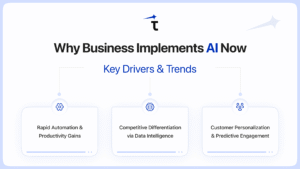
The emergence of Artificial Intelligence (AI) is now modernizing the way businesses work, compete and grow. For a year ago AI was just a topic people were talking about, but now it is all about innovation. The implementation of AI in business is automating, personalizing and helping smarter enterprises to make smart decisions. However, the organizations adopting AI today are realizing the clear benefits afforded by efficiency, intelligence with data, and engagement with customers.
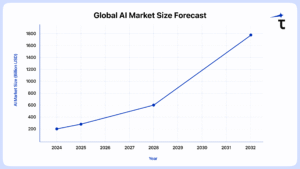
The global AI market is witnessing remarkable growth, projected to leap from $233 billion in 2024 to an anticipated $1.78 trillion by 2032. This significant increase highlights the swift pace at which businesses in various sectors are embracing AI to enhance automation, make better decisions, cut costs, and provide highly personalized customer experiences.
This projection makes one thing clear:
Organizations that integrate AI into their operations early on will establish a lasting competitive advantage, while those who delay may find themselves lagging behind in efficiency, innovation, and overall customer satisfaction.
More reasons why one must adopt AI for their business:
Rapid Automation & Productivity Gains
Business systems are being transformed by new automation solutions powered by AI that limit the human commitment to manual capabilities and improve precision. AI fuels productivity improvements, from workflow automation, to the predictive maintenance of their valuable assets to achieve more in less time.
- If you Implement AI in Business you can Streamlines repetitive tasks requiring time and effort
- Provides speed and consistency for operations
- Gains productivity that does not fatigue at night or on weekends
- Lowers costs while increasing productivity as an arbitrary measure of business value
Competitive Differentiation via Data Intelligence
In the technology era, data is a new currency, and AI capitalizes on that currency into actionable intelligence. When using AI analytics, organizations can not only track certain trends and optimize allocation of resources, but also make more intelligent decisions and shift customer behavior from predictive foresight.
- By Implement AI in business you can transforms complex data today into real-time business intelligence
- Uses data to anticipate demand, reduce risk and reveal opportunities
- Improves accuracy when assessing the value of conditions using predictive models
- Contributes improved competitive position for businesses through an agile and intelligent use of data.
Customer Personalization and Predictive Engagement
The contemporary customer holds expectations of a more personalized, salient experience. if you Implement AI in Business it can helps brands measure and drive the understanding of behavioral patterns to add value to their targeting audience where relevant.
- Predicts user needs using behavioral and historical data
- Delivers personalized recommendations and dynamic content
- Optimizes user engagement by way of AI chatbots and virtual assistants.
- Forecasting results leads to increased satisfaction and retention of customers.
Benefits of Implementing AI in Businesses
AI adoption will revolutionize the way companies, startups, and teams operate – allowing smarter, faster decisions, efficient processes, and hyper-personalized experience for customers. If you are founder of a startup or multinational company seeking overall efficiencies, AI has the capabilities, tools, and technologies to drive measurable impact across your organization.
For Enterprises & Startups
-
Better decisions With real-time analytics
AI gives leaders real-time visibility from the data overload to make timely and intelligent decisions for their organizations. Predictive analytics tools take it one step further by helping your organization to anticipate trends – upcoming events – mitigate risks, and create new opportunities for growth.
-
Enhanced operational efficiency & automation
AI automation and machine learning workflows allow the business to reduce manual work, free-up bottlenecks, and expedite time to market. Intelligent Process Automation (IPA) and AI tools have begun to provide seamless and scalable solutions to many processes.
-
Cost optimization & resource utilization
AI can help firms plan and implement their resources and spot operational inefficiencies. Through the use of predictive maintenance, predictive energy optimization, and intelligent budgeting tools, businesses can increase value by maximizing operational output and generating higher returns on investment through reduced costs.
-
Scalable and adaptive business models
A key feature of AI systems is the ability to adapt to market demands, which allows for businesses to scale and remain flexible. Whether it’s automating customer care, or expanding into new geographical regions, AI driven formatting and structures streamline and can effectively/efficiently scale as the organization grows.
-
Innovation & competitive edge
WIth the implementation of AI businesses can create smarter products, optimize customer behaviours, and examine how to compete with market changes. This really works to create an innovation culture and provides strong competitive advantage in uncertain and fast-moving industries.
For Employees & Teams
-
Automation of repetitive tasks
AI tools free employees of monotonous and repetitive work, so they have more time to engage in more interesting and meaningful creative work that will be an actual value-add to your organization.
-
Improved workflow through intelligent assistants
AI based assistants or chatbots improve employee experience through simplification of workflows, report automation, and improved inter-departmental collaboration, and better employee engagement.
-
Data-Driven Understanding
The real-time based AI dashboards and performance metrics, allow employees to track their progress, identify areas for improvement, and support continuous productivity growth.
-
Upskilling With AI tools
AI implementation in business assists employees for better and fast learning and automates mundane tasks. Overall it helps them to increase productivity and to prepare for Tech related challenges.
-
Improved Collaboration and Productivity
AI helps to improve collaboration within a team, by real-time insights, workflow automation, and simplified communication. As AI allows data-driven support and smart coordination, the implementation of AI in business can help teams to complete their tasks faster.
For Customers
- Personalized experiences & smarter interactions
Using AI-driven personalization engines enables companies to create bespoke recommendations, individual product suggestions, and individualized content tactics—creating a truly customer focused experience.
- Faster service delivery
AI chatbots and virtual agents facilitate near-in-time responses, automate service requests, and create consistent customer engagement—providing customers access and assurance any time of day.
- Predictive support & engagement
Through predictive analytics enable organizations to forecast and solve anticipated customer issues before they escalate or to establish a base of proactive interactions to make them seamless.
- Omnichanel Experience & Seamless Integration
AI creates a unified experience of consumer engagement through apps, websites, and social media. This consistent experience across each channel promotes loyalty and customer retention.
Types of AI Solutions for Businesses
AI is not one size fits all – it is different for the business function, and industry that is being applied. From enhancing customer experience to improving operational processes, AI based solutions provide organizations a way to work smarter, scale faster, and be prepared for the future.
The following are a summary of some of the more meaningful types of AI solutions relative to the business function and industry application:
By Function
-
AI in Operations & Supply Chain
With machine learning algorithms, predictive maintenance needs combined reduce equipment downtime, affords detection of future equipment failures and limits operational interruptions relative to logistics functions. AI-based supply chain management offers real-time update visibility into its cost-effective deliveries, and its making-time-time-costs, and value in virtually every market category.
-
AI in Marketing & Sales
Tools such as smart recommendation engines, lead scoring models, and AI-supported personalization enable organizations to reach the right customers with the right message at the right time. This approach leads to better conversions, returns on investments, and data- fueled marketing strategies and offers more value than intuition and opinions.
-
AI in Customer Support
AI tools like chatbots, and AI-assisted virtual voice assistants allow for customer service predictive customer service. AI tools afford nearly instant response time, will use NLP to understand the intent of inquiries, and support customer requests 24/7 and an improved customer experience without an accompanying cost increase.
-
AI in Finance & Accounting
AI systems can automate anomaly detection through fraud detection systems, which take a number of steps to avoid, and remedy fraudulent mishaps, thus ultimately reducing financial losses to organizations. Machine learning models can also provide prediction capabilities towards revenue forecasting, automate simple data entry processes, and assure accuracy in compliance tasks; thus allowing finance teams to make more prompt, balanced decisions.
-
AI in Product Development
AI architectures create generative designs and simulation-based testing, as well as, automated quality testing to reduce the product innovation cycle time. From concept to prototype, businesses are able to leverage AI to not only reduce errors, but optimize designs and expedite getting market ready products to consumers.
By Industry
-
Healthcare
AI will have a radical effect on patient care within the healthcare sector. Patient care will be enhanced with the help of AI predictions, medical imaging, and AI-assisted diagnostics. By making it easier and quicker to make decisions, AI increases the chances of a clinician to detect the disease at a younger age and provide a more personalized treatment recommendation. EHR management will also be automated, even in hospital environments, to streamline workflows to enhance patient care and lower operational expenses.
-
E-commerce and Retail
Implementation of AI in business of E-commerce and Retail sector, helps brands to improve their inventory, applying dynamic pricing, and also helps in giving personalized recommendations. The recommendation engines improve purchases and retain customers through analytics of consumer behavior and shopping patterns.
-
Manufacturing
AI and machine learning in the manufacturing industry, will introduce predictive maintenance, intelligent robotics, and automated quality control to the market. The machine learning to predict analytics will be informed by AI analytics to create efficiencies and prevent production delays. Incorporating intelligence and automation into real time data can enable manufacturers to create smarter and generate more output, less waste and better supply chain efficiencies- resulting in companies creating faster and less expensive products.
-
Fintech
AI and machine learning will have a major influence on how the financial institutions will identify fraud, mitigate the risks, and manage customers. Analyses of transactions through algorithms that are able to analyze transactions in a shorter period of time can start informing the institutions on whether transactions are benign. Credit scoring can offer better underwriting in areas which we have not previously experienced regarding lending.
-
Logistics & Transportation
Artificial intelligence-based logistics solutions enable firms to have the ability to optimize their routes, anticipate fleet repairs, and track their vehicles in real time. The applications of AI in businesses include the ability to predict demand, plan efficient delivery routes, and lower fuel costs. AI would provide safer, faster, and more sustainable transportation networks in the supply chain and last-mile delivery operations with the help of computer vision and IoT.
-
Real Estate
AI is transforming the work style in real estate. AI improves efficiency and transparency in various ways, it helps to automate documentation, intelligent lead scoring, virtual property tours, and predictive pricing. It facilitates more informed investment choices, enhances the client experience, and simplifies operations for agents, developers, and property managers.Fup
-
EdTech & E-learning
AI in education is facilitating the personal learning paths and adaptive learning curriculum models. Intelligent self-learning systems are used to analyze the performance of the students to provide them with specific lessons, and AI-based analytics assists teachers in gauging engagement and learning achievements. This will result in increased knowledge retention, better access, and an actual personalized learning experience in digital platforms.
-
Energy & Utilities
The use of AI in energy employs smart grid operations, predictive maintenance and optimization of renewable energy. Through demand analysis and weather data AI systems adjust the energy load and predict demand well. Using AI in utilities, sustainability, efficiency, and waste reduction: Making power systems smarter, cleaner, and resilient.
What Risks & Challenges Business May Face For AI Implementation
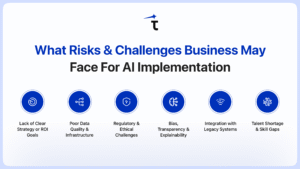
Implement AI in business isn’t merely about implementing models, it’s about transforming processes, personnel, and priorities. While the promise is enormous in potential, many firms will falter at the point of implementation, often due to strategic, technical, and operational gaps. Let’s take a look at some of the core challenges and approaches well-meaning businesses can use to gain traction.
Lack of clear strategy or measurable ROI goals
Many companies implement AI in business haphazardly without a clear objectives for success and measurable ROI outcomes. Without a measurable strategy with AI ROI KPIs or identified business objectives, an AI project will easily lose momentum at its initial stages. The goal with an AI initiative should always be aligned with one’s long-term goals such as in cost reduction, customer retention, and future-predictive analysis. This way, all AI-related investments will yield recognizable business value.
Poor data quality or insufficient data infrastructure
AI is only as strong as its supporting data. With poor data, inconsistent or siloed data will lead to the eventual failure of even the most sophisticated AI models. Poor data will easily derail plans for implementation. Therefore, great care must be taken to develop data pipelines that will underpin and enable AI practices within the company. Companies will also need data governance structures and cloud-based data centers to enable real-time data validity, availability, and sync between departments.
Regulatory & ethical challenges
The myriad of compliance related to AI—GDPR to HIPAA—may appear as an intimidating and complicated void. Addressing regulations in industries as varied as healthcare, fintech, or education, even a minor infringement can result in significant fines. There are also ethical complications that require attention, which include consent, fairness, and accountability. Responsible AI frameworks along with an investment in compliance resources must be developed to calibrate innovation with regulation.
Bias, transparency & explainability issues
Computer bias, societal bias, or bias based on training data is a continuing concern for AI adoption. It is very common for AI to operate in a manner which is unexplainable or “black box.” This is problematic because it can be difficult to rationalize why a decision was made by a model. Possible solutions include developing models that can facilitate explainable AI (XAI), conducting ongoing audits of material bias pre-and-post deployment, or diversifying training data, all of which would promote fairness, traceability, and ethical accountability across each application.
Integration with legacy systems
Enterprise technology-initiatives often run into roadblocks when implementing AI solutions in previous-generation legacy systems or outdated software packages. Compatibility upgrades may limit the deployment of AI initiatives, and limit scalability. You will need to adjust organizational tech-stack to an API-first architecture, cloud migration and modular integration that prepares them for AI investment and to future-proof technology advances.
Talent shortage & skill gaps
The shortage of skilled AI engineers, data scientists, and ML practitioners in an organization is often a direct cause of delays in execution. Some organizations can undertake AI projects in house using tools like TensorFlow, PyTorch or Azure AI, but many of the internal players do not have experience with hands-on development. Programs that facilitate enhancement of skills, external partnering, or AI as a service platform can work to bridge this gap more effectively and sustainably.
How to Implement AI in Business — Step-by-Step Process
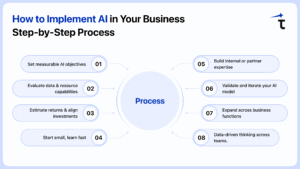
Identify Business Problems & Define Goals
Recognize the main business issues that AI can assist in addressing, whether that is “workflow automation, predicting customer behavior or improved decision making.” Having a clear, measured objective is helpful in guiding focus and setting expectations; AI initiatives should look to be aligned with your strategic objectives to best ensure that all AI plays a direct role adding value to your efficiency, innovations and business growth.
Assess AI Readiness (Data, Infrastructure, Skills)
Before beginning to develop the AI solution or implement AI in business, assess whether the organization is in fact, AI-ready. Do you have the available data, or organizational infrastructure set up, or human resources available that have the skill sets and elevate experience? Companies with clean structured data and scalable infrastructure will be open to apply AI solutions much sooner than others. Consider whether you have the requisite cloud storage and computing capacity, sufficient data security considerations, and compliance addressed.
Conduct Feasibility & ROI Analysis
Every AI initiative needs to have an appropriate business case to invest. Perform a feasibility study and understand the complete cost involved, estimated return and operational impacts in the process. For example, when estimating your return, you might be looking at time savings, avoidance of costs or generation of revenue. This is an important enabler to inform stakeholders of value as tangible as rapidly and must be a consideration to win executive support and ultimately longer engagement/commitment to your AI transformation strategy.
Choose the Right AI Use Case to Start (Pilot Project)
Instead of starting the AI rollout with a major undertaking, get a small pilot (an easy to implement AI in Business project) up and running first. Something like a chatbot for improved customer support, or a predictive analytics model to forecast sales or inventory. Starting small will quickly allow you to prove/disprove your initial assumptions, learn quickly, and iterate and refine your plan to deploy and scale AI across your organization.
Assemble or Hire an AI Team (Internal or Partner)
AI is a people-based technology. To impelment AI in Bsuiness you will need data scientists, machine-learning engineers, and experts in the domain you want to deploy AI into – and these individuals need to work very closely. You might not have the ability to build a talented team in-house, and it may be valuable to partner with an established AI development company. A good development partner is able to quickly come up to speed with your organization, will bring domain knowledge, and will help accelerate the time-to-market in a compliant and scalable way.
Select Technology Stack & Platform (Cloud, On-prem, Hybrid)
The stack of technology is an important step in your AI rollout. Factors like your business size, organizational goals, and data sensitivity will affect choosing the right mix of technology stack. There are many cloud-based AI platforms (e.g., AWS and Azure, or Google Cloud) that will provide more flexibility and scalability to execute your plan, while on-premise setups will allow a tighter grip on data. Many enterprises have adopted a mixed/hybrid environment to maximize performance, security, and compliance, while mapping to a more cost-effective approach for deployment.
Design Data Pipeline & Governance Model
Artificial intelligence is driven by quality and well-managed data. when you implement AI in business, Create a data pipeline that allows for the easy process of data gathering, cleaning, labeling, and transformation. Develop an effective data governance framework to promote consistency, security and compliance with such regulations as GDPR or HIPAA. This move prepares the foundation of credible and just AI results.
Develop an MVP or Proof of Concept (PoC)
Create a Minimum Viable Product (MVP) or Proof of Concept (PoC) to ensure that your AI model is working in the real world. This enables testing of algorithms, user feedback and tweaked functionality before complete deployment. MVP-first is a risk-averse strategy that saves on costs and speeds up the learning curve in your AI project.
Test, Validate, & Iterate (Accuracy, Performance, Security)
When you impelment AI in business you need to do rigorous testing process to validate accurate and dependable reliability across use cases. You will build assessments for model accuracy, provide scaling, and test security within simulated real-world loads. Test for A/B testing, validate outputs, and resolve bias. Iterative enhancement is important. Your AI system will improve reliability through recurring feedback loops and performance measurements.
Scale & Integrate AI Across Business Functions
Once you have validated your use case you will want to rapidly expand your AI implementation from department to department – marketing, HR, operations, finance or others. You will also want the models to be integrated with existing ERP or CRM.
Monitor, Maintain, & Continuously Improve
AI systems evolve over time. Periodically check performance metrics, monitor data drift and retrain on new data. The continuous improvement will make sure that it is accurate and relevant with each change in business conditions. Consider AI as a living system – one that learns, evolves and develops with the digital transformation roadmap of your organization.
Key Features & Capabilities of AI-Driven Systems
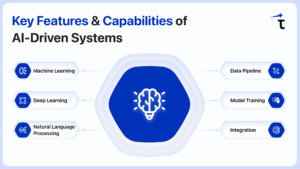
AI-driven systems are developed on the basis of data, intelligence and automation- to think, learn and evolve. Here’s what powers their performance and how each ability changes business practices.
Core Features
-
Data Collection & Preprocessing Pipelines
AI systems are based on high-quality and structured data. Automated data pipelines acquire, clean, and normalize data in various sources, thereby being accurate and consistent. The basis allows consistent machine learning results and removes inefficiencies created by dirty or unfinished datasets.
-
Model Training, Validation & Deployment
The stage converts raw information into intelligence. The AI models are trained based on the historical patterns, they are checked to be correct and sent to production. The constant retraining makes them adjust to new information, which makes them accurate and reliable in business applications.
-
Dashboards & Real-time Analytics
Intelligent dashboards AI-based are providing actionable insights in form of real-time data visualizations and predictive insights. Businesses are able to track KPIs and identify anomalies as well as predict trends- all on a single platform. This makes it possible to make decisions in advance and act much quicker to evolving market forces or operational bottlenecks.
-
Integration with CRMs, ERPs, or custom systems
The seamless integration will guarantee the flow of AI insights through the enterprise systems, such as CRM, ERP, and HRM. It bridges the gap between analytics and operations, which automates decision making and enhances customer management, resource allocation and business intelligence within a single digital ecosystem.
Advanced Capabilities
-
Predictive Analytics & Forecasting
AI enables business organizations to predict trends using predictive analytics, which are useful in identifying risks, predicting demand, and optimizing strategies. Predictive models are used to predict future data, whether it is sales or maintenance schedules and this is better than relying on historic data to make predictions because the whole process is more accurate and profitable.
-
Natural Language Processing (NLP)
AI systems can comprehend, analyze and react to human language with NLP-driven chatbots, virtual assistants, and sentiment analysis. It allows businesses to provide experiences of personalization and conversation, scale communication automation, and infer insights in text data.
-
Computer Vision & Image Recognition
Computer vision developement Company enables AI to analyze visual inputs – inspecting defects, identifying objects or processing medical images. Transforming imagery to actionable data helps businesses in quality control, safety monitoring, and precision in operations in various industries such as healthcare, manufacturing, and retail
-
Generative AI & Automation Agents
Auto generation AI goes a step further by producing new content, code or learnings. It enables intelligent agents that learn through context and operate autonomously to drive innovation, creative workflows and productivity to industries such as marketing to product design.
-
Reinforcement Learning for Optimization
The reinforcement learning enables the AI to develop over time as a result of feedback. It works best with dynamic decision-making, such as the logistics routing, pricing strategies, or robotic control, so that one can continuously optimize and achieve long-term performance improvements due to adaptive learning.
Estimation of AI System’s Development Cost, Timeline & Resource
The development of an AI solution is an investment in innovation – however, knowing the cost, duration and resources required initially can allow businesses to make informed decisions based on ROI for impelment AI in Business. Here’s how you can break it down wisely:
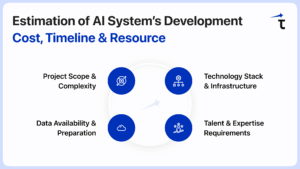
Project Scope & Complexity
weeks, and a prediction analytics platform or a recommendation engine can need months. Setting goals and technical complexity of a project in an objective manner will provide a realistic cost prediction and speedy completion.
Data Availability & Preparation
Data is the lifeblood of AI. Cleaning, labeling and processing will be as laborious as the quality, volume and structure of your data. The main advantage of fragmented or unstructured data to businesses may be longer preparation times but with accuracy and value upon proper training of models.
Technology Stack & Infrastructure
The decisions of using cloud-based, on premise or hybrid AI infrastructure affect cost and flexibility. Utilizing the advanced AI frameworks, such as TensorFlow, PyTorch, or AWS SageMaker, can cut down the time-to-market, whereas investing in the scalable data pipelines can make the system expand as your business grows.
Talent & Expertise Requirements
The creation of AI requires a combination of data scientists, ML engineers, experts, and software developers. Regardless of the fact that you hire within or engage an AI development firm, by matching the skills with the objectives of the projects, there will be less rework and the successful implement of AI in Business is achieved faster.
Model Training, Testing & Optimization
The computational resources and time are needed in training and tuning AI models. Prices depend on the model (deep learning, NLP, computer vision, etc.) and the levels of the required accuracy. Recursive testing and optimization make sure that models are likely to work in the real world – provide quantifiable ROI.
Integration & Scalability
The implementation of an AI system with the current CRM/ERP or some custom business software can affect cost and time. Early construction of scalable APIs and modular architecture is what makes implementation more smooth and will make scaling simple as the business needs increase.
Maintenance & Continuous Improvement
AI is not a fixed construct, it is a dynamic asset. Periodic surveillance, re-training using new data and keeping up with new algorithms make systems correct and future-proof. Continuous optimization budgeting guarantees long-term performance and a competitive edge.
Average Cost & Timeline Benchmarks
The cost of AI projects may vary, as MVPs can cost as low as $25,000, and enterprise-level systems cost up to and over $300,000, plus the 3-12 months timeline depending on the project scope. It is all about taking things slow, you have to begin small, prove ROI, and intelligently scale.
Transform Your Operations through AI Implementation Excellence with TechnoYuga
Choosing the best AI development company is never an easy task — particularly when balancing creativity, price, and long-term scalability. While we wrote an in-depth step-by-step guide for how to adopt AI into your business, the truth is, execution is often an involved process that requires expertise, infrastructure, and strategic alignment.
This is where TechnoYuga shines. We don’t just help you adopt AI — we help you implement AI in business with intelligence. Our team builds end-to-end ai solutions specifically for your business needs, including identifying the correct use case, building custom models, and integrating them into your operation effectively.
Whether you are a startup wanting to experiment with the possible potential of AI or a mainstream corporation looking to scale automation, TechnoYuga can help you experience a smooth and efficient AI transformation with a return on investment. Let’s make your AI vision a reality — faster, smarter, and better.
Conclusion
Artificial Intelligence is transforming industries by enabling increased automation, decision-making, and sustainable growth in innovative ways. Ultimately, success is connected with implementing a strategic approach instead of casually adopting a technology. Organizations that match AI with an organizational goal that aligns with a data strategy are in better strategic posturing for sustained competitive advantage.
The future will belong to intelligent enterprises that seamlessly connect human creativity with machine-generated intelligence — removing limits altogether and unleashing innovation and operational efficiency. Founders, CIOs, and digital leaders must recognize “now is the time” to harness AI as a sustainable transformation tool that will deepen the competencies for success in the next generation of business.