In the current scenario, most firms view AI transformation as a vital need in order to remain competitive in the current hyperconnected environment. After all, AI transformation roadmap involves more than just automation: it entails integrating AI into the business strategy, operations, and overall corporate culture. It involves a powerful alignment of transformative technologies and data analytics.
Grounded in strategic decision-making, AI transformation enhances operational efficiencies, accelerates innovation, and improves customer interactions. Without an AI transformation strategy, organizations run the risk of ineffective ideation, arbitrary execution, and unstructured scaling of developed solutions. Predictive insights, streamlined operational workflows, and individualized customer engagement are just a few of the AI-informed game changers for organizations wanting to impact growth.
In the era of digital hyperconnectivity, an actionable AI strategy is a business imperative if organizations are to achieve innovation and competitive advantage. Well, if you are someone who wants to know it we will cover all the details. From starting to end we will help you to know everything in detail for better understanding and to step into it seamlessly!
Key takeaways:
- A structured AI transformation roadmap is essential for moving from experimentation to enterprise-scale adoption, ensuring every initiative aligns with measurable business goals and delivers long-term value.
- Data readiness, governance, and infrastructure maturity form the backbone of successful AI implementation; without clean, unified data pipelines and scalable cloud systems, even strong models fail to perform.
- Pilot-first, scale-later is the most effective strategy, helping enterprises validate value early, minimize risk, and expand AI solutions confidently across departments through MLOps and continuous optimization.
- AI transformation requires more than technology—culture, talent, and responsible governance matter, emphasizing cross-functional collaboration, workforce upskilling, and ethical AI principles to ensure adoption and trust.
- Partnering with an experienced AI transformation provider like TechnoYuga accelerates innovation, offering end-to-end expertise, scalable architectures, and ROI-driven execution that helps enterprises move from idea to deployment seamlessly.
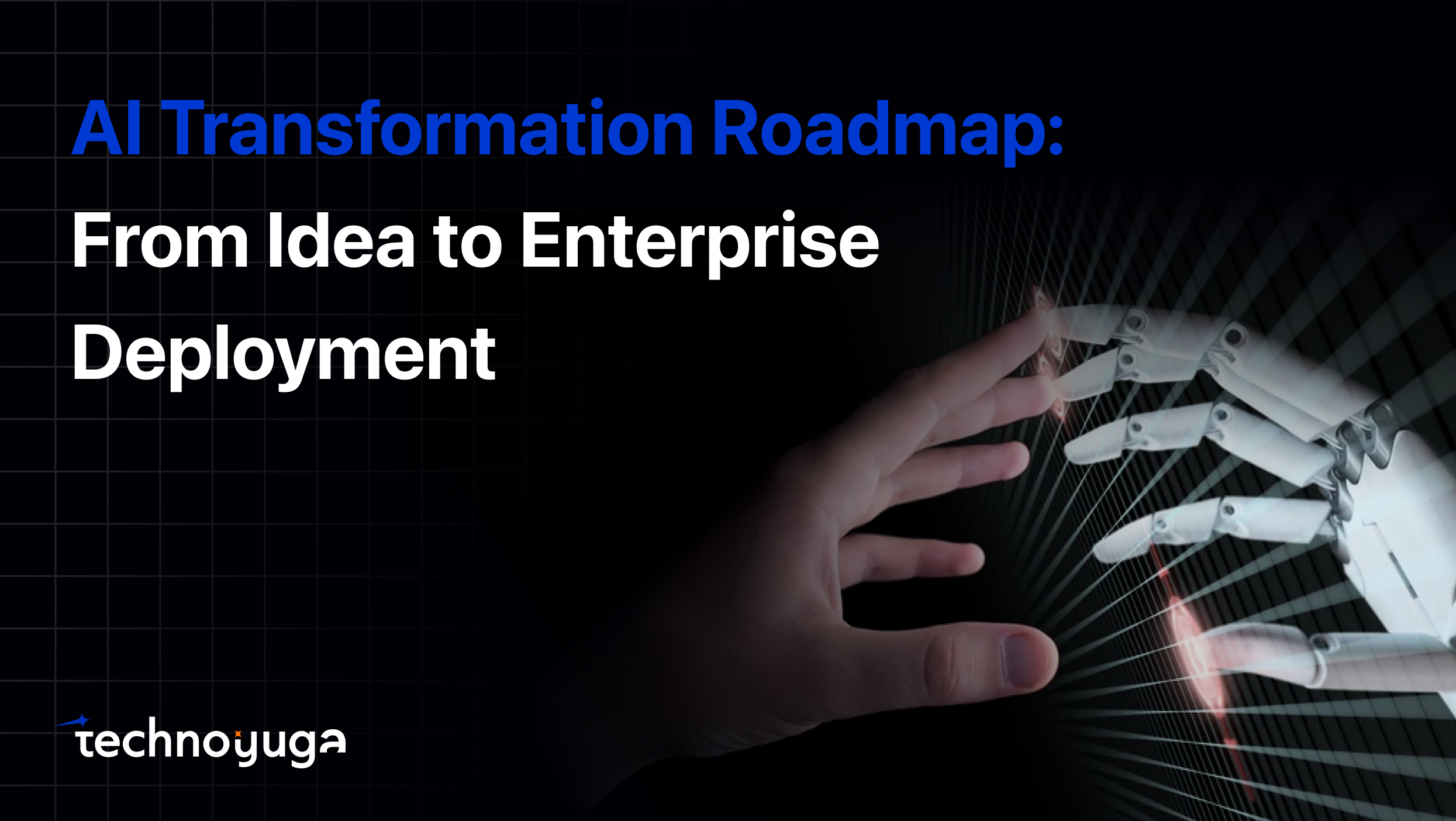
Understanding AI Transformation
For organizations at a certain stage in their digital development, the adoption of AI has shifted from being a trial-and-error practice to a strategic business imperative. This involves the thoughtful merging of AI within all aspects of your business, and having a sustained effect over time. Capturing the essence of this AI integration is crucial in creating a transformative, innovative roadmap for the business to attain value in a scalable manner.
The Shift from Experimentation to Enterprise-Scale Adoption
The early days of AI were dominated by small-scale pilot projects designed to test feasibility rather than deliver outcomes. Today, the landscape has transformed — enterprises are scaling AI to drive operational excellence and innovation at every level.
- Businesses are moving from isolated proof-of-concept models to organization-wide AI adoption.
- Data and cloud platforms now allow AI systems to learn continuously and operate efficiently across departments.
- The emphasis is shifting from “Can we use AI?” to “How do we maximize business value with AI?”
- TechnoYuga supports this transition by helping organizations design scalable frameworks that evolve with their business goals.
How AI Creates End-to-End Business Value
A mature AI transformation roadmap drives value across the full business lifecycle — from data collection to customer engagement. It helps enterprises unlock efficiencies, accelerate innovation, and strengthen decision-making.
- Predictive analytics enables proactive planning and smarter operations.
- Intelligent automation reduces manual effort and minimizes operational costs.
- Personalized customer experiences enhance satisfaction and retention.
- Data-driven insights improve forecasting, risk management, and strategy execution.
- Partnering with TechnoYuga ensures seamless AI integration that delivers measurable ROI across departments.
Key Components of an AI Transformation Journey
Every successful AI transformation rests on five core pillars that guide organizations from concept to enterprise deployment.
- Strategy: Define clear goals, outcomes, and governance structures for AI adoption.
- Data: Build reliable, high-quality data pipelines and enforce strong data governance.
- Technology: Select scalable AI tools, cloud infrastructure, and integration frameworks.
- Talent: Upskill teams or collaborate with specialized partners like TechnoYuga for domain expertise.
- Governance: Maintain ethical, transparent, and compliant AI operations across the organization.
Together, these elements form a comprehensive blueprint for scaling AI responsibly and effectively, ensuring that innovation aligns with business growth.
Global Market Insights & Adoption Trends
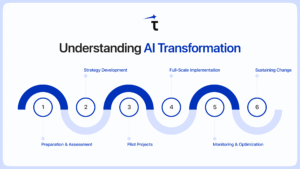
The pace at which artificial intelligence (AI) is being adopted and invested globally underscores why organizations are racing to build a robust AI transformation roadmap. From rapid investment growth and evolving maturity levels, to measurable business impact, the transformation is real — yet uneven. Below are key insights for enterprise leaders to understand where the market stands and what it means for their own AI implementation strategy.
AI investment growth across industries
- Global corporate investment in AI reached US $252.3 billion in 2024, with private investment up 44.5% and M&A up 12.1 %.
- The global AI market size was estimated at USD 279.22 billion in 2024, projected to grow to USD 3,497.26 billion by 2033 (CAGR ~31.5%).
- In India alone, the AI economy is projected to grow at a CAGR of 25-35% in the near term.
- These investments are not just in labs—they reflect broad industry interest: from healthcare to retail, manufacturing to fintech.
- For companies working with a partner like TechnoYuga, this investment momentum reinforces the strategic value of aligning with a proven AI transformation services provider.
Enterprise AI maturity levels (pilot, production, scaling)
- Most organizations are still in the pilot or experimentation phase, not yet scaled enterprise-wide. For example, a global survey found nearly two-thirds of respondents say their companies have not yet begun scaling AI across the enterprise.
- According to one study, only about 12% of enterprises have “cracked the code” and achieved enterprise-wide AI integration — the remaining 88% struggle with data silos, talent gaps, and strategic alignment.
- A maturity-model framework outlines stages such as:
- Stage 1: Awareness & foundation
- Stage 2: Active pilots and skill-building
- Stage 3: Operationalisation and governance
- Stage 4: Enterprise-wide adoption
- For enterprises engaging a partner like TechnoYuga, understanding which maturity stage applies to your organisation is critical for crafting a realistic roadmap from pilot to full scale.
AI-driven business impact statistics & success stories
- Among organisations investing in AI, 84% report gaining ROI from their AI or generative AI investments.
- Research shows that firms investing in AI exhibit higher growth in sales, employment, and market valuations, primarily through increased product innovation.
- Case studies of pilots reveal that 70-90% of AI initiatives fail to scale from pilot to full deployment — emphasising the critical need for a solid roadmap.
- For enterprise leaders working with TechnoYuga, the focus is not just on launching AI pilots but on scaling them—ensuring measurable business impact, not just experimentation.
Why Enterprises Are Prioritizing AI Transformation
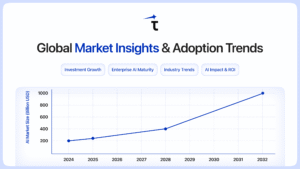
Enterprises across the globe are rapidly prioritizing AI transformation as a strategic initiative to remain competitive, agile, and future-ready. Artificial Intelligence has evolved from a support technology into a core business enabler, redefining how companies make decisions, engage customers, and optimize resources. By embedding AI into every operational layer, businesses can achieve data-driven intelligence, predictive foresight, and unparalleled personalization — key elements for sustainable growth and innovation in the digital age.
Data-Driven Decision-Making
The foundation of any successful AI transformation roadmap is data. Enterprises are leveraging AI and advanced analytics to turn vast, unstructured datasets into actionable intelligence.
- AI-driven insights help leadership teams make real-time, evidence-based decisions instead of relying on intuition.
- Predictive models analyze patterns, enabling companies to forecast trends and mitigate risks before they occur.
- With platforms following AI transformation roadmap like those developed by TechnoYuga, organizations can automate analytics pipelines and integrate intelligence directly into business workflows — accelerating strategy execution and ROI realization.
Intelligent Automation & Efficiency Gains
Automation powered by AI is revolutionizing how businesses operate. From back-office functions to front-end processes, intelligent automation is driving speed, consistency, and cost optimization.
- Repetitive, manual tasks are automated, allowing teams to focus on strategic and creative problem-solving.
- AI-powered bots and systems streamline operations, improving throughput and reducing error rates.
- According to McKinsey, companies adopting AI-based automation experience up to 40% higher operational efficiency.
- TechnoYuga’s enterprise AI solutions are designed to help organizations automate at scale while maintaining flexibility and compliance.
Predictive Capabilities & Proactive Operations
Modern enterprises no longer react to challenges — they predict and prevent them. AI transformation roadmap equips organizations with the ability to anticipate future scenarios, optimize resource allocation, and enhance business continuity.
- Predictive analytics enables accurate demand forecasting, maintenance planning, and financial projections.
- Machine learning algorithms continuously refine performance by learning from historical data.
- In manufacturing, predictive AI minimizes downtime; in retail, it optimizes inventory; and in healthcare, it improves patient outcomes.
- Through TechnoYuga’s data intelligence frameworks, enterprises can operationalize prediction and ensure proactive business management.
Enhanced Customer Engagement & Personalization
At the heart of AI transformation lies customer-centricity. AI enables enterprises to deliver personalized experiences that resonate with individual needs and preferences.
- AI systems analyze behavioral and contextual data to tailor offers, communication, and recommendations.
- Chatbots, voice assistants, and recommendation engines deliver faster and smarter customer support.
- Personalized engagement enhances loyalty, conversion rates, and brand reputation.
- With TechnoYuga’s AI personalization models, businesses can create adaptive digital experiences that evolve in real time, ensuring every customer interaction adds measurable value.
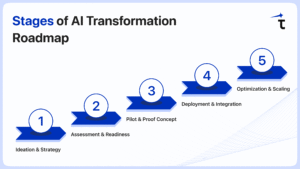
Stages of AI Transformation Roadmap
A well-structured AI transformation roadmap provides enterprises with a clear, step-by-step path from initial ideation to large-scale deployment. Each stage builds upon the previous one, ensuring that strategy, technology, and business alignment work in sync. By following these stages, organizations can move confidently from experimentation to measurable, enterprise-wide impact — minimizing risk and maximizing ROI.
Ideation & Strategy Phase
This is where the AI transformation journey begins — by identifying opportunities that align with business priorities and market needs.
- Identifying high-impact AI opportunities: Analyze processes where AI can deliver measurable benefits, such as cost reduction, efficiency gains, or innovation potential.
- Aligning AI initiatives with business goals: Every project should directly support key organizational objectives like revenue growth, customer retention, or sustainability.
- Defining success metrics & KPIs: Set clear performance benchmarks (accuracy, ROI, adoption rates) to measure project outcomes.
- Gaining leadership buy-in & stakeholder support: Executive sponsorship is critical for resource allocation, change management, and long-term success.
Assessment & Readiness Phase
Once goals are defined, enterprises must evaluate their AI readiness across technology, data, and skills.
- Data infrastructure & governance evaluation: Assess data quality, accessibility, and compliance with privacy regulations.
- Technology and tools assessment: Identify platforms (cloud, edge, hybrid) and AI frameworks that align with scalability and integration needs.
- Skill & capability gap analysis: Evaluate internal expertise and identify areas requiring upskilling or external support.
- Risk and compliance readiness: Review potential regulatory, ethical, and operational risks associated with AI deployment.
Pilot & Proof of Concept (PoC) Phase
The pilot phase validates your AI idea through small-scale experimentation before full deployment.
- Selecting the right AI use case for pilot: Choose a high-impact, low-risk use case that demonstrates value quickly.
- Building PoC with measurable outcomes: Develop a prototype or MVP focused on solving a specific business challenge.
- Testing accuracy, scalability, and ROI potential: Use real-world data to evaluate performance and ensure scalability.
- Feedback loops & stakeholder validation: Gather insights from key users and refine the model for improved adoption.
Deployment & Integration Phase
Once validated, it’s time to scale from PoC to enterprise-level implementation.
- Scaling AI models from PoC to production: Migrate tested models into production environments with strong monitoring systems.
- Integrating AI with enterprise systems (CRM, ERP, Cloud): Ensure seamless interoperability with existing business software and platforms.
- Ensuring interoperability & data flow consistency: Maintain consistent data pipelines between departments and applications.
- Security, compliance, and ethical considerations: Implement best practices for privacy, model governance, and explainability.
Optimization & Scaling Phase
The final stage focuses on continuous improvement, ensuring that AI systems evolve with the business.
- Continuous model improvement (MLOps, AutoML): Automate model updates and retraining for better accuracy and adaptability.
- Performance monitoring & retraining pipelines: Establish regular performance audits and data quality checks.
- Expanding AI capabilities across departments: Scale successful use cases into other verticals and processes.
- Building a culture of data-driven innovation: Encourage teams to leverage AI insights for everyday decision-making.
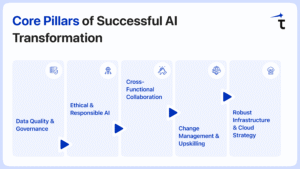
Core Pillars of Successful AI Transformation
Achieving true AI transformation roadmap requires more than just deploying algorithms — it demands a solid foundation built on governance, ethics, collaboration, and technology. These pillars ensure that AI adoption not only delivers measurable business outcomes but also aligns with organizational values, compliance standards, and long-term scalability. Below are the five critical pillars that drive sustainable enterprise-wide AI transformation.
Data Quality & Governance
High-quality, well-governed data is the backbone of successful AI initiatives. Without accurate, consistent, and compliant data, even the most advanced models can fail to produce reliable insights.
- Centralized data governance frameworks ensure consistency across departments and maintain data lineage.
- Data cleaning and enrichment processes enhance the usability of both structured and unstructured data.
- Compliance adherence (GDPR, HIPAA, etc.) ensures responsible handling of sensitive information.
- Metadata management and cataloging make enterprise data more discoverable and ready for AI-driven analytics.
Ethical & Responsible AI Practices
Enterprises must adopt AI responsibly to build trust among stakeholders and end-users. Ethical frameworks ensure AI systems are fair, transparent, and unbiased.
- Bias detection and mitigation techniques are critical during model training and validation.
- Explainable AI (XAI) improves transparency, allowing users to understand how decisions are made.
- Ethical AI committees or oversight boards guide responsible innovation and ensure compliance with global standards.
- Regular audits help track fairness, accountability, and data ethics.
Cross-Functional Collaboration
AI transformation thrives when business and technology teams work together toward a shared vision.
- Collaborative AI teams — combining data scientists, domain experts, IT specialists, and decision-makers — drive innovation efficiently.
- Business-driven AI strategies ensure that every project delivers tangible outcomes aligned with enterprise goals.
- Cross-departmental alignment promotes faster adoption and scalability across business units.
- Transparent communication reduces resistance and encourages organizational buy-in.
Change Management & Upskilling
Adopting AI is as much about people as it is about technology. Building a workforce that understands and embraces AI ensures long-term transformation success.
- Continuous upskilling programs prepare employees to work effectively with AI tools and insights.
- Change management strategies address fear, resistance, and misconceptions related to AI adoption.
- Leadership training helps executives make data-driven decisions and champion innovation.
- Incentive-based adoption programs encourage teams to leverage AI solutions proactively.
Robust Infrastructure & Cloud Strategy
Scalable, secure, and high-performing infrastructure is essential for powering AI workloads.
- Hybrid and multi-cloud environments provide flexibility and resilience for AI applications.
- Modern data architectures (like data lakes and warehouses) ensure real-time analytics and fast data access.
- Integration with edge computing enables low-latency decision-making for IoT and real-time scenarios.
- Scalability and cost optimization ensure sustainable AI growth across global operations.
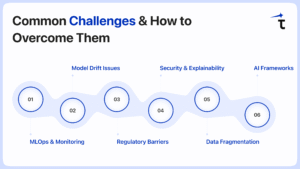
Common Challenges & How to Overcome Them
While AI transformation promises immense value, many enterprises struggle to translate vision into tangible outcomes due to strategic, technical, and organizational barriers. Understanding these common challenges — and how to overcome them — is key to ensuring sustainable success.
- Lack of Strategic Clarity or Measurable ROI
Many businesses begin their AI journey without a clear strategic roadmap, resulting in scattered projects and unclear value realization.
Challenges:
- No defined AI vision or business alignment
- Unclear ROI measurement frameworks
- Fragmented initiatives without executive support
How to Overcome: - Develop a comprehensive AI transformation roadmap aligned with enterprise goals.
- Define KPIs that measure performance, efficiency, and revenue impact.
- Secure leadership sponsorship to ensure cross-departmental collaboration and budget support.
Data Silos & Integration Complexity
AI thrives on unified, high-quality data — yet many enterprises struggle with fragmented systems and legacy architectures.
Challenges:
- Disconnected data sources across departments
- Legacy systems that resist integration
- Poor data governance and quality control
How to Overcome: - Build a centralized data lake or warehouse that consolidates structured and unstructured data.
- Implement data governance frameworks for standardization and accessibility.
- Use API-driven integrations and cloud platforms to enhance interoperability.
Talent Shortage & Training Gaps
The demand for skilled AI and data professionals far exceeds supply, leaving organizations struggling to execute complex AI initiatives.
Challenges:
- Lack of experienced data scientists or ML engineers
- Limited internal AI literacy
- High competition for skilled talent
How to Overcome: - Invest in upskilling and reskilling programs for internal teams.
- Leverage AI development partners for technical execution and knowledge transfer.
- Build cross-functional AI teams blending domain expertise with data science skills.
Model Drift & Maintenance Challenges
Once deployed, AI models can degrade over time due to changing data patterns — a phenomenon known as model drift.
Challenges:
- Decreasing model accuracy over time
- Untracked model updates and performance metrics
- Inefficient retraining and deployment pipelines
How to Overcome: - Implement MLOps frameworks for automated monitoring, retraining, and deployment.
- Regularly validate models against real-world data.
- Ensure transparency through version control and explainability tools.
Regulatory and Compliance Barriers
As AI adoption accelerates, so does scrutiny over data privacy, transparency, and ethical use.
Challenges:
- Adhering to regional and global data regulations (GDPR, HIPAA, DPDP, etc.)
- Lack of AI explainability and audit trails
- Concerns over algorithmic bias and accountability
How to Overcome: - Implement Responsible AI policies with clear audit documentation.
- Ensure data anonymization and secure storage practices.
- Conduct ethical impact assessments before deployment.
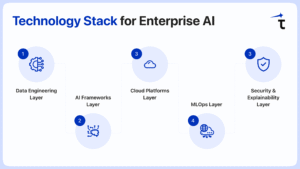
Technology Stack for Enterprise AI
Building a scalable and reliable AI transformation roadmap requires a well-structured technology stack that supports the entire lifecycle — from data ingestion to model deployment and monitoring. A robust tech stack not only ensures performance and scalability but also accelerates time-to-market for enterprise AI solutions. Below is a detailed breakdown of the key technology layers essential for successful AI transformation.
Data Engineering & Pipeline Tools
The foundation of any AI initiative lies in the ability to collect, clean, and process data efficiently.
- Data ingestion tools: Apache Kafka, Apache NiFi, Talend, and AWS Glue enable seamless real-time data collection.
- ETL & data pipeline management: Apache Airflow, Prefect, and Dagster help orchestrate complex workflows.
- Data lakes and warehouses: Snowflake, Databricks, and Google BigQuery centralize enterprise data for scalable AI workloads.
- Data governance & quality tools: Collibra and Alation ensure compliance, lineage tracking, and high data accuracy.
AI Frameworks (TensorFlow, PyTorch, etc.)
AI frameworks power model development, training, and deployment, forming the core of enterprise AI ecosystems.
- Deep learning frameworks: TensorFlow, PyTorch, and Keras are ideal for building and training neural networks.
- Classical machine learning libraries: Scikit-learn and XGBoost the classical machine learning liabraries provide scalable predictive modeling capabilities.
- Natural Language Processing (NLP): SpaCy, Hugging Face Transformers, and OpenAI APIs power advanced text and conversational systems.
- Computer Vision: OpenCV and YOLO are the best computer vision frameworks that enable object detection, image recognition, and video analytics.
Cloud Platforms (AWS, Azure, GCP)
Modern AI systems rely heavily on cloud computing for scalability, elasticity, and global deployment.
- AWS AI Suite: Offers tools like SageMaker, Comprehend, and Rekognition for model training, NLP, and image processing.
- Microsoft Azure AI: Provides Azure ML, Cognitive Services, and OpenAI integrations for enterprise-grade deployments.
- Google Cloud AI: Delivers Vertex AI, BigQuery ML, and AutoML for end-to-end AI lifecycle management.
- Hybrid & multi-cloud strategies: Enable flexibility and avoid vendor lock-in while maintaining compliance.
MLOps & Monitoring Systems
Once models are deployed, continuous monitoring and lifecycle management are critical to maintain performance and trustworthiness.
- Model lifecycle management: Tools like MLflow, Kubeflow, and DVC support version control and experiment tracking.
- Monitoring & observability: Prometheus, Grafana, and Evidently AI track drift, latency, and performance metrics.
- Automated retraining: AutoML and continuous deployment pipelines keep models accurate as data evolves.
- Collaboration & reproducibility: Weights & Biases and Neptune.ai simplify team collaboration and reporting.
Security & Explainability Tools
As AI systems gain influence over business-critical decisions, ensuring security, fairness, and transparency becomes non-negotiable.
- Data security frameworks: AWS KMS, HashiCorp Vault, and Azure Key Vault protect sensitive AI assets.
- Model explainability tools: LIME, SHAP, and What-If Tool help interpret model behavior for transparency.
- AI governance and audit tools: Fiddler AI and Arize AI enable compliance tracking and ethical assurance.
- Anomaly detection systems: Monitor for adversarial attacks or unauthorized data access.
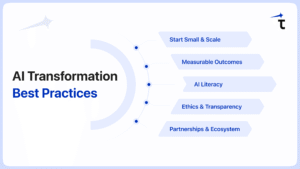
AI Transformation Best Practices
Implementing AI transformation successfully requires a balance between strategic planning, technical execution, and cultural readiness. While every organization’s journey is unique, following a few universal best practices ensures scalable, ethical, and ROI-driven outcomes.
- Start Small, Scale Strategically:
Begin with focused pilot projects that target high-impact areas. Use early success as a foundation to scale AI across departments with clear goals and governance in place. - Focus on Measurable Business Outcomes:
Every AI initiative should be tied to quantifiable metrics — such as cost reduction, process efficiency, or customer engagement — ensuring investments translate into tangible value. - Foster AI Literacy Across Teams:
Encourage employees to understand, use, and trust AI tools. Building AI literacy enhances collaboration, innovation, and adoption across all levels of the organization. - Integrate Ethics and Transparency from the Start:
Implement responsible AI practices early on to maintain fairness, accountability, and compliance. Transparency builds stakeholder confidence and long-term trust. - Invest in Partnerships & Ecosystem Collaborations:
Collaborate with experienced AI partners like TechnoYuga to access domain expertise, scalable infrastructure, and continuous innovation. Ecosystem partnerships accelerate transformation and reduce risk.
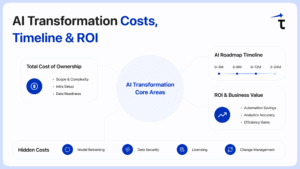
AI Transformation Costs, Timeline & ROI
A successful AI transformation requires strategic investment in technology, talent, and infrastructure. Understanding the cost dynamics, project timelines, and ROI factors helps organizations plan realistically and ensure sustainable value creation.
Factors Influencing Total Cost of Ownership (TCO)
The overall cost of implementing AI depends on several variables, including:
- Project scope and complexity: Larger AI ecosystems (like predictive analytics or NLP-based automation) demand higher initial investment.
- Data readiness: Cleaning, labeling, and integrating data often consume 30–40% of total project costs.
- Infrastructure setup: Costs vary between on-prem, cloud, and hybrid deployment models.
- Talent and partnerships: Hiring AI experts or engaging with partners like TechnoYuga impacts both speed and cost-efficiency.
Typical Enterprise AI Roadmap Timeline (6–24 Months)
The journey from ideation to enterprise-scale deployment typically unfolds across these stages:
- 0–3 months: Ideation, business alignment, and data audit
- 3–6 months: Proof of Concept (PoC) or pilot development
- 6–12 months: Scaling successful models into production systems
- 12–24 months: Enterprise-wide integration, automation, and continuous optimization
Measuring ROI from Automation, Analytics, and Insights
Return on Investment (ROI) from AI transformation is measured not just in cost savings, but in strategic business impact:
- Automation: Reduced manual workloads and faster process cycles
- Analytics: Data-driven decision-making and improved forecasting accuracy
- Customer Insights: Enhanced personalization and engagement rates
- Operational Efficiency: Lower error rates and optimized resource utilization
Hidden Costs & Scaling Considerations
While AI delivers exponential returns, organizations must plan for hidden and recurring costs:
- Model retraining & maintenance (especially for dynamic data environments)
- Data storage and security costs
- Licensing fees for tools and APIs
- Change management and training programs for teams
Planning for these ensures sustainable scaling and predictable budgets.
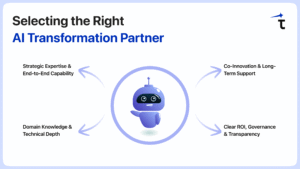
Selecting the Right AI Transformation Partner
Choosing the right AI transformation partner can make the difference between fragmented adoption and enterprise-wide success. A trusted partner brings the technical depth, domain understanding, and long-term support needed to translate AI vision into measurable business outcomes. Below are key considerations when evaluating a strategic AI partner — and why TechnoYuga stands out in delivering end-to-end transformation excellence.
What to Look for in a Strategic AI Partner
A true AI partner should act as an extension of your organization, aligning technology initiatives with your business strategy.
- Proven expertise in enterprise AI implementation across multiple industries.
- Ability to deliver end-to-end solutions — from ideation and PoC to deployment and scaling.
- Focus on ROI-driven outcomes rather than just technical delivery.
- Commitment to data security, ethical AI, and compliance standards.
TechnoYuga serves as a strategic AI transformation partner, offering tailored solutions that accelerate innovation and ensure long-term business value.
Evaluating Domain Expertise & Technology Depth
The right partner must combine deep domain knowledge with cutting-edge technical capability.
- Experience with AI frameworks (TensorFlow, PyTorch), cloud ecosystems (AWS, Azure, GCP), and MLOps tools.
- Familiarity with specific industry challenges — such as healthcare compliance, retail personalization, or fintech automation.
- Ability to integrate AI seamlessly with CRMs, ERPs, and existing business systems.
With TechnoYuga’s cross-industry expertise, businesses gain access to scalable AI architectures, predictive analytics, and automation systems that are tailored to real-world use cases.
Importance of Co-Innovation and Post-Deployment Support
AI transformation doesn’t end at deployment — it’s an ongoing evolution.
- Partners should provide continuous monitoring, model optimization, and performance tuning.
- Co-innovation fosters shared learning and ensures that solutions evolve with the enterprise.
- Post-launch support, including data drift analysis and feature enhancements, ensures lasting value.
TechnoYuga believes in co-creation, working closely with client teams to innovate, optimize, and evolve AI systems well beyond launch.
Key Questions Before Engagement
Before finalizing an AI transformation roadmap with development partner, enterprises should ask:
- What measurable ROI have you delivered in similar industries?
- How do you handle data privacy, security, and governance?
- Can your AI frameworks integrate with our existing infrastructure?
- What level of training and post-launch support do you provide?
- How do you ensure model transparency and explainability?
TechnoYuga’s client-first approach ensures clarity, accountability, and continuous alignment—from the first consultation to full-scale AI transformation.
Conclusion
The future of AI-powered enterprises lies in their ability to harness intelligence not just as a tool, but as a core business driver. As industries continue to evolve, organizations that embed artificial intelligence across their operations, decision-making, and customer engagement strategies will lead the next wave of digital disruption. From automating complex workflows to predicting market shifts, AI is transforming how businesses innovate, compete, and deliver value.
A clear and strategic AI transformation roadmap is the foundation for achieving sustainable success. It ensures every initiative — from pilot projects to enterprise-wide deployments — is guided by measurable goals, ethical principles, and strong governance. By aligning AI strategy with business vision, enterprises can scale innovation confidently while maintaining agility and control.