AI is no longer a futuristic idea but is now an essential technology to contemporary businesses. Organizations in logistics, manufacturing, fintech, retail, and healthcare are quickly turning to AI to automate operations, improve decision-making, and provide more customized customer experiences. Such an influx of adoption has created a tremendous need in the development of AI services, which has compelled businesses to look into the Cost of AI Development prior to making projects.
Nonetheless, AI development cost does not only consist of budgeting, it also directly influences ROI, scalability, and general success of digital transformation. By properly estimating the cost of AI development, businesses can plan their resources efficiently, choose the appropriate use cases, and not waste money, as well as secure long-term value generation. The transparent cost information also assists the organizations in deciding on whether to implement custom solutions, ready-made models or a combination of the two to ensure the greatest returns at the lowest risk.
With AI emerging as a strategic priority of world enterprises and an expanding start-up, the clear understanding of AI project costs, schedules and resource requirements has never been such a competitive advantage.
Key Takeaways:
- The prices of AI development vary depending on complexity, data requirements and the level of deployment, so it is imperative that businesses should plan their budgets depending on a well-defined scope of the project.
- Depending on which of the three categories you are developing a PoC, a mid-level pilot or a full enterprise AI system, timelines can range between a few weeks to several months.
- The total cost of AI Development can also be brought to a halt by hidden costs such as data annotation, model retraining, and compliance that is not planned prior.
- The pre-trained models, cloud-native AI services, MLOps automation, and the appropriate selection of the implementation partner can be used to create AI in the most cost-effective way.
- The choice of an experienced AI partner such as TechnoYuga guarantees clear-cut prices, scalable architecture and increase in ROI, which will decrease the risks of long-term operation and development.
What Drives the Cost of AI Development?
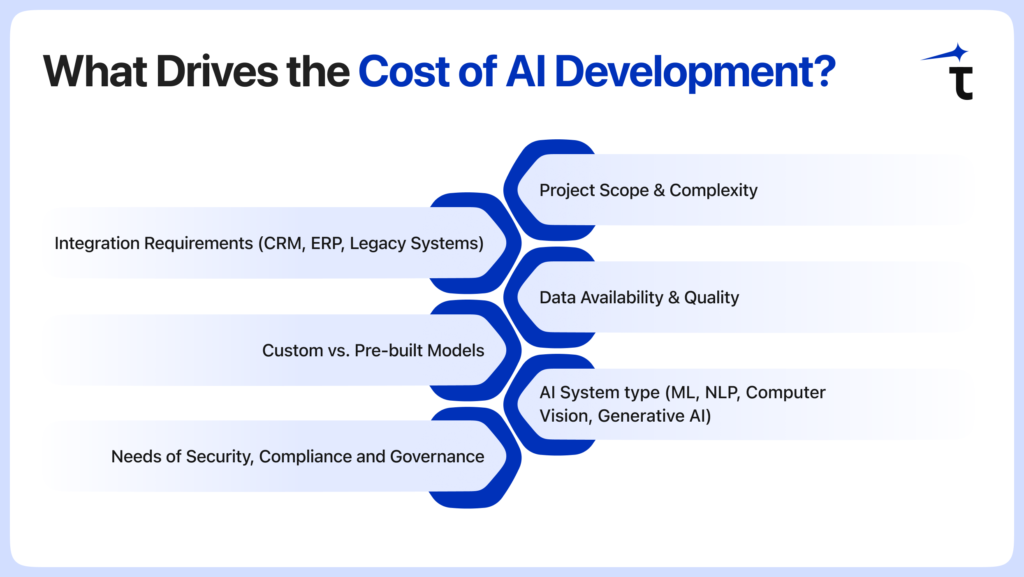
It is imperative to know what drives the cost of developing AI so that the planning process is feasible and ROI is expected to be realistic. There are several different factors that influence the overall cost of AI development and each of them shapes the timeframes, difficulty and the investment all-in-all.
Project Scope & Complexity
The larger and more complex the project, the higher the AI project cost. Cases of multiple model usage, complex workflows, or real-time processing often demand increased development time, experimentation and engineering. Even more complex features such as recommendation engine, fraud detection, or generative automation are added.
Data Availability & Quality
We all know, AI solutions are based on data. Inadequate or low-quality data usually requires a large amount of preprocessing, cleaning, and labeling, a task that increases the cost of AI development considerably. It is observed that projects with available, organized and properly managed datasets are quicker and less expensive.
AI System type (ML, NLP, Computer Vision, Generative AI)
Various types of AI are associated with varying cost setups. The cost of developing machine learning is, say, not equivalent to NLP model development cost or computer vision development cost. Custom LLMs and generative AI systems, in general, have a tendency to be costly to invest in because of the intense training and usage of large datasets.
Integration Requirements (CRM, ERP, Legacy Systems)
Adopting the usage of AI in combination with the current tools like CRM, ERP, HRMS, or legacy software may introduce a considerable amount of effort. The greater the number of integrations needed the greater the cost of AI implementation because of the testing, API development and considering system interoperability.
Custom vs. Pre-built Models
The most flexible, and thus more expensive, option is to create a solution by hand, which will provide the greatest flexibility. Oppositely, pre-trained or open-source models can reduce expenses- but can restrict personalization, scalability or control based on the application.
Needs of Security, Compliance and Governance
Strict adherence is needed in such industries as healthcare, financial, insurance, and government, (HIPAA, GDPR, RBI, ISO). Risk mitigation and long-term trust require the implementation of secure pipelines, encryption, audit trails, and governance frameworks, which may be costly to the AI software development.
Types of AI Solutions & Their Cost Ranges
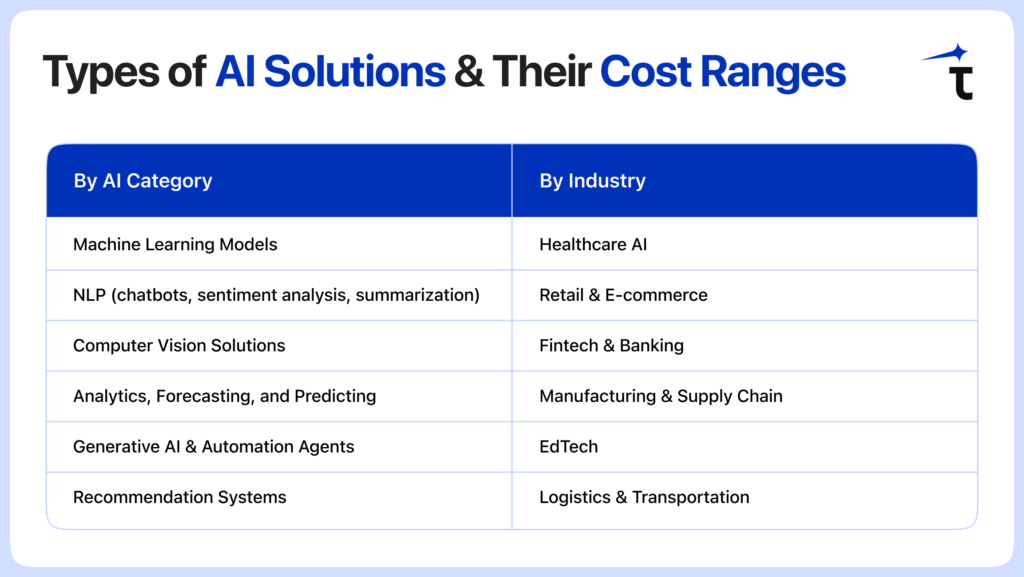
The cost of AI development varies widely based on the type of solution a business needs. Various types of AI need varying amounts of data, engineering and algorithms and infrastructure- this has a direct impact on the final cost of AI development. The types of the most common AI solutions and their effects on pricing are outlined below.
By AI Category
Machine Learning Models:
Classification systems, clustering systems, anomaly detection systems, and prediction systems based on machine learning typically entail data preprocessing, feature engineering, and model training. The cost of machine learning development is greater when dealing with large volumes of data or other complicated algorithms.
NLP (chatbots, sentiment analysis, summarization)
The costs of NLP-based solutions (chatbots, voice assistants, sentiment engines, or document summarizers) can also differ greatly. The advanced LLM fine-tuning or custom NLP models are usually more expensive to develop than an NLP model, and template-based chatbots are still cheaper.
Computer Vision Solutions
The image recognition, video analytics, defect detection, face recognition, or OCR AI solutions are trained long and have high requirements of large labeled datasets. These are some of the reasons that make computer vision development cost more than in cases that require real-time or high accuracy.
Analytics, Forecasting, and Predicting
Financial, retail and logistics businesses are relying on forecasting models to determine the trends, demand and threats. The cost is related to the sources of data, the number of variables and the accuracy of the model. These solutions are usually in the middle category in terms of the cost of AI development.
Generative AI & Automation Agents
Some of the most expensive development categories are generative AI tools, such as custom LLMs, fine-tuned GPT-style models, AI agents, or content automation systems. Their capabilities are higher than the rest so the cost of generative AI development is higher particularly when it is trained on proprietary data.
Recommendation Systems
Recommendation Systems that are used in e-commerce, media and SaaS platforms and need behavioral data, personalization logic and inference pipelines in real-time. This adds to further cost of AI software development, based on its size and level of personalization.
By Industry
The needs in different industries are peculiar and that affects the cost of the AI project. This is how the pricing scale is determined by industry-specific needs:
Healthcare AI
Strict adherence, sensitive information and life-threatening precision increases the cost of AI development in hospitals, diagnostics, pharmaceuticals and telehealth platforms.
Retail & E-commerce
Solutions, such as recommendation engines, demand forecasting, and customer segmentation are neither low cost nor mid cost but rather high cost depending on the level of personalization.
Fintech & Banking
Detection and preventive measures of fraud, AML/KYC automation, credit scoring require a high level of security and reliability, which raises the cost of AI implementation.
Manufacturing & Supply Chain
IoT and real-time analytics will be needed in predictive maintenance, quality inspection and production optimization, and will influence the overall AI development cost.
EdTech
Typically, adaptive learning engines, proctoring systems, and personalized content tools lie in the mid range of development cost of AI.
Real Estate
Moderate investment is usually required in AI valuations, lead scoring software, automation agents, and image analytics.
Logistics & Transportation
Such applications as route optimization, fleet analytics and predictive warehousing integrate big data and real-time systems – increasing the cost of AI project.
Cost Breakdown of AI Development
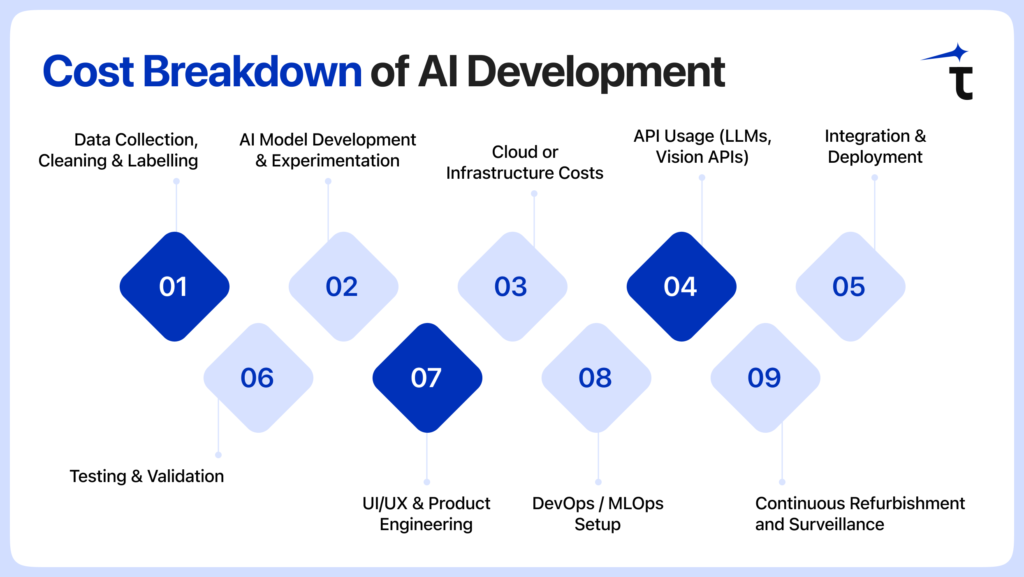
The cost for AI development depends on a variety of technical, functional, and infrastructure elements. Knowledge of such factors assists companies to estimate the cost of the AI project correctly and prevent having to incur unforeseen costs when executing it.
Major Cost Components
Data Collection, Cleaning & Labelling
Data preparation can be a major part of the cost of AI development. Manual annotation and large-scale labeling projects, as well as multi-source data ingestion, are usually more expensive.
AI Model Development & Experimentation
The construction, training, optimization, and testing of AI models are based on trial and error. Complex applications, like fraud detection or generative models, increase the cost of AI software development by a significant margin because of increased development cycles.
Cloud or Infrastructure Costs
The cost of AI implementation is affected by compute resources, i.e., GPUs, cloud environments, data storage, and deployment servers. Scalable cloud infrastructure might be needed to support real-time systems or large data sets, which are long-term costs.
API Usage (LLMs, Vision APIs)
Premium APIs such as OpenAI, Google vision, or third-party NLP engines have a recurring fee, either on a token or call or volume basis. These have to be included as the AI project cost estimates by the businesses.
Integration & Deployment
Integrating artificial intelligence models into CRMs, ERPs, legacy platforms, or mobile/web applications involves extra engineering work. Complexity of the integration is a direct factor in the cost of AI development.
Testing & Validation
The accuracy, stability, reduction of bias, security, and performance across edge cases are guaranteed, which adds more time to testing schedules and the overall cost, particularly in a regulated industry.
UI/UX & Product Engineering
AI has to have end-user-friendly interfaces. The cost of AI software development is increased by the cost of building dashboards, workflows, analytics screens, and custom applications.
DevOps / MLOps Setup
Installation of pipelines to conduct automated training, monitoring, deployment, and versioning is part of the cost of AI development in the long term. MLOps is needed to support production-scale AI systems.
Continuous Refurbishment and Surveillance
Drifting can be avoided by updating models regularly. Ongoing surveillance, retraining, security patches, and infrastructure upgrades can be added to the ongoing AI maintenance fee.
Standard AI Pricing (SMBs, Enterprises, Startups)
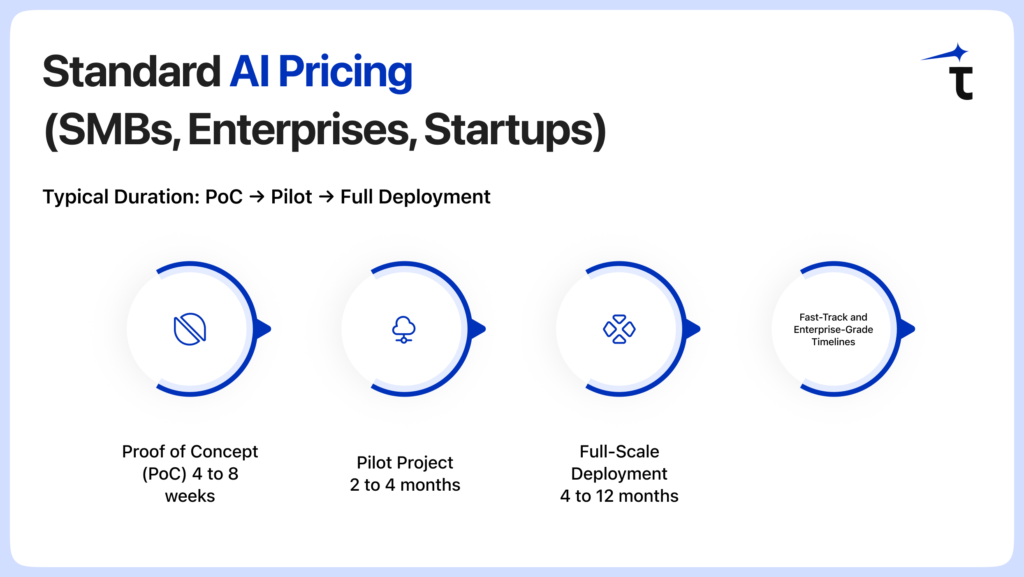
The cost of AI development may vary in its levels depending on the size of the business, complexity, and purpose.
● MVP / Proof of Concept
The first validation or basic prototyping is in the lowest category. The AI PoC cost is also not much because it is limited to a small scale and has limited integrations.
● Pilot Project (Mid-Level Complexity)
As businesses graduate out of a PoC into a working pilot, the amount of engineering work rises. This bracket includes middle datasets, multi-workflow, and initial deployment. The price of AI pilot project is typically in the middle income category.
● Enterprise AI System Replica
Real-time analytics, multi-integration pipelines, dashboards, and automation Enterprise AI platforms are also very costly to invest in. These are the types of solutions that may be classified as high-end enterprise AI cost.
● Generative AI Solutions (Custom LLM or Fine-Tuned Models)
The most costly type is usually building or finetuning generative models, automation agents or proprietary LLMs. The development cost of the generative AI increases because of:
- GPU-intensive training
- Large-scale datasets
- Custom pipeline engineering
- Reinforcement learning (optional)
● Price Competition in each category
The pricing levels are divided into each category and depend on the scope, complexity of data, quantity of features, integrations, and maintenance needs in the long-term.
Timeline for AI Project Development
Development of an AI solution has a timeline that depends on the level of complexity, preparation of data, integrations, and scale. The knowledge of the development time is effective to allow the businesses to plan resources, budget, and ROI. The timeline also affects the cost of the general AI development because longer cycles mean more investment in engineering and infrastructure.
What Factors Influence AI Development Time?
The timeline for completion of an AI project depends on several factors, such as the scope of the project, availability of data, number of integrations, the type of AI system (ML, NLP, Computer Vision, Generative AI) and the sophistication of the current infrastructure. The development of AI is normally prolonged by the use of complex use cases or when developing a specific model.
● Typical Duration: PoC → Pilot → Full Deployment
The majority of AI applications use a gradual development process:
Proof of Concept (PoC) — 4 to 8 weeks
Rapid testing of feasibility, data patterns, and model preliminary behavior. The shorter cycles minimise early AI project cost and risk.
Pilot Project — 2 to 4 months
The functional and fine variant released towards a small number of viewers. This step entails enhanced models, incorporations, and initial MLOps configuration. Timeline is based on the maturity of the use cases and data complexity.
Full-Scale Deployment 4 to 12 months
Multi-environment integration, AI systems with real-time inference, dashboards, and automation pipelines are the most time-consuming features of enterprise-grade. These levels play a very important role in determining the cost of AI implementation and resource planning.
● Fast-Track and Enterprise-Grade Timelines
Companies that utilize ready-made models or cloud-based AI providers can accomplish shorter go-to-market durations. In the meantime, companies developing their own LLMs, deep learning pipelines, or multi-module architectures have long timelines because they must test their systems, pass compliance, and are required to be highly accurate. This trade-off between speed and depth has an eventual effect on the cost of AI development and the project efficiency.
Hidden Costs Businesses Should Be Aware Of
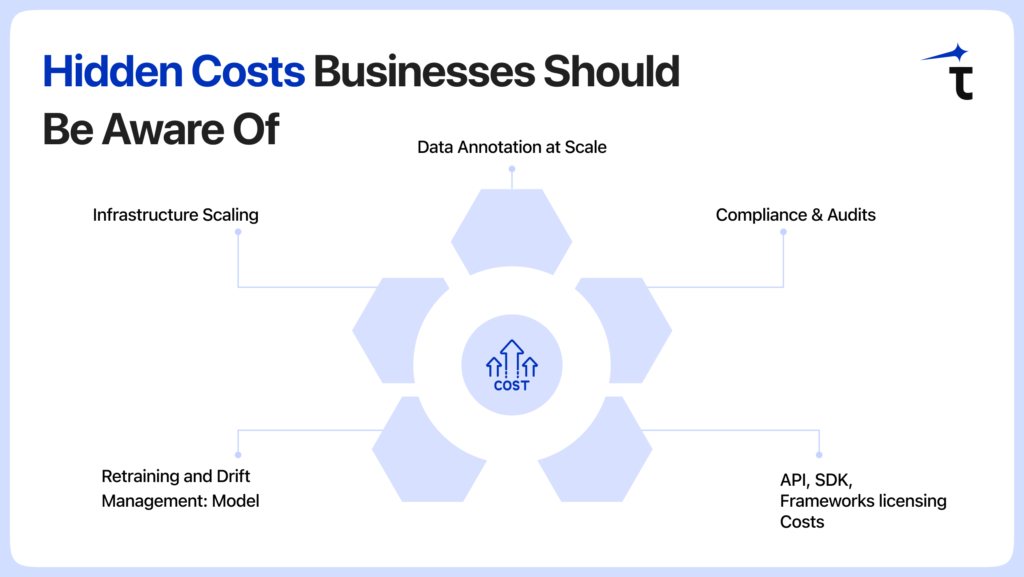
Although a high percentage of organizations consider the initial cost of AI development, a few submerging or indirect expenses may have a huge impact on the overall cost. This knowledge will assist businesses in preventing surprising expenses and developing a more precise and ROI-centred budget to fund their AI projects.
● Data Annotation at Scale
Huge datasets in AI solutions may also require manual or semi-automated labeling: notably, computer vision, NLP and generation AI solutions. With the increasing amount of data, annotation may cause one of the largest cost in AI project areas, especially in cases where precision and field knowledge are needed.
● Infrastructure Scaling
Undoubtedly, AI models might need high-performance CPUs, GPUs, cloud storage or real-time servers, during development and deployment. With increased use, the businesses would have to scale infrastructure, which would increase the long-term cost of implementing AI higher than it was initially estimated.
● Retraining and Drift Management: Model
The degradation of AI models with time changes is because of the variation in user behavior, market condition, or data patterns. Re-training, oversight and drift detection incur recurring maintenance costs in AI which guarantee accuracy and reliability in manufacturing facilities.
● Compliance & Audits
Industries such as the healthcare sector, finance, and BFSI industry demand high compliance such as GDPR, HIPAA, or RBI regulation. There are security audits, documentation, logging, and ethical AI practice which add to the cost of hidden AI software development that business should expect.
● API, SDK, Frameworks licensing Costs
The usage-based pricing is often used to sell premium APIs of LLMs, vision models, speech recognition, or cloud services. These recurring charges have a significant effect on the overall AI development cost over time, particularly when scaling or using a workload of high-frequency inference.
How to Reduce AI Development Costs
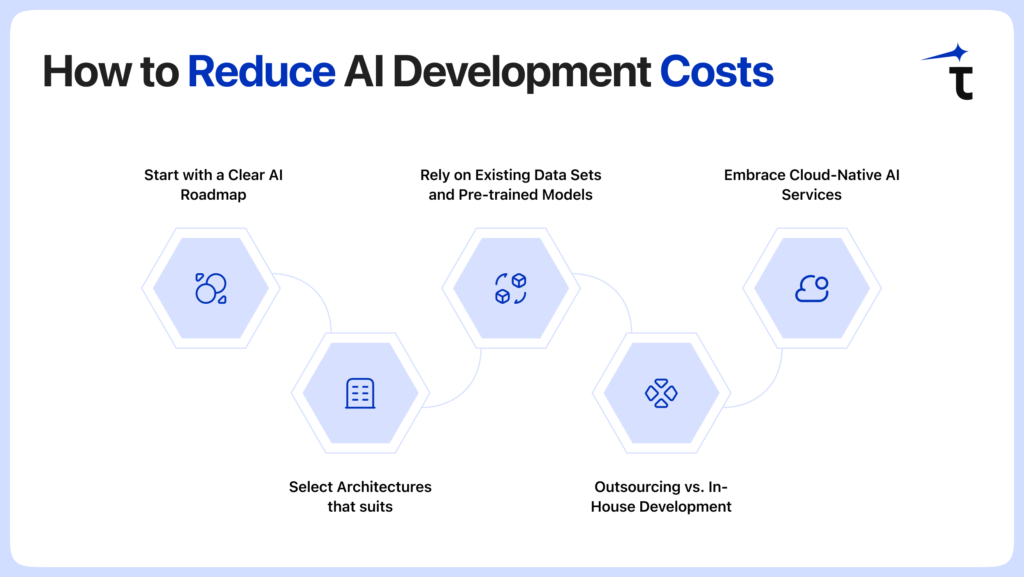
Reducing the cost of AI development is not just about cutting expenses—but optimizing strategy, infrastructure, and execution so businesses get maximum ROI with minimal waste. By following proven techniques, organizations can significantly lower their AI project cost without compromising model performance or scalability.
● Start with a Clear AI Roadmap
Clear roadmap aids teams to prevent unnecessary iterations, scope creep, and unmet expectations. Specific objectives will make the cost of AI development predictable and targeted to high-impact applications with quantifiable ROI.
● Rely on Existing Data Sets and Pre-trained Models
Training on existing models and published datasets can save time on development and AI software development by a massive margin. It is much cheaper to fine-tune existing models than to create custom models by hand-writing new models, particularly in NLP, CV, and generative AI.
● Embrace Cloud-Native AI Services
Scaling On-demand scaling can be implemented with the help of cloud AI services (AWS, Azure, Google Cloud, etc.) and does not require significant investment in infrastructure. Cloud pipeline services are useful in reducing the cost of AI implementation, increasing agility, and reducing operational costs in the long term.
● Select Architectures that suits
Microservice-based and API-driven architectures and module based reduce duplication of work and future upgrades are cost-effective. Scalable design helps to make sure that the cost of AI project does not multiply in case of adding new features, models or user loads.
● Outsourcing vs. In-House Development
An AI team would need to be developed in-house, which would consist of machine learning engineers, data scientists, MLOps specialists, product managers, and domain specialists. This considerably raises the AI development prices to most companies.
Choosing the Right AI Development Partner
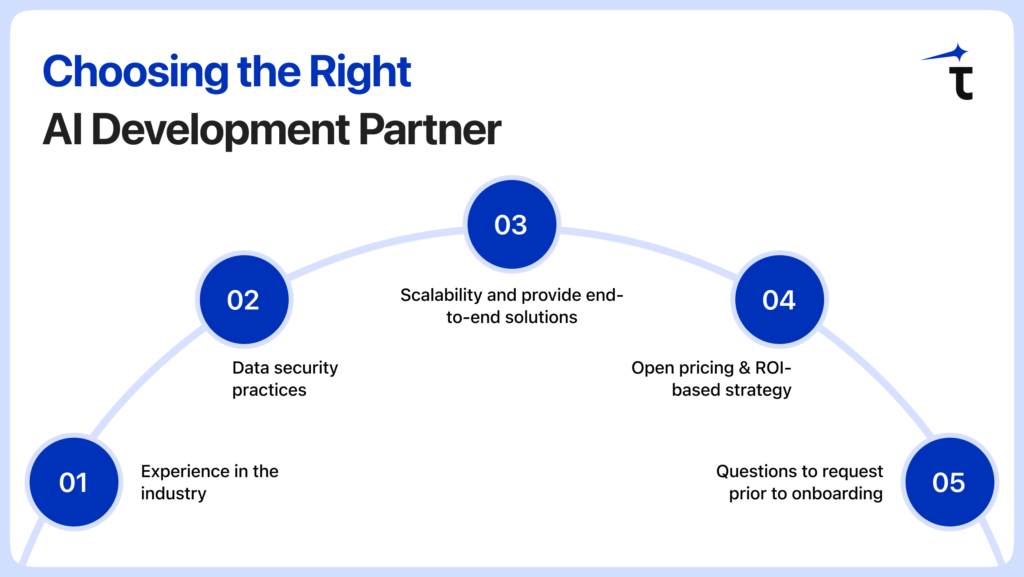
Choosing the right AI Development Partner is also a must to consider. Some factors that can help you with it are:
Experience in the industry:
Your AI partner must possess experience in other fields such as healthcare, fintech, retail, and enterprise AI transformation. Find groups that have provided production quality models, scalable infrastructures, and quantifiable business results. We at TechnoYuga, have a good AI and digital engineering capacity, and we can well address this expectation.
Data security practices
The success of AI requires high data control, pipelines safety, and adherence to regulations, including GDPR, HIPAA, or SOC 2. Make sure that the partner implements encryption, privacy-by-design, and secure MLOps workflows. The history of successful AI development by TechnoYuga qualifies the company as a reliable option.
Scalability and provide end-to-end solutions
The AI partner must be reliable to all the stages of data engineering and model development, as well as to implementation, monitoring, and improvement. TechnoYuga provides complete delivery systems which assist companies to grow rapidly without interfering with reliability.
Open pricing & ROI-based strategy
Find those teams that offer transparent pricing models, focus on creating value and measure success by cost savings, efficiency gains, and enhanced customer experience. Using TechnoYuga, it is usually predictable and the ROI is highly emphasized.
Questions to request prior to onboarding
- What are your knowledge bases in AI frameworks, architectures and toolchains?
- What is your approach to data privacy, security and compliance?
- Will you give me case study in my industry?
- How do you use MLOps, deployment, and scaling?
- What do you do to estimate financials, schedule, and ROI?
- What about maintenance and retraining on a long-term basis?
Conclusion
It is important to fully understand the cost of AI development to support businesses willing to use AI without any doubt and in the long term. By knowing where money is being used, data preparation, model development, cloud infrastructure, integration and continually maintained, the leaders will be able to make better decisions, prevent unforeseen overruns, and expect ROI-driven returns.
With the development of AI technologies, the introduction of pre-trained LLMs, agents of automation, cloud-native architecture, and MLOps is making costs significantly lower and increasing scalability. SMBs can now afford to use powerful AI systems, consuming huge budgets, without having to allocate big funds to it. The most sensible course of action that any business taking the AI investment is to begin with a clear roadmap, test small scale pilot projects, select scalable architectures, and collaborate with teams that have transparent pricing and can record quantifiable outcomes. When properly planned and cost-transparent, AI is not only affordable, but a competitive edge in the long term.
FAQs
1. What is the average price of creating an AI solution?
Prices of AI are only available in different ranges and usually cost between 3-50 lakhs depending on the complexity and level. The Prices are highly dependent on data preparation, model design, cloud usage, and integrations. Do know that the Small PoCs are less expensive, whereas enterprise-level systems have bigger investments.
2. Why do AI companies have varying prices by a wide margin?
The companies employ varied levels of talent, technology, and productivity levels. Others are based on custom models that are costly and others are based on cheap pre-trained systems. Maturity of their MLOps and automation also influences overall pricing.
3. What does the cost of training or fine-tuning an AI model depend on?
The size of datasets, training compute (GPU/TPU hours), and model complexity are the most important. With better quality labeled data the accuracy escalates but the cost rises considerably. The price is also added by the number of training experiments and training iterations.
4. What is the average length of an AI development project?
- Basic prototypes require 4-8 weeks whereas mid-level solutions need 3-6 months.
- Enterprise AI systems Large enterprise AI systems could require 6-12 months of integrations.
- Timelines vary with the availability of data and complexity of the processes.
5. Are there any underwritings on AI development that businesses miss?
Yes-data annotation, cloud compute spikes and frequent model retraining are typical. Costs of monitoring, audit, compliance verification and storage are cumulative. Continuous MLOps is important to prevent performance dropouts.
6. Is it more costly to have a self-built AI team than to outsource?
- Home-based teams involve permanent staffing, software and training expenses.
- Outsourcing eliminates the initial investment and provides quicker access to professional talent.
- Hybrid models can be the most economical to use in case of long-term AI growth.
7. What can be done to reduce the cost of AI development without affecting the quality?
Make use of pre-training models, transfer learning and cloud native AI services. Implement PoCs on a small scale and then progress to deploy on the entire enterprise. MLOps Automate data pipelines and monitor data with MLOps to minimize manual overhead.
8. Is there any difference in the cost of AI development influenced by the cloud platform?
Yes- compute, storage and GPUs cost differently across all cloud providers. Optimizing the selected region, type of instance and autoscaling strategy is cost-effective. Spot pricing or reserved instances may be a big help in cutting down the long-term costs.
9. What effect does data quality have on the overall budget of AI?
Quality data saves on training time, enhances accuracy of models and minimizes rework. Bad data has to be subject to heavy cleaning, annotation and validation- increases costs. The majority of AI failures are caused by the failure to estimate the work on data preparation.
10. How can an AI project be done in the most cost-effective manner?
- Start by having a defined business problem and quantifiable KPI-based objectives.
- Create a PoC or low cost MVP to confirm value before scaling.
- Take advantage of existing models and automation systems to accelerate development.