Looking to build a secure, scalable Telemedicine, EHR, or Patient Portal? Connect with TechnoYuga’s healthcare experts today.
Today’s digital health systems have totally reshaped how doctors interact with their patients. Custom Healthcare Software Development: Telemedicine, EHR & Patient Portals, such as telehealth, are helping healthcare providers market themselves and expand their reach, while electronic health records (EHRs) and online appointment-booking applications are enhancing efficiency and coordination among caregivers for a particular patient.
With the rise of telemedicine applications, patients have greater access to medical experts because they can interact with a doctor through several channels (video, chat, or email), without needing to take time off work or spend additional time travelling to a clinic.
By providing secure access to patients’ health records, online payment options for bills, and secure messaging with providers, patient portals have also given patients control and autonomy over their health care experience.
Research indicates that 68% of patients want to have online access to their medical records, while 92% of healthcare providers offer some form of secure messaging.
Here, we will discuss how healthcare software development is transforming healthcare operations through EHR and patient portal systems. This includes how improving patient access and increasing operational effectiveness through enhanced patient engagement will provide better overall healthcare, and why developing custom tools for all patients in today’s world is a critical component of patient-centred care.
Key Takeaways:
- Custom telemedicine solutions allow patients to consult doctors remotely, reducing travel time and improving access to healthcare services, especially in rural or underserved areas.
- Video consultations, chat support, and appointment scheduling can all be tailored to meet specific clinic or hospital needs.
- Custom EHR development ensures compliance with regulations such as HIPAA, while offering features that align with the organization’s workflow.
- Custom software can scale with a healthcare provider’s expansion, supporting additional users, new departments, and integration with emerging technologies such as AI diagnostics and wearable devices.
- Analytics tools integrated into custom software help providers track patient outcomes, monitor population health trends, and make informed clinical decisions.
Why Custom Healthcare Software Development Matters Now — Key Drivers & Trends
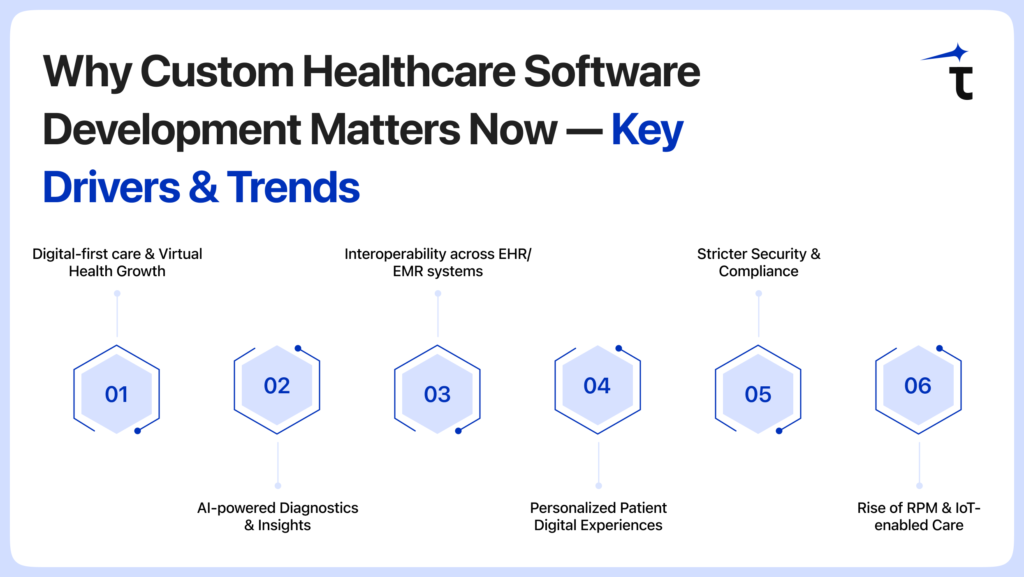
The healthcare sector is rapidly changing due to increased patient expectations and the evolution of digital-first technologies for delivering healthcare services. Healthcare software development has become a focus for hospitals, clinics, health insurance companies, pharmaceutical companies, and Health-Tech start-ups globally.
AI in healthcare development is vital to the digitalization of real-time healthcare delivery, secure sharing of medical data across care providers, improved patient engagement, and efficient operations throughout the continuum of care. Let’s explore the trends that make custom healthcare essential.
- Digital-first care & Virtual Health Growth
Telemedicine has been widely adopted in healthcare today. Telemedicine helps providers transition to technologies that enable remote consultations, e-prescribing, and virtual monitoring through custom healthcare software development.
- AI-powered Diagnostics & Insights
AI-powered clinical tools have increased the clinical accuracy of many health technologies. Through predictive analytics and automated imaging analysis, Custom healthcare providers can provide unprecedented access to intelligent diagnostic capabilities, significantly accelerating time-to-care.
- Interoperability across EHR/EMR systems
Hospitals generally use multiple software applications, including laboratory, pharmacy, and radiology systems, in addition to EHR Systems. Healthcare software development for healthcare providers enables these systems to communicate with one another through interoperability, improving coordination across clinical departments.
- Personalized Patient Digital Experiences
Patients want to access their medical information and schedule appointments at their convenience, and to gain insight into their personal health. With advances in healthcare software development, healthcare companies can create customized patient portals and individualized treatment plans to improve patient engagement and satisfaction.
- Stricter Security & Compliance
Numerous laws and regulations, including HIPAA, GDPR, HL7, and FHIR, govern the healthcare economy. Therefore, when developing a custom healthcare software application, each feature must be secure, encrypted, and compliant with all global healthcare industry data security and compliance requirements.
- Rise of RPM & IoT-enabled Care
Remote Patient Monitoring (RPM) has become a key component of both chronic care and preventive healthcare. Healthcare software development can facilitate the integration of IoT technologies, allowing for continuous monitoring of vital signs, such as heart rate, blood glucose, and blood oxygen levels, which is critical to enabling early intervention when necessary.
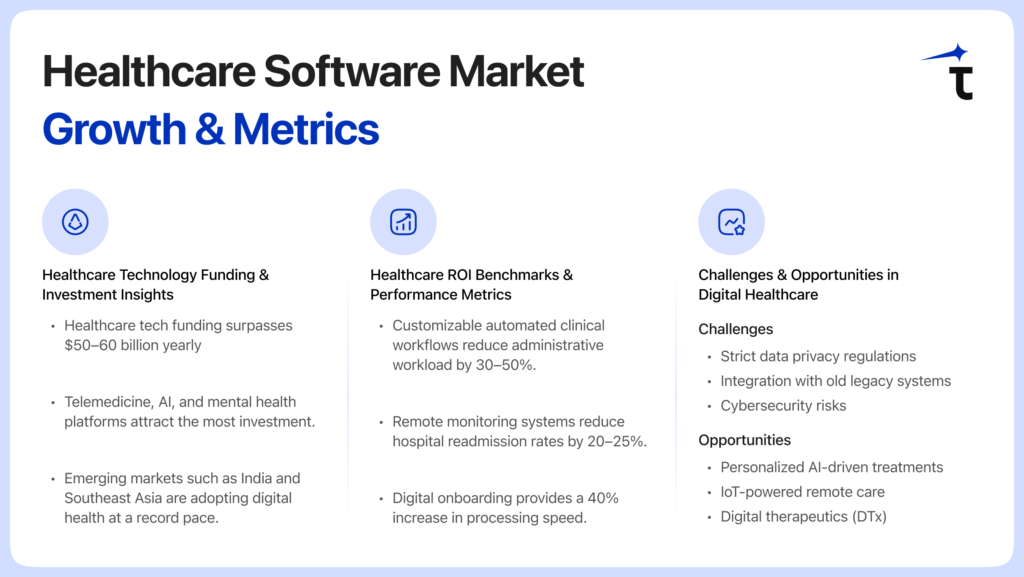
Healthcare Software Market Growth & Metrics
The growth of digital healthcare is accelerating worldwide. Recent research shows that:
- More than 80% of hospitals use digital health technologies.
- Telemedicine use has increased by more than 300% since 2020.
- Over 70% of patients now prefer digital as their primary channel for receiving medical care.
- More than 90% of hospitals in developed economies have implemented Electronic Health Records.
- Healthcare Technology Funding & Investment Insights
Global investment trends highlight the rising confidence in digital healthcare:
- Healthcare tech funding surpasses $50–60 billion yearly.
- Telemedicine, AI, and mental health platforms attract the most investment.
- Emerging markets such as India and Southeast Asia are adopting digital health at a record pace.
Investors clearly see long-term potential in healthcare digitalization, supporting innovations that improve efficiency, reduce costs, and expand access to care.
- Healthcare ROI Benchmarks & Performance Metrics
Healthcare organizations experience high returns on investments with custom digital solutions:
- Customizable automated clinical workflows reduce administrative workload by 30–50%.
- Digital onboarding increases processing speed by 40%.
- Remote monitoring systems reduce hospital readmission rates by 20–25%.
The aforementioned tangible outcomes illustrate why healthcare software development should carefully evaluate and select a development partner that will deliver the best overall long-term return.
- Challenges & Opportunities in Digital Healthcare
Major Challenges
- Strict data privacy regulations
- Integration with old legacy systems
- Cybersecurity risks
- Interoperability issues
- High operational complexity
Exciting Opportunities
- Personalized AI-driven treatments
- Telemedicine expansion into rural areas
- IoT-powered remote care
- Automation to reduce burnout among clinicians
- Global interoperability standards
- Digital therapeutics (DTx)
Benefits of Custom Healthcare Software Development
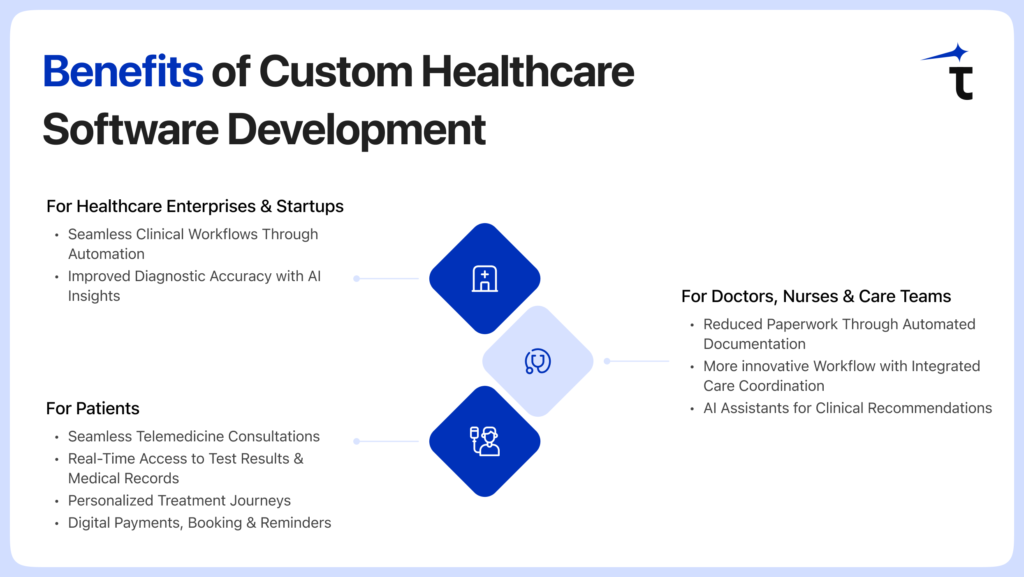
Most medical communities, hospitals, and clinics use healthcare software developers to build purpose-built digital health products. These digital tools will ultimately help healthcare providers deliver faster, more efficient, higher-quality care to their patients through a digitally enabled environment. Any business that wants to remain competitive in the industry must invest in a custom healthcare software platform.
For Healthcare Enterprises & Startups
Custom healthcare software development enables businesses to operate more effectively, deliver better patient care, and build a sustainable digital ecosystem in the healthcare industry.
- Seamless Clinical Workflows Through Automation
Eliminating manual care-delivery processes improves operational speed and accuracy and reduces the time hospitals take to implement necessary operational changes.
- Improved Diagnostic Accuracy with AI Insights
AI-powered analytics enable clinicians to access diagnostic information faster and more accurately, thereby improving overall clinical outcomes.
- Better Resource Utilization & Cost Optimization
Through healthcare software development, healthcare companies may reduce overhead associated with staffing, equipment, and operational processes.
- Scalable Systems Supporting New Modules & Integrations
As a healthcare organization grows, it will continue to use custom-built solutions to integrate telehealth, billing, labs, and pharmacy into its operations.
- Faster Decision-Making Using Real-Time Analytics
The development of real-time dashboards enables administrators and clinicians to make informed decisions.
For Doctors, Nurses & Care Teams
Healthcare software development improves productivity and reduces administrative load for medical teams.
- Reduced Paperwork Through Automated Documentation
Digital workflows reduce manual data entry, allowing providers to focus more on patient care.
- More innovative Workflow with Integrated Care Coordination
Centralized systems enable seamless collaboration between departments and care teams.
- AI Assistants for Clinical Recommendations
Innovative AI tools offer clinical suggestions, improving accuracy and reducing decision fatigue.
- Efficient Appointment, Billing & EMR Handling
Integrated modules simplify scheduling, payments, and EMR management in a single interface.
- Easy Access to Patient History Across Departments
Unified records help doctors quickly review medical history, improving diagnosis and treatment efficiency.
For Patients
Custom healthcare software development enhances the patient experience through convenient, transparent digital access.
- Seamless Telemedicine Consultations
Patients can connect with doctors anytime through secure video consultations.
- Real-Time Access to Test Results & Medical Records
Patient portals offer instant access to lab results, prescriptions, and reports.
- Personalized Treatment Journeys
AI-driven systems create customized care plans based on patient data and health patterns.
- Digital Payments, Booking & Reminders
Easy online payments and automated reminders simplify the entire care journey.
- Faster Support Through Chatbots & Virtual Assistants
24/7 digital assistants provide quick answers, appointment help, and basic medical guidance.
Types of Custom Healthcare Software Solutions
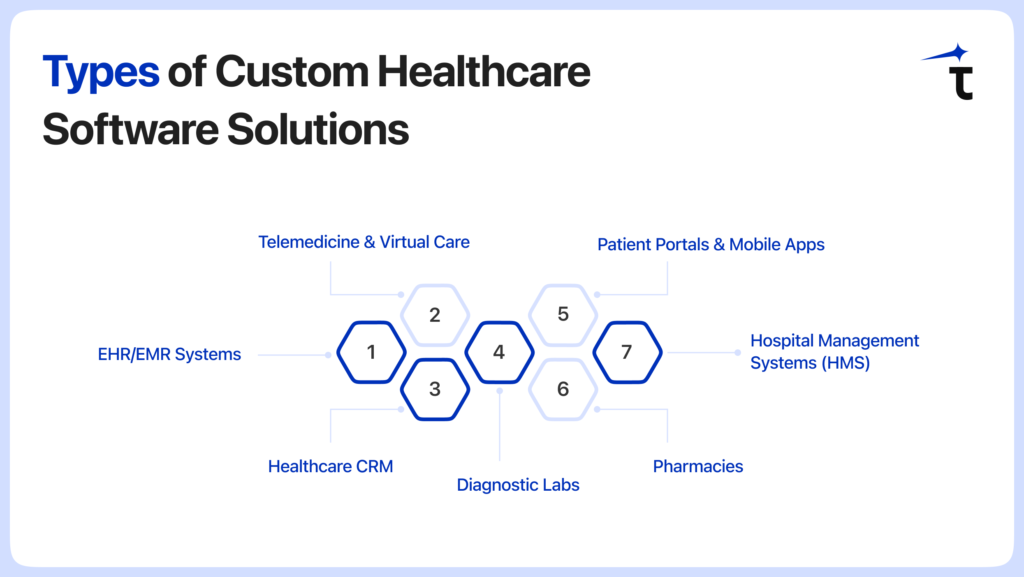
Custom healthcare software development solutions can enable hospitals and clinics to take full advantage of modern technology (e.g., Telemedicine, Electronic Health Records (EHR), Mobile Applications (Apps), Automation, etc.) in a secure, scalable manner that is tailored to fit their specific needs and improve operational efficiency, patient experience, and quality of care.
By Function
- Telemedicine & Virtual Care
Video consultations with a doctor, remote diagnosis, and e-prescription services enable patients to receive care without in-person visits, providing unlimited access to care from anywhere in the world.
- EHR/EMR Systems
EHRs/EMRs enable the centralization and digitization of patient records, reducing documentation duplication, increasing clinical collaboration, and improving patient safety.
- Patient Portals & Mobile Apps
Patients can book appointments, access digital records, order prescriptions, and receive health notifications via mobile apps and patient portals, enhancing patient engagement.
- Healthcare CRM
Healthcare CRM tools include reminders, follow-up, and communication features that improve quality and help maintain strong patient relationships.
- Hospital Management Systems (HMS)
An integrated and centralized solution to manage all hospital operations, including scheduling, wards, inventory, surgery, and billing.
- Billing & Revenue Cycle Management
Automating billing, claims management, coding, and payment processes reduces billing errors and improves financial performance.
By Industry Segment
- Hospitals & Clinics
Hospitals require comprehensive electronic health records and billing systems, as well as a single telemedicine interface.
- Telemedicine Providers
For successful online offerings for Digital-first brands, a custom solution is the best option for video consultations, automated Artificial Intelligence (AI) benefit assessments, and electronic prescriptions, and it provides 24/7 patient monitoring.
- Diagnostic Labs
Labs use software solutions to organize sample calls, manage lab tests, and generate and deliver reports to hospitals.
- Health Insurers
Using specialized, developed solutions helps accelerate claims processing, attribute policy information to individuals, monitor customer service, and potentially prevent fraud.
- Pharmacies
Digital pharmacy solutions track medication inventory, manage order processing, control e-prescribing, organize medication delivery, and maintain medication history.
- Mental Health Platforms
Applications designed for mental health, such as therapy, mood-tracking, internet-enabled therapy, and customized wellness programs, rely on healthcare software development.
- Fitness & Wellness Apps
Fitness and wellness applications help individuals improve their physical fitness and overall health by supporting physical activity and nutrition, developing healthy routines, and synchronizing their devices with wearable technology.
- MedTech/IoT Device Manufacturers
MedTech device manufacturers require custom dashboards and solutions that facilitate device integration, as well as a well-designed data pipeline to enable real-time monitoring and patient support for their intelligent health devices.
Risks & Challenges in Healthcare Software Development
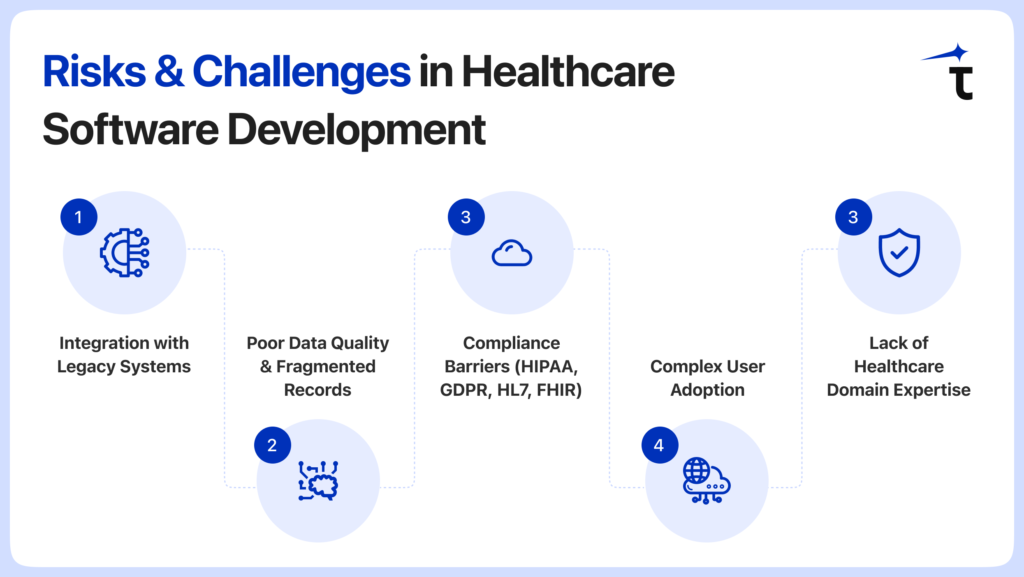
The development of digital healthcare solutions involves more than programming; it also entails navigating heavily regulated environments, fragmented data, legacy systems, and procedures that directly affect patient care. In addition to delivering innovative solutions,custom healthcare software development presents key challenges that developers must address early to succeed.
- Integration with Legacy Systems
Many healthcare providers continue to use aging EHR, radiology, and billing systems that were never designed to integrate with today’s modern API guidelines. Therefore, many of these systems are now inherently slow, expensive, and complex to integrate. Thus, both healthcare providers and developers alike will need to consider interoperability issues.
- Poor Data Quality & Fragmented Records
Data associated with healthcare is frequently found at a variety of locations, creating an incomplete record; hence, solutions must incorporate the processes that need to occur to organize, improve, and connect such data sets for enhanced diagnostic capabilities and comprehensive reporting, i.e., workflow automation.
- Compliance Barriers (HIPAA, GDPR, HL7, FHIR)
To avoid severe legal or financial penalties associated with Software Development, developers must ensure compliant software application architectures, comply with data encryption protocols, and include audit trails within their system endpoints to prevent data security issues.
- Complex User Adoption
Typically, different user types use the same software in various ways. Therefore, if a user finds the software unintuitive, they will have greater difficulty adopting it, which in turn disrupts workflows.
- Lack of Healthcare Domain Expertise
Healthcare software vendors with no medical experience typically create inefficient or non-compliant software systems. For custom healthcare software development to succeed, the healthcare vendor must have a solid understanding of the entire healthcare workflow, operational processes, and regulations.
Step-by-Step Process to Implement Custom Healthcare Software Development
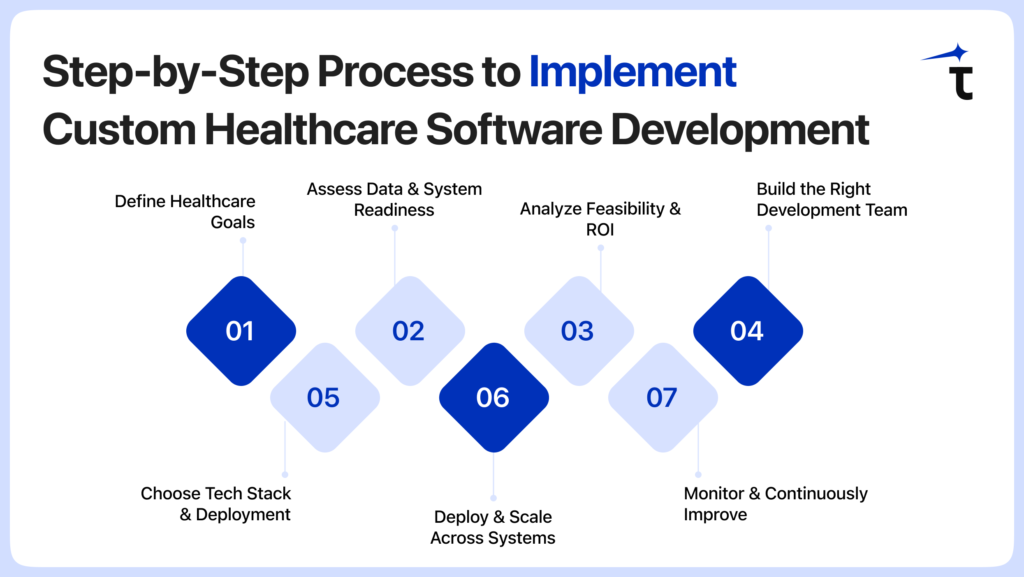
When building custom software for healthcare providers, a solid structure and strategy must be in place to ensure the solution meets the specific needs of clinical operations, adheres to applicable rules and regulations, meets patient needs, and provides a seamless experience for end users.
Below, we describe how healthcare providers can create an effective custom software solution to improve patient care quality and support their operational and financial objectives.
- Define Healthcare Goals
Before commencing, identify the main areas of focus within health care, i.e., improving patient experiences, quicker processing time or increasing accuracy, as this will direct your overall use of technology throughout your Project.
- Assess Data & System Readiness
Assess current assets and data quality, and establish compliance requirements before implementing any new systems to ensure successful integration into existing healthcare providers’ technology infrastructure.
- Analyze Feasibility & ROI
The development of healthcare software should be based on a thoroughly assessed scope of work and a risk-benefit analysis, as will be evident during the analysis stage.
- Build the Right Development Team
Select developers who not only possess superior technical expertise but also understand the nuances of the healthcare industry related to security, compliance, and user experiences.
- Choose Tech Stack & Deployment
Select technology stack and deployment model, i.e., the cloud, on-premise, or Hybrid Model for scalability, future integration, and long-term resilience.
- Deploy & Scale Across Systems
Roll out the solution across departments and connect it with EHRs, billing, labs, and patient apps without disrupting workflows.
- Monitor & Continuously Improve
Track performance, fix issues, and update features regularly to keep the system secure, efficient, and aligned with evolving care needs.
Best Practices for Successful Healthcare Software Development
The development of successful healthcare software depends on careful strategy, high-quality data, and skilled collaboration among team members. By adhering to successful practices such as focusing on start-up costs versus returns, ensuring ethical AI, and creating an atmosphere conducive to genuine partnership, one can contribute to building secure, scalable, and efficient healthcare solutions.
- Start Small, Scale Smart
Start with a core feature to reduce risk and validate your workflow. Once that is working well, strategically build on your solution to improve your overall healthcare software development process.
- Keep ROI as the Anchor
Only invest in healthcare software development projects that deliver measurable returns, improved workflows, fewer errors, and better patient experiences.
- Ensure Ethical & Clear AI Use
Integrate AI into your processes in an ethical, unbiased manner that complies with regulations. Using AI ethically builds trust in your healthcare software development strategy.
- Strengthen Data Quality & Governance\
Having high-quality, reliable, securely governed data ensures you can obtain accurate insights, comply with regulations, and scale your healthcare software development process smoothly.
- Enable Team Collaboration & Upskilling
Collaboration across functional areas and continuous education of team members improve alignment between healthcare software development efforts and real-world clinical needs.
Emerging AI Trends & Technologies in Healthcare Software Development
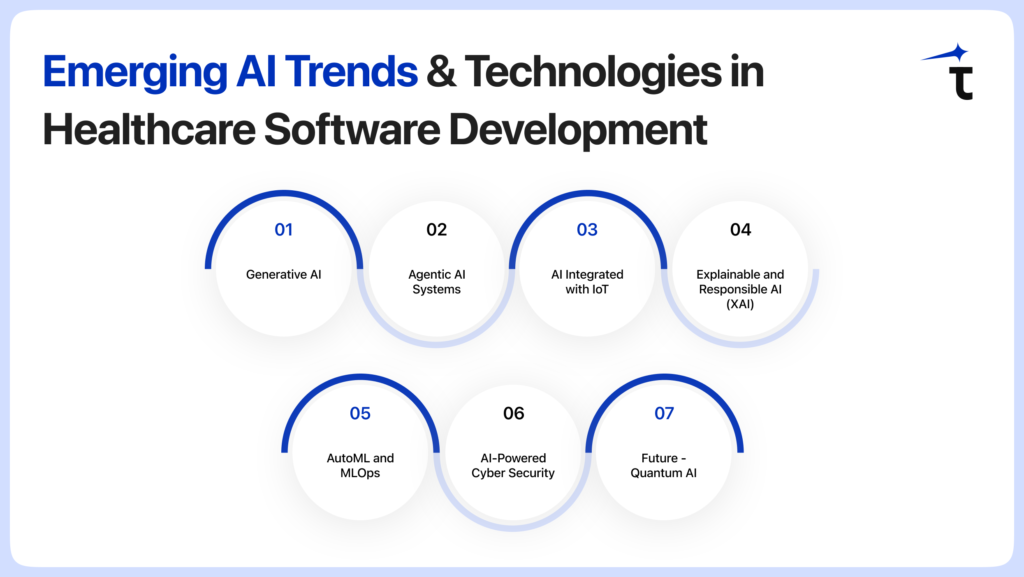
Robust AI technologies are advancing healthcare by automating tasks, providing additional resources to improve patient outcomes, and streamlining operational processes. Here are some of the primary emerging trends associated with utilizing AI in healthcare software development :
- Generative AI
Using generative AI (GAI) to automate administrative processes such as the generation of clinical documentation, assisting with the analysis of medical imaging data, etc., will decrease the time a program has to spend generating documentation, completing tasks, and documenting treatment.
- Agentic AI Systems
Agentic AI systems are a type of artificial intelligence that will perform Triage, personalized treatment recommendations, and treatment workflow optimization for physicians and hospitals.
- AI Integrated with IoT
The integration of IoT devices and AI systems through wearables, sensors, and connected medical equipment will enable real-time patient monitoring and proactive healthcare plans.
- Explainable and Responsible AI (XAI)
In healthcare, recommendations from AI Systems must be transparent and interpretable.
- AutoML and MLOps
Automated model building and deployment enable predictive analytics on diseases and hospital resources to optimize resource allocation.
- AI-Powered Cyber Security
As healthcare organizations rely more on AI, AI-powered cybersecurity is becoming essential to protect patient data.
- Future – Quantum AI
The potential impact of combining quantum computing and AI on healthcare includes Drug Discovery, Genomics, and Complex Medical Simulations.
Resource Estimation in Healthcare Software Development
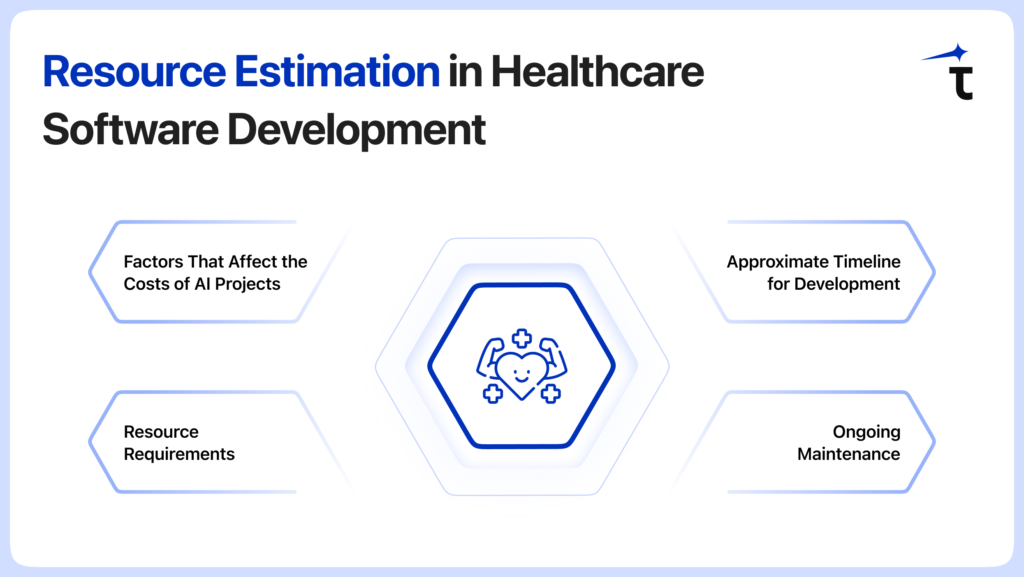
Developing AI-based healthcare software requires proper planning and management to achieve the desired return on investment (ROI) and support successful implementation.
- Factors That Affect the Costs of AI Projects
The total cost of an AI project will primarily depend on the project scope, the volume and quality of healthcare data used, the complexity of the AI model, and the degree of integration.
- Resource Requirements
AI-based health care solutions require a combination of data scientists, machine learning engineers, software developers, and subject-matter experts (SMEs) in the health care domain to develop solutions that are clinically accurate and compliant.
- Approximate Timeline for Development
Designing health-care solutions will require a phased approach, typically comprising proof of concept (PoC), pilot, and full-scale implementation. The duration of each phase will vary based on project complexity and regulatory requirements.
- Ongoing Maintenance
Ongoing expenses can include software upgrades, ongoing machine-learning retraining based on new patient data, electronic health record (EHR) 74, cybersecurity monitoring and support, and additional scaling to support expanded departments or facilities.
How to Choose the Right Development Partner for Custom Healthcare Software
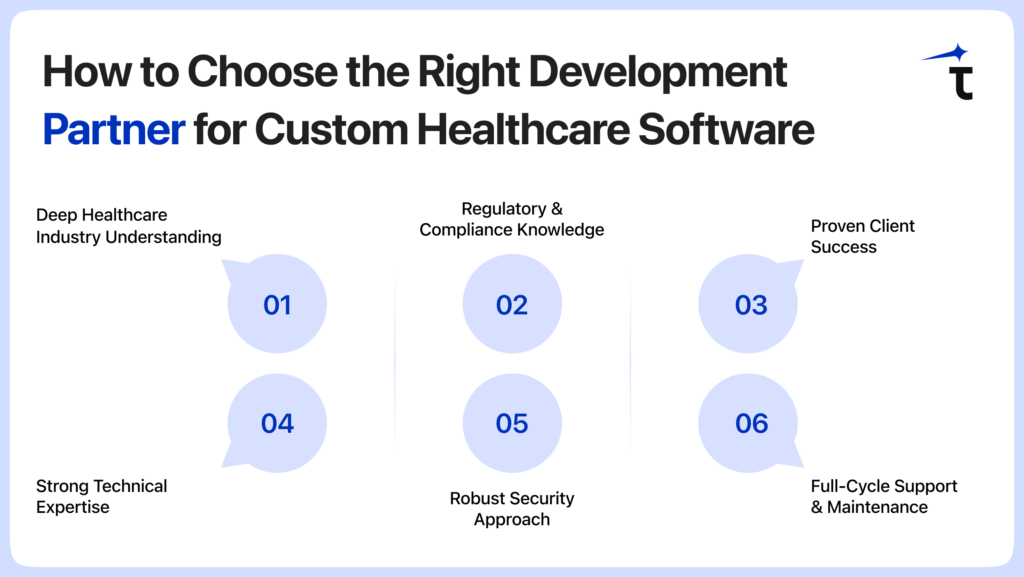
Consider the following six attributes to select only the ideal custom healthcare software development provider for your organization.
- Deep Healthcare Industry Understanding
Choose a partner with prior experience working in hospitals, clinics, and health technology. Knowledge of clinical workflows, regulatory requirements, and interoperability will ensure the custom-developed healthcare software meets real-world industry requirements.
- Strong Technical Expertise
Choose a vendor who has demonstrated competence in the technical aspects of EHR integration, HL7/FHIR, AI/ML, telemedicine, and secure cloud systems. A solid technical foundation will ensure that your custom-developed healthcare software is scalable and ready for future developments.
- Regulatory & Compliance Knowledge
Your vendor partner for custom healthcare software development must have comprehensive knowledge of HIPAA, GDPR, FDA, and regional healthcare regulations. Compliance will safeguard patient data and ensure your organization’s compliance with the custom healthcare software developed.
- Robust Security Approach
Verify that the vendor adheres to best practices for securing sensitive healthcare records, including strong encryption, secure APIs, role-based access controls, and continuous threat monitoring.
- Proven Client Success
Conduct due diligence by reviewing case studies, customer testimonials, and project histories. This will provide insight into the vendor’s competency, communication capabilities, and reliability in delivering custom-developed healthcare software.
- Full-Cycle Support & Maintenance
Select a vendor for custom healthcare software development that provides ongoing maintenance, bug fixes, security patches, and optimization. Ongoing support will ensure that your software remains secure and compliant while continuing to address the evolving needs of the healthcare industry.
Final Thoughts
Custom healthcare software development plays a critical role in this shift to digital. Digital healthcare, including telehealth and AI-based insights, is being funded to develop custom solutions that help healthcare providers improve efficiency, enhance patient experiences, and comply with evolving regulations.
To select a custom software development partner, look for a partner with technical expertise, healthcare industry knowledge, and a strong commitment to protecting patient information. The custom healthcare software your partner provides must be scalable, secure, and future-proof.
FAQs
1. What is custom healthcare software development?
Custom healthcare software development involves building tailored digital solutions like telemedicine apps, EHR systems, and patient portals designed to fit the specific workflows, compliance needs, and operational goals of healthcare organizations.
2. How is custom healthcare software better than ready-made solutions?
Custom software aligns perfectly with your clinical workflows, integrates with your existing systems, ensures better security, and offers long-term scalability, unlike generic off-the-shelf tools that may have limited flexibility.
3. What features are included in a telemedicine platform?
Standard telemedicine features include video consultations, appointment scheduling, digital prescriptions, real-time chat, remote monitoring, payment processing, and secure patient data management.
4. What does an EHR system typically include?
EHR systems typically support patient records, clinical notes, e-prescriptions, lab integrations, appointment management, billing, analytics, and interoperability via HL7/FHIR standards.
5. How do patient portals improve care delivery?
Patient portals help patients access test results, schedule appointments, view medical history, communicate with providers, and manage their health more proactively—leading to higher engagement and better outcomes.
6. Are custom healthcare solutions HIPAA-compliant?
Yes, all custom healthcare software is designed to be fully HIPAA-compliant with secure authentication, data encryption, access control, and audit logs.
7. How long does it take to build telemedicine, EHR, or patient portal software?
Timelines vary depending on complexity, but most projects fall between:
- Telemedicine app: 8–16 weeks
- Patient portal: 10–20 weeks
- Custom EHR system: 4–9 months
8. How much does custom healthcare software development cost?
Costs depend on features, integrations, and security requirements:
- Telemedicine apps: Starting from mid-range budgets
- Patient portals: Moderate budget range
- EHR systems: Higher investment due to complexity
Exact pricing is determined after requirement analysis.
9. Do you offer post-launch support and maintenance?
Absolutely. Support includes bug fixes, upgrades, compliance updates, security enhancements, performance optimization, and feature improvements.
10. Can AI be integrated into telemedicine or EHR solutions?
Yes, AI features like symptom checkers, automated triage, predictive analytics, voice-to-text clinical notes, and personalized care recommendations can be integrated to enhance efficiency and accuracy.