Today’s changing domain and the urgency to meet rising delivery expectations, global disruptions, and the lack of real-time data are driving a dramatic shift toward leveraging Digital technologies in logistics and supply chain management. Traditional methods can no longer meet all demands in logistics and supply chain management; therefore, enterprises are implementing more innovative route-optimization and inventory-management solutions.
AI is the primary driver of this global change. By analyzing traffic, demand, and warehouse data, and by laser-focusing on operational constraints in real time, AI will help businesses eliminate delays, reduce transport and labour costs, minimize stockouts, and optimize each step of the supply chain.
The continued growth of the market indicates that the logistics software development market will exceed $25 billion by 2030, and route-optimization tools will grow at a 15% CAGR. Companies that have adopted AI solutions will see 30% to 50% reductions in logistics inefficiencies, potentially leading to a 40% reduction in warehousing operating expenditures.
If you want clarity on how tech-driven logistics solutions are transforming the supply chain, you’re in the right place. Read on to learn everything in a simple, structured way!
Key Takeaways:
- Innovative logistics systems have become a key driver of efficiency across a company’s supply chain management by automating route planning, inventory management, and day-to-day operations.
- AI-powered technology enables businesses to optimize delivery routes, saving time and money by reducing fuel consumption.
- With real-time inventory tracking, businesses can take steps to avoid stockouts, overstock, and delayed shipments, thereby maintaining supply chain integrity.
- These integrated systems provide companies with enhanced visibility into their warehouse operations, enabling them to make informed, timely decisions.
- Emerging technologies, such as IoT and AI, will drive the future of logistics. It will use these technologies through automated alert systems, predictive analytics, and continuous real-time data collection.
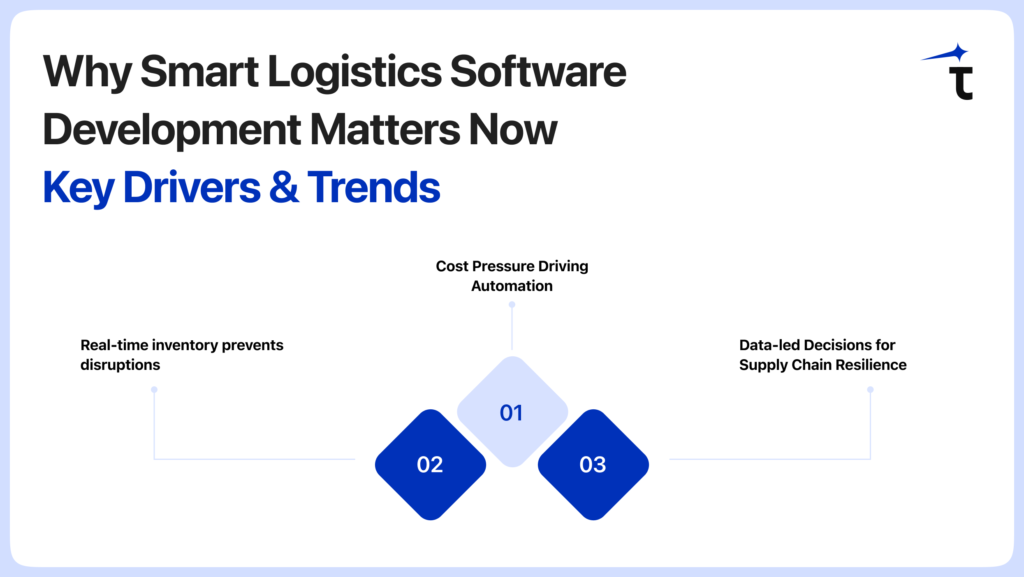
Why Smart Logistics Software Development Matters Now — Key Drivers & Trends
As customer service speeds and operational costs skyrocket, logistics software development is now a necessity for businesses. With real-time visibility, automation, and actionable intelligence, companies have the tools to compete in today’s domain as logistics continues to evolve.
Let’s review some trends that explain why companies are adopting it early to gain an advantage.
- Need for Real-Time Visibility & Faster Delivery
Innovative logistics software enables organisations to achieve real-time visibility across their entire fleet and all shipments, thereby minimising transit times, maximising route efficiency, and reducing the time it takes for goods to reach customers.
- Cost Pressure Driving Automation
By automating many aspects of logistics software development, including route planning, digital documentation, and more, logistics teams can eliminate manual processes, reducing error rates and overall Logistics costs.
- Data-led Decisions for Supply Chain Resilience
With many organisations facing uncertainty about demand for their products due to recent Global Disruptions, they must now be more strategic in their supply chain decisions. AI- and analytics-driven logistics systems help logistics teams improve forecasting and enhance supply chain resilience.
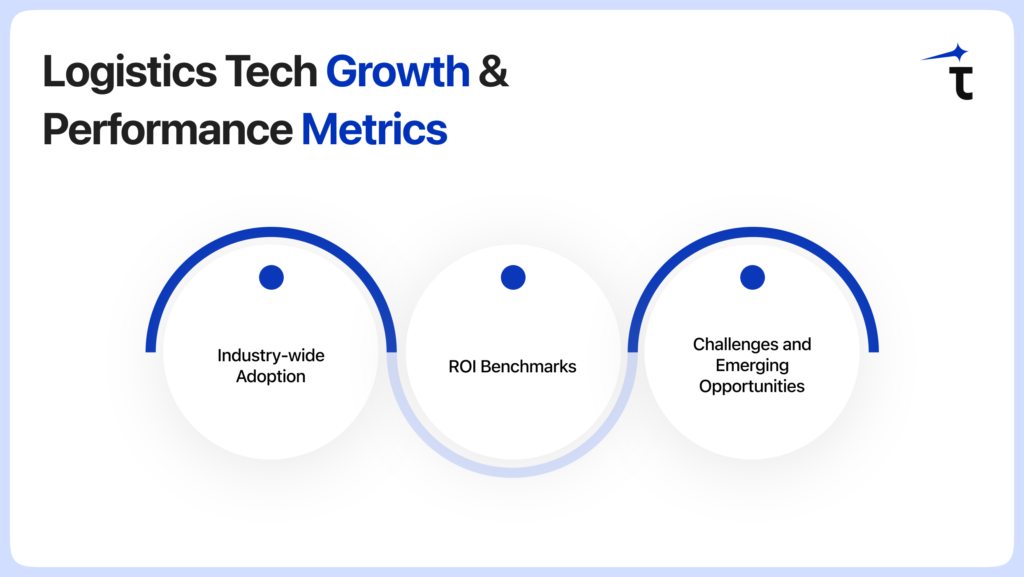
Logistics Tech Growth & Performance Metrics
Due to globalization and demand for global trade, companies need to invest in logistics software and supply chain management tools more quickly than ever to remain competitive. In retail, manufacturing, distribution, and transportation, businesses have adopted digital platforms to enhance speed, accuracy, visibility, and decision-making confidence.
- Industry-wide Adoption
Growingly, businesses are embracing automated routing and warehouse automation technologies and connecting them to their fleets to provide real-time visibility and control.
- ROI Benchmarks
Businesses have achieved significant ROI by using automated routing and digital platforms to streamline operations, reduce fuel consumption, improve delivery efficiency, and enhance the customer experience.
- Challenges and Emerging Opportunities
The use of IoT technology to improve supply chain visibility, and the use of predictive analytics tools to build a more intelligent and resilient supply chain.
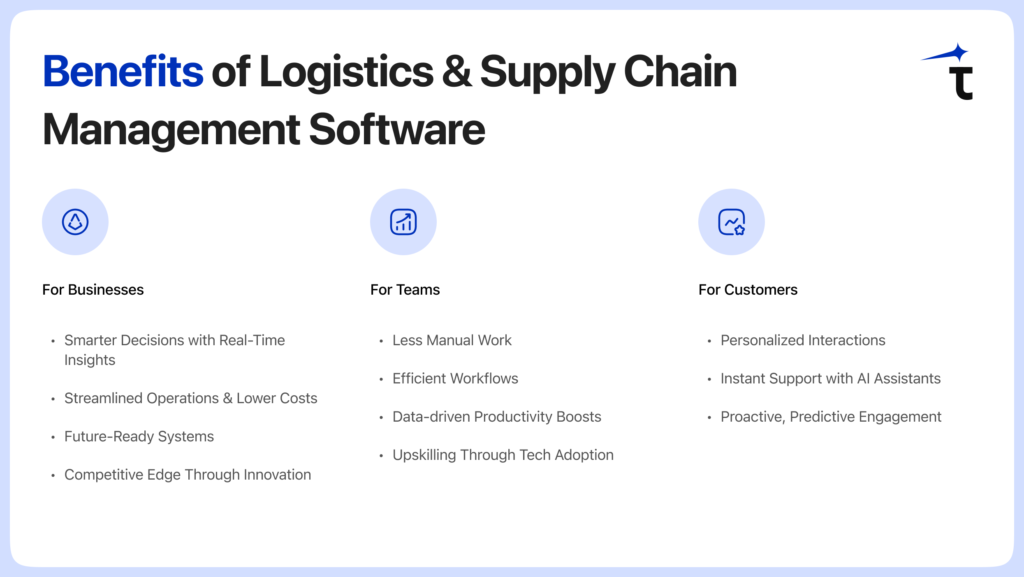
Benefits of Logistics & Supply Chain Management Software
Logistics, supply chain, and inventory management software are critical to streamlining operations through technology, reducing operational costs, enabling more informed data-driven decisions, and positioning companies for future change.
Here, we will examine the significant benefits of implementing logistics software for a business and its employees.
For Businesses
- Smarter Decisions with Real-Time Insights
Having access to real-time fleet, warehouse, and inventory information allows you to make quicker, more accurate decisions and improve overall operational efficiency.
- Streamlined Operations & Lower Costs
Automating route planning, stock management, and order entry reduces labour costs, decreases manual errors, and increases the efficiency of product delivery.
- Future-Ready Systems
Scalable software solutions that grow with your company’s needs will also enable you to adopt emerging technologies, such as artificial intelligence, the Internet of Things, and predictive analytics.
- Competitive Edge Through Innovation
Businesses that utilise modern supply chain management software and logistics software will gain a technological advantage over competitors, leading to higher customer satisfaction and greater market responsiveness.
For Teams
- Less Manual Work
Manual work reduces automation, reducing the number of tasks that must be completed repeatedly. This frees teams from repetitive tasks, allowing them to focus on future planning.
- Efficient Workflows
Integrated platforms provide a seamless, easy way to collaborate across the organization. This eliminates the need to wait on one another and reduces the possibility of errors.
- Data-driven Productivity Boosts
Analytics and reporting capabilities enable teams to make informed decisions about resource optimization and improve productivity.
- Upskilling Through Tech Adoption
Teams may use modern tools, incorporate AI into decision-making, and apply digital methods to build experience and prepare for future supply chain management software.
For Customers
- Personalized Interactions
Customized recommendations and more innovative touchpoints make every experience feel customized.
- Instant Support with AI Assistants
Chatbots and virtual agents deliver fast, 24/7 responses without waiting.
- Proactive, Predictive Engagement
Systems anticipate needs, resolve issues early, and keep customers informed before problems arise.
Types of AI Solutions for Modern Businesses
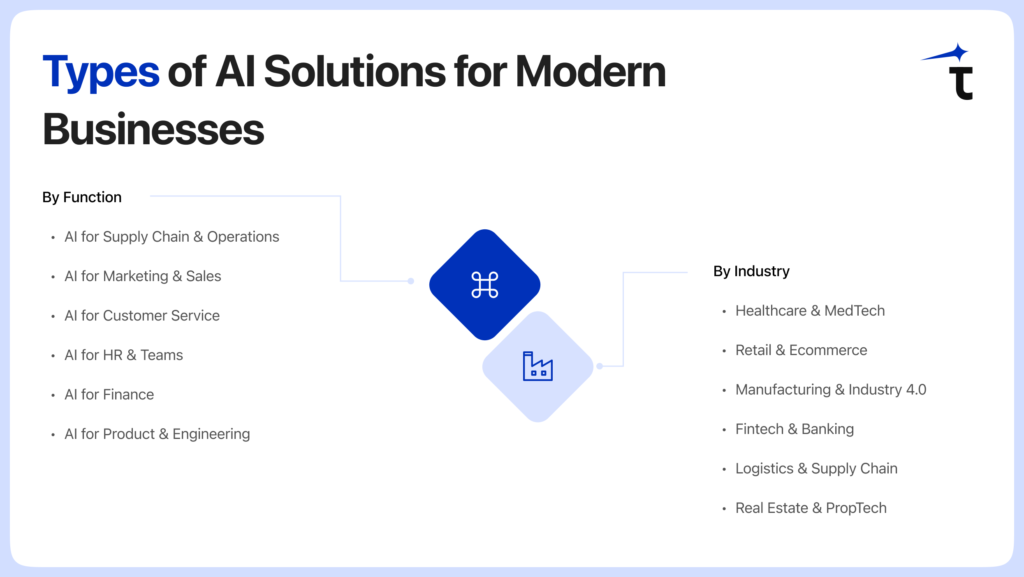
By Function
- AI for Supply Chain & Operations
Artificial Intelligence enhances traditional management by leveraging capabilities. By integrating with existing supply chain management software, artificial intelligence can eliminate bottlenecks, reduce stockouts, and improve visibility across the supply chain.
- AI for Marketing & Sales
AI enables organizations to target customers more effectively, deliver a higher level of personalized service, and identify those likely to purchase. Organizations can utilize predictive analytics and recommendation engines to generate additional revenue with minimal effort.
- AI for Customer Service
Chatbots, robotic agents, and other automated tools provide 24/7 customer service, minimize wait times, and improve service quality, resulting in a more seamless customer experience.
- AI for HR & Teams
AI helps organizations expedite the hiring process, monitors employee performance, and forecasts staffing requirements. HR agencies can make informed hiring decisions utilizing a data-driven approach.
- AI for Finance
AI integrates all back-office functions to automate payroll and minimize risk by increasing accuracy and reducing overhead.
- AI for Product & Engineering
AI enables designers and product engineers to use automated testing and defect-detection systems, enabling them to create better products more quickly.
By Industry
- Healthcare & MedTech
AI helps healthcare providers deliver faster, more accurate diagnoses and patient monitoring, while streamlining operations to provide care more efficiently.
- Retail & Ecommerce
Retailers use AI to enhance their customers’ shopping experience by providing personalized product recommendations, improving sales forecasting, and managing inventory.
- Manufacturing & Industry 4.0
AI is a key component of Industry 4.0, powering predictive maintenance, automated inspection, and production optimization to drive higher production rates and improved productivity.
- Fintech & Banking
AI enables greater fraud detection, more accurate risk assessment and scoring, improved automation, and deeper insights into the customer experience in the financial services industry, leading to faster, safer transactional processes.
- Logistics & Supply Chain
The combination of AI and supply chain management software enhances supply chain visibility, minimizes shipment delays, and reduces operating expenses.
- Real Estate & PropTech
AI is revolutionizing how we manage buildings by enabling innovative building automation, property management, and predictive maintenance technologies that enhance the tenant experience and increase property value.
- EdTech & Learning Platforms
AI is enhancing educational practice by enabling personalized learning experiences, automating assessments, and providing access to virtual tutors.
- Energy & Utilities
AI has enhanced the reliability of the electrical grid, improving demand forecasting accuracy and optimising energy use, leading to significant reductions in waste and risk associated with facility operations.
Key Challenges in AI Adoption for Modern Systems & Supply Chain Management Software
Understanding the challenges is the first step toward successful AI implementation and optimized logistics and supply chain operations. So let’s dive into that.
- Unclear Goals & ROI
Many organisations are implementing artificial intelligence in their operations without first establishing an overall strategy and clear, measurable return-on-investment objectives. Failure to define these goals will likely limit the potential benefits of AI-related projects.
- Data Quality Issues
Artificial intelligence requires large amounts of structured, already-sorted data to learn and make informed recommendations for its users. If data in a company’s supply chain management system and other systems is unorganised, incomplete, or inconsistent, it will lead to poorly automated operations.
- Compliance & Privacy Risks
There are various industries, such as healthcare and financial services, that operate under strict regulations. If a company does not take appropriate steps to develop its AI models in accordance with these rules, it could jeopardise customer data.
- Bias & Transparency Gaps
Because AI models are trained using specific methods, their decisions may not always be reliable. When stakeholders using supply chain management software cannot fully understand how, why, or when an AI-generated output was produced, their trust in the underlying processes will likely diminish.
- Legacy System Integration
When attempting to incorporate AI capabilities into legacy systems, the process can be complex. Older generations of supply chain management applications typically lack AI, delaying the adoption of the new technology and increasing overall costs.
- Talent & Skill Shortages
Implementing artificial intelligence applications requires expertise not only from those capable of creating and using them, but also from those who understand the areas where they are being deployed. Without such individuals, the overall development timeline for an AI project may be extended, reducing the benefits of AI-enabledsupply chain management software.
Step-by-Step Guide to Implementing AI in Logistics & Business
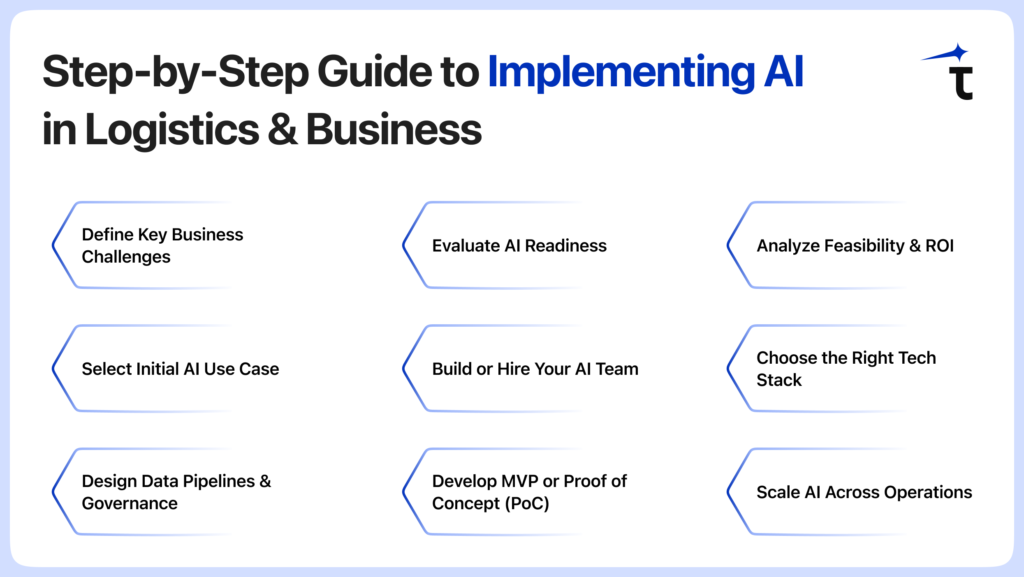
The combination of AI with logistics, supply chain, and inventory management software has the potential not only to improve operational efficiency but also to reduce costs and enhance decision-making capabilities.
Here is an example of a sequential methodology to successfully implement AI within Logistics and business operations:
- Define Key Business Challenges
Identify operational bottlenecks, delays, and inefficient processes within your supply chain or inventory. Having a well-defined problem description will help identify how AI can most effectively support a solution while integrating with supply chain management.
- Evaluate AI Readiness
You should assess your data quality, data infrastructure, and your team members’ capabilities and skills. By evaluating your organization’s current state to determine where to deploy AI, you can deploy it within logistics software development projects.
- Analyze Feasibility & ROI
By estimating your costs, potential benefits, and expected returns for AI initiatives and aligning them with your business strategies, you can prioritize the AI software initiatives that will deliver the most significant, measurable impact.
- Select Initial AI Use Case
You should develop an AI Use case that contains a defined initial goal, such as Predictive routing, Inventory Forecasting, or Warehouse Automation, before expanding AI Use Cases across all Operations.
- Build or Hire Your AI Team
Internal expertise or partnering with experts in logistics software development will provide the technological and subject-matter expertise needed to easily access AI.
- Choose the Right Tech Stack
Select from cloud, hybrid, or on-premise platform capabilities for AI Model implementation. Also, ensure that the selected solution is compatible with supply chain management and inventory management to enable straightforward integration.
- Design Data Pipelines & Governance
Create a reliable, secure, and compliant pipeline structure for all AI data. Having data appropriately governed will enable accurate AI prediction and full regulatory compliance for logistics & inventory business process sourcing.
- Develop MVP or Proof of Concept (PoC)
To thoroughly vet AI’s functionality and its impact on operations and decision-making, create a prototype using the logistics software development toolset.
- Scale AI Across Operations
By integrating AI with supply chain and inventory management software, you will optimise routes, improve demand forecasting, and increase overall efficiency across your business operations.
Best Practices for Effective AI in Logistics & Supply Chain
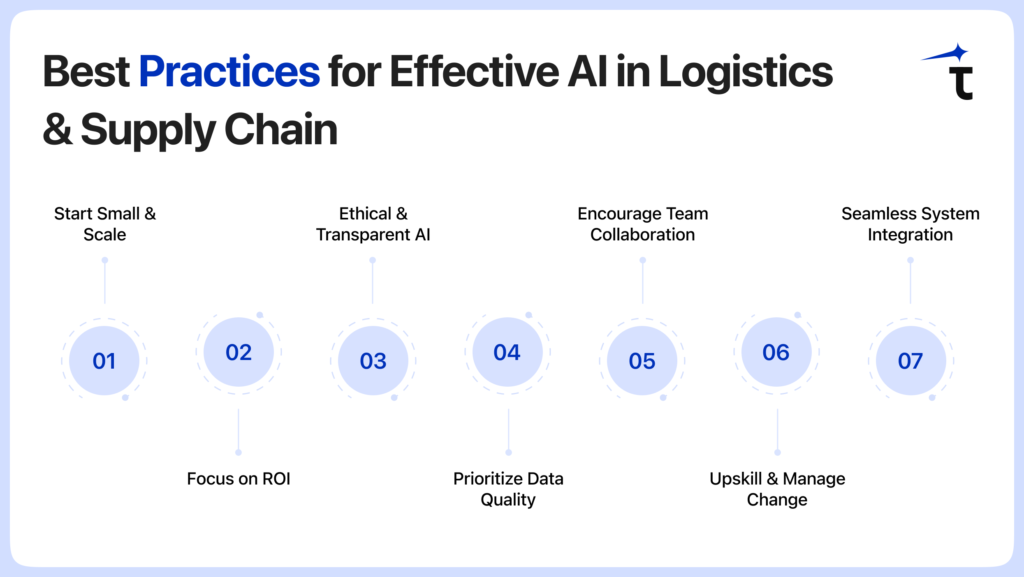
AI is changing logistics and supply chain operations, driving more intelligent decision-making, faster deliveries, and optimized inventory management. However, successful implementation requires more than technology; it requires strategic planning with systems such as logistics and supply chain management software.
By following best practices, enterprises can maximize AI’s impact, improve operational efficiency, and gain an advantage in a rapidly growing industry.
- Start Small & Scale
Begin with focused AI pilot projects, such as predictive routing or inventory forecasting, within your logistics software development or supply chain management systems. Scaling gradually ensures measurable results and minimizes disruption.
- Focus on ROI
Whether optimizing warehouse operations, fleet management, or inventory, aligning AI with ROI ensures your supply chain management investments are cost-effective and performance-driven.
- Ethical & Transparent AI
Ensure all AI models are explainable, fair, and compliant with applicable industry regulations. Using transparent AI promotes trust between teams and stakeholders and protects sensitive operational and customer data.
- Prioritize Data Quality
Clean, structured, and accurate data are critical to the success of any AI solution. Using quality data in your logistics software development and supply chain management system will improve your predictive capabilities and the quality of your routing and inventory management.
- Encourage Team Collaboration
By working closely with all stakeholders in developing AI solutions, organizations can ensure those solutions meet business needs and are successfully used to increase productivity and efficiency across their supply chains.
- Upskill & Manage Change
Investing in employee training on AI-based tools and adapting to alternative approaches can significantly accelerate the adoption of available AI-based logistics software development solutions by providing effective means to manage changes driven by technological advancements.
- Seamless System Integration
To achieve maximum results with AI across logistics operations, companies must enhance their use of AI tools by ensuring they integrate seamlessly with their existing cloud-based supply chain management, or risk operational difficulties from poorly integrated hardware.
Emerging AI Trends & Technologies in Logistics & Supply Chain
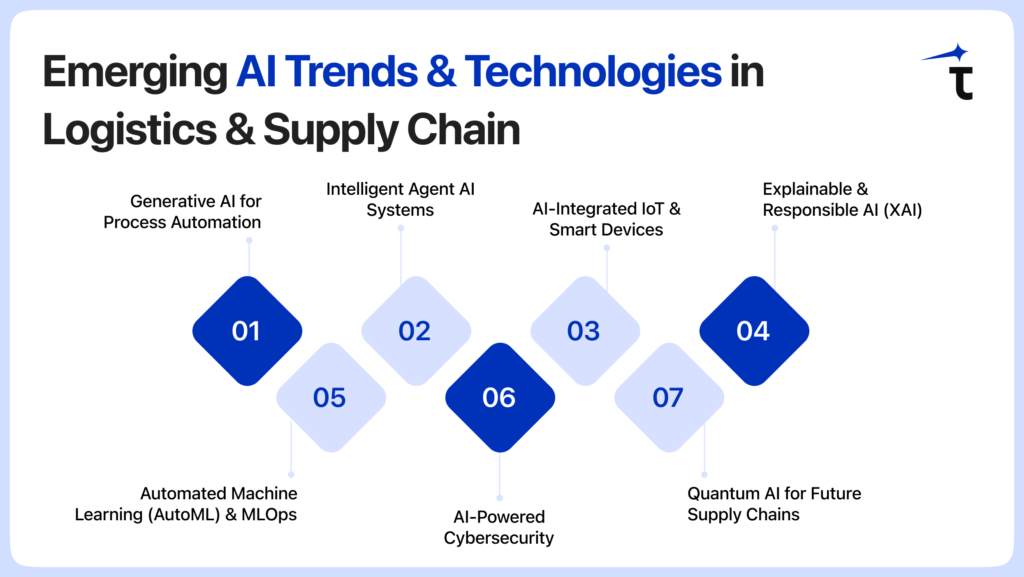
Staying up to date on emerging AI trends is paramount for enterprises aiming to maintain their position in today’s supply chain management software domain.
- Generative AI for Process Automation
Generative AI processes can be enhanced by integrating with an AI system (e.g., route generation). When combined with generative AI, you will achieve optimal routing for your shipments and reduce manual effort in logistics.
- Intelligent Agent AI Systems
An autonomous AI agent’s capabilities extend beyond inventory control and shipment coordination, and it optimizes supply chain workflows with less human interaction than other AI agents.
- AI-Integrated IoT & Smart Devices
By using IoT sensors and devices connected via the Internet of Things (IoT), logistics managers can receive real-time updates on their fleet’s current state, warehouse conditions, and inventory levels.
- Explainable & Responsible AI (XAI)
While we want to create AI systems that can explain themselves, we also want to ensure they remain responsible and ethical. Thus, our ability to develop explainable, accountable AI systems is critical to the logistics industry and the delivery of quality goods.
- Automated Machine Learning (AutoML) & MLOps
With Automated Machine Learning (AutoML) and MLOps, you can streamline model building, deployment, and monitoring to efficiently scale AI success across all operational areas.
- AI-Powered Cybersecurity
By using AI Solutions for cybersecurity, advanced AI will help determine anomalies in the supply chain and protect sensitive data. Additionally, AI secures logistics systems from cyber-attack.
- Quantum AI for Future Supply Chains
As a new approach for many of tomorrow’s supply chains, we expect to deliver sophisticated logistics optimisation capabilities through Quantum Computers integrated with AI. The combination of QC AI creates new opportunities to build highly effective simulations of any logistics route.
Timeline & Resource Planning for AI in Logistics & Supply Chain
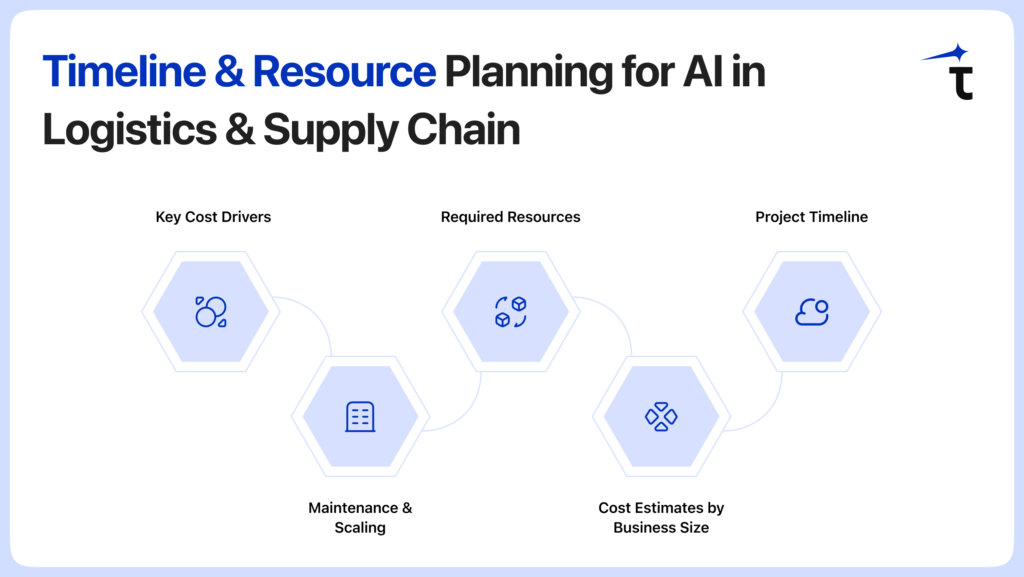
When implementing AI in logistics software development and supply chain operations, it is essential to prioritize time and resource planning. The timeline, resource requirements, and scale needs must be understood to maximise and leverage the potential of AI in the supply chain.
- Key Cost Drivers
Several factors, including project scope, data requirements, model complexity, and integration with logistics software development or supply chain management systems, influence the cost of AI projects.
- Required Resources
To successfully employ Artificial Intelligence in supply chain operations, you will need a combination of technical skills from data scientists and machine learning engineers, as well as supply chain management expertise, to configure the solution for the business.
- Project Timeline
The implementation timeline for AI Projects generally follows a three-phase approach: Proof of Concept (PoC), Pilot, and Full deployment. However, the timeframes depend heavily on the project’s complexity and the ease with which AI can be integrated into the rest of the business systems.
- Maintenance & Scaling
Ongoing expenses for maintaining and expanding AI include upgrading the AI System, Addressing Cybersecurity concerns, and the cost of rolling out AI to additional companies and facilities.
- Cost Estimates by Business Size
Investment levels vary based on the scope of the AI project, the size of the supply chain network, and the number of systems that need to be integrated in a small business, an enterprise, or a startup.
How to Select the Ideal AI Partner for Logistics & Supply Chain Management Software
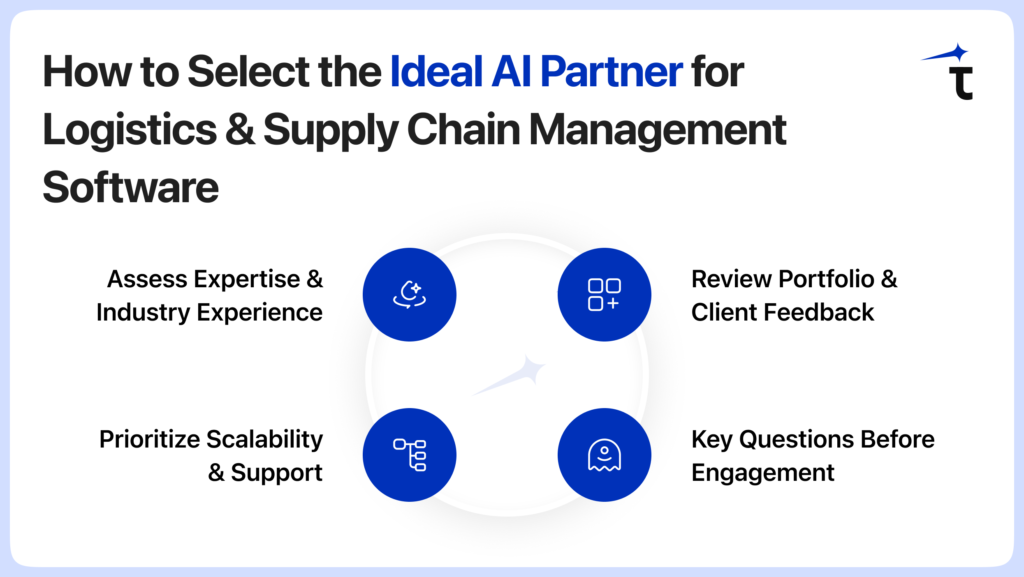
Finding an AI supplier that meets your needs is critical to achieving optimal outcomes with logistics solutions and to realizing a strong return on investment from implementing AI-enabled supply chain management software and logistics operations. Let’s look at pointers for selecting the right partner for overall logistics operations.
- Assess Expertise & Industry Experience
The most effective way to determine if your prospective AI suppliers are a good fit for your company is to conduct thorough evaluations of their capabilities, experience, and expertise. This includes evaluating the potential AI partner’s technical capabilities and skills to determine whether they have the expertise to deliver AI solutions.
- Review Portfolio & Client Feedback
To best assess a partner’s reliability and ability to deliver quality work, review their prior projects/case studies, as well as client testimonials. A proven track record of success with AI-driven logistics and supply chain projects is an excellent indicator of the partner’s level of expertise.
- Prioritize Scalability & Support
Your AI partner should continue to provide maintenance and scalability as your business grows, and offer seamless integration with your current supply chain management and inventory management software to maximize operational effectiveness.
- Key Questions Before Engagement
You should inquire about the AI partner’s process for deploying their AI models, data governance practices, integration with your current systems and processes, and their plan for keeping their solutions up to date.
Transform Your Logistics & Supply Chain with TechnoYuga
Our solutions provide companies with tools to improve supply chain performance through enhanced route optimization, warehouse management, and predictive analytics, as well as to automate inventory processes.
By leveraging IoT monitoring systems, tech-enabled solutions such as predictive AI, and end-to-end system integration, TechnoYuga enables logistics providers, e-commerce businesses, and large enterprises to innovate faster than ever and gain a significant competitive advantage in the marketplace.
When you’re ready to take your supply chain processes to the next level, TechnoYuga is the ideal partner.
Final Thoughts
AI is transforming logistics and supply chain management software by providing increased insight for better decision-making, faster delivery times, and improved inventory management. Companies that take a strategic approach to developing AI-enabled logistics, supply chain, and inventory management software will benefit from greater efficiency, scalability, and competitive advantage over time.
The future of business will belong to companies that are intelligent enough to use AI to forecast their needs, automate their processes, and enhance their overall organizational resilience. Therefore, it is critical for individuals in leadership roles to clearly define their objectives and follow best practices for AI implementation. Companies should also partner with an AI development firm with proven experience to fully realize the potential of AI in the ongoing development of their supply chains.
FAQs
1. What is logistics software development?
Logistics software development involves creating digital tools to optimize fleets, manage routes, track shipments, and enhance overall supply chain efficiency.
2. How does AI enhance supply chain management software?
AI improves supply chain management software by enabling predictive analytics, demand forecasting, inventory optimization, and more intelligent decision-making.
3. What are the benefits of inventory management software?
Inventory management software helps track stock levels, predict demand, reduce errors, optimize warehouse operations, and cut costs.
4. How can businesses start implementing AI in logistics?
Businesses can begin by integrating AI into logistics software development for tasks such as route optimization, predictive maintenance, and inventory planning, then scale gradually.
5. What are the key challenges in AI adoption for supply chains?
Challenges include poor data quality, integration with legacy systems, compliance risks, skill gaps, and unclear ROI in supply chain management projects.
6. How long does it take to deploy AI in supply chain software?
AI deployment in supply chain management software typically follows a three-phase approach: Proof of Concept (PoC), pilot, and full-scale rollout, depending on system complexity.
7. What resources are needed for AI implementation in logistics?
Projects require data scientists, ML engineers, logistics domain experts, and developers experienced in logistics software and inventory management software.
8. How does AI improve customer experience in logistics?
AI integration in logistics software provides real-time tracking, predictive delivery updates, chatbots, and personalized supply chain interactions.
9. Can AI help reduce logistics costs?
Yes, AI in supply chain management optimizes routes, automates processes, reduces errors, and streamlines inventory management software, lowering operational costs.
10. How do I choose the right AI development partner?
Select a partner with expertise in logistics development, supply chain management, and inventory management software, proven experience, strong data governance, and scalable solutions.