The rapid rise of digitalization in real estate has led to greater emphasis on custom real estate software development across all aspects of the industry, including property management and customer relationships. Cloud computing, artificial intelligence and machine learning, automation, and application programming interfaces (APIs) are some of the technologies that are rapidly becoming the norm for many Real Estate businesses, and through custom software development, Real Estate businesses have an opportunity to develop Unique Solutions that will provide a competitive advantage and allow them to grow.
Creating a customized software solution for the real estate industry will enable property managers, Brokers, and real estate agencies to improve the efficiency of their daily operations, generate more accurate data, and deliver an optimal digital experience for potential buyers, sellers, and tenants.
Real estate businesses are increasingly using specialised software to manage properties and tenants through a PMS. These systems include all aspects of property leasing, rent collection, maintenance, and accounting.
- The use of Customer Relationship Management (CRM) to build stronger relationships with clients by managing leads, automating follow-ups, tracking customer activity, and increasing sales conversions.
- Ensuring that sensitive company and customer information is secure while complying with local real estate regulations and accounting and financial reporting requirements.
- Offering customers greater opportunities for engagement and interaction through digital portals that give them online access to their property listing, leasing documents, payment history, and real-time interaction with agents.
- Development of automating operational processes to remove repetitive tasks from the workplace and improve productivity across all departments.
- The creation of a user-friendly, secure online experience that provides a consistent digital experience for today’s technology-savvy consumers.
Market Statistics & Insights on the Real Estate Software Industry
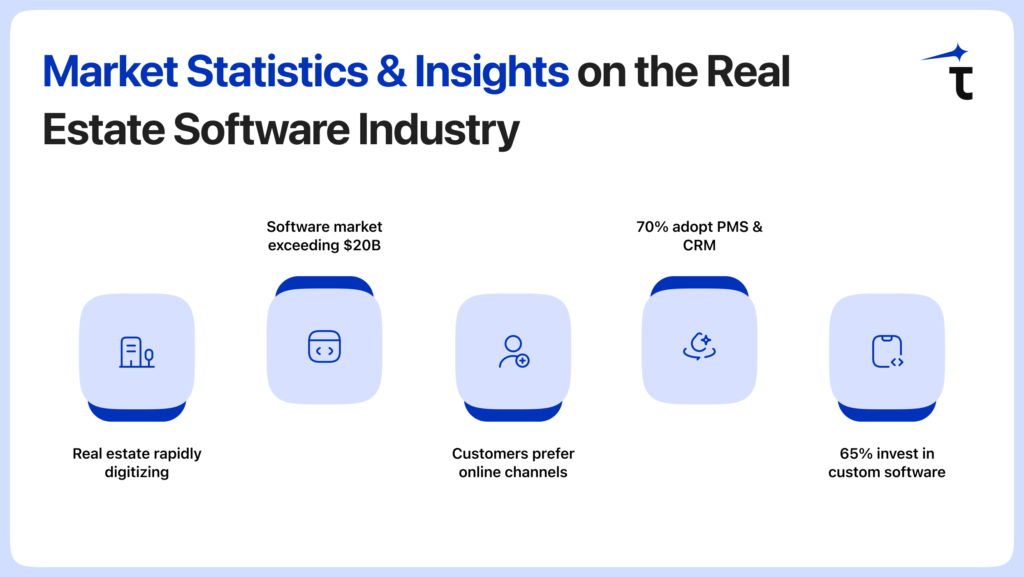
- In response to evolving customer expectations and the accelerated adoption of technology, the real estate industry is moving toward a digital model faster than ever.
- The Real Estate software market is projected to exceed $20 billion by 2030, driven primarily by Property Management Systems (PMS) and Customer Relationship Management (CRM) systems.
- Over 80% of renters and homebuyers prefer online channels for searching, communicating, and utilising self-service.
- Property Management Software and CRM Systems are being utilized by over 70% of real estate companies to manage their properties, tenants, and leads.
- Moreover, over 65% of real estate companies are investing in custom software solutions to enhance scalability and security and improve customer engagement.
Why Custom Real Estate Software Development Matters Now — Key Drivers & Trends
With changing customer expectations, increasing complexity in property portfolios, and a growing emphasis on digital-first, virtual-based property experiences, the real estate industry is rapidly transforming. As a result, property managers, real estate agents and brokers, developers, and technology-based firms known as proptech or proptech start-ups are focusing heavily on developing real estate software products, both large and small.
In addition to providing basic listing services or spreadsheets, these new-age real estate software solutions are often inclusive of proprietary property management software, customer relationship management (CRM) and customer analytics, as well as additional functionality for electronically managing one’s portfolio as well as securely storing all data, creating transparency with customers, and driving operational effectiveness throughout the three phases of real estate.
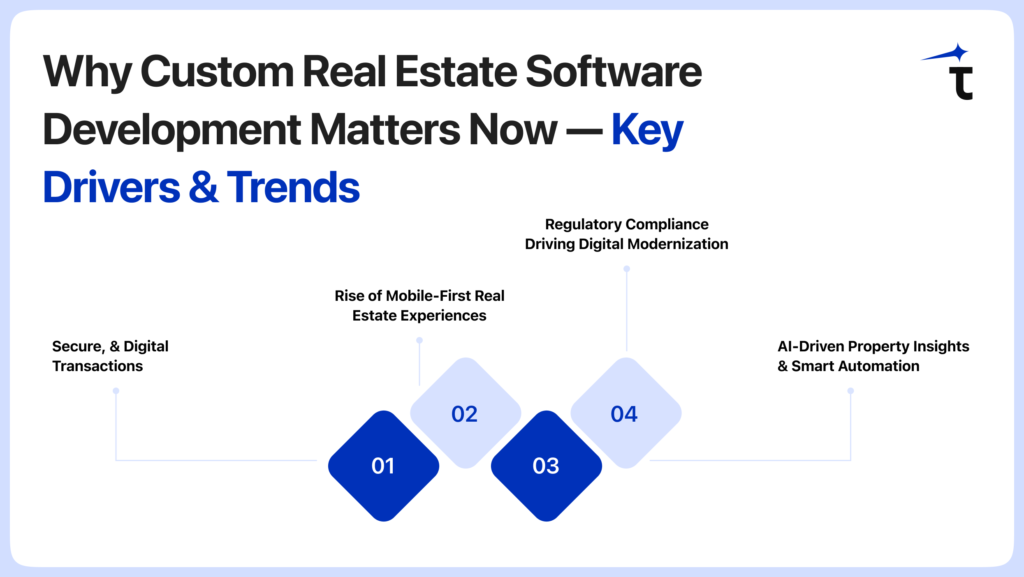
- Secure, & Digital Transactions
Digital property management software has changed the way property owners, managers and tenants work together. Typical features include online rent payments, maintenance requests, virtual property tours and digital lease management.
Digital property management software must include:
- Secure online payment gateways
- Encrypted data storage and communication methods
- Cloud-based and scalable architecture
- Real-time booking, leasing, and maintenance systems
- Automated notification and workflow management tools
- Rise of Mobile-First Real Estate Experiences
Real estate has evolved increasingly mobile-first. Tenants, buyers, and agents now rely on smartphones for:
- Searching and viewing property listings
- Scheduling property visits
- Paying rent and fees
- Submitting supervision requests
- Communicating with agents and possessions managers
This movement pushes enterprises to adopt real estate software solutions that are:
- Intuitive and mobile-responsive
- Incorporated with CRM and analysis systems
- Securely authenticated
- Capable of helping with smart building and IoT integrations
- Regulatory Compliance Driving Digital Modernization
Real estate operations are subject to numerous local and regional laws governing leasing, taxation, data privacy, and financial reporting related to property ownership. Compliance with these laws for real estate organizations includes:
- Local laws pertaining to property ownership and leasing
- Data protection and privacy laws
- Financial reporting and taxation laws
- Digital payment and invoicing guidelines
Many legacy systems cannot cope with these legal compliance challenges. Modernizing through the custom development of real estate software allows for:
- Automated lease and contract management
- Secure document storage and access to documents
- Real-time audit trails with reporting capabilities
- Accurate billing, invoicing, and tax calculation
- Standardized platform integration
Failure to modernize your technology can put you at risk of non-compliance and inefficiencies, and lead to income loss.
- AI-Driven Property Insights & Smart Automation
The real estate industry is being transformed by Artificial Intelligence and data analytics. Companies in the real estate sector implement AI within their software solutions to perform tasks such as:
- Predicting Property Values and Prices
- Predicting Maintenance and Managing Assets
- Analyzing Tenant Behavior and Reducing Turnover
- Identifying Potential Leads and Automating Customer Relationship Management
- Detecting Fraud in Rent and Payment Systems
The AI capabilities enabled by these technologies reduce manual labour, improve decision-making, and deliver deeper business insights, laying the foundation for next-generation property management and CRM platforms.
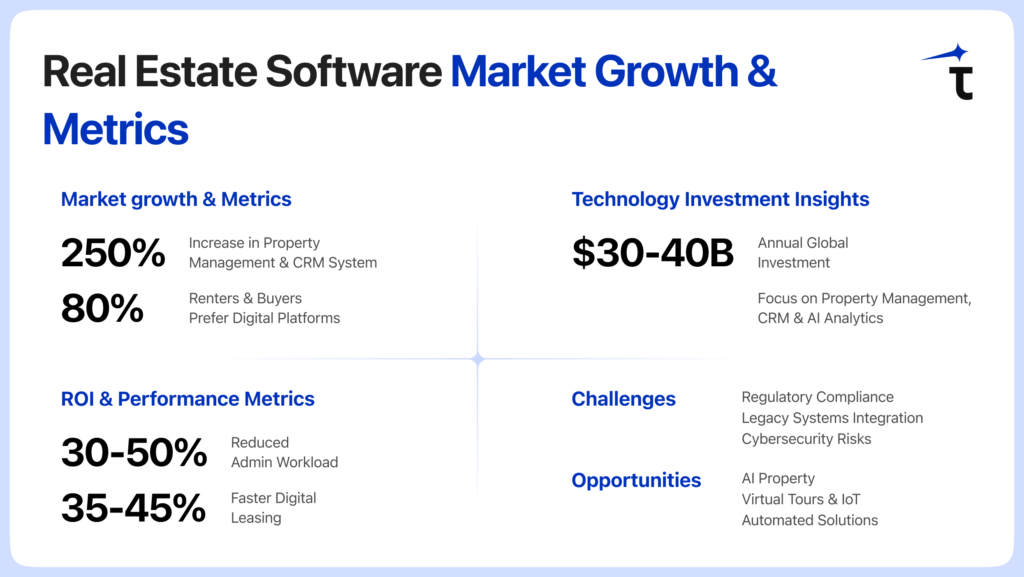
Real Estate Software Market Growth & Metrics
- The vast majority of companies engaged in commercial and residential real estate use digital platforms, including CRMs, to manage their properties, leases, and customer interactions.
- There has been a 250%+ increase in the use of property management and CRM systems since the introduction of technologies that enable automated transactions and online payment methods.
- More than 80% of renters and homebuyers prefer to search for properties, communicate, and manage transactions through digital channels.
- Almost 75% of real estate companies operating in developed markets have implemented comprehensive systems to provide property management, tenant, lead, and financial operations.
- Real Estate Technology Funding & Investment Insights
As a general guide on technology investment in real estate and property technology, it is noted that:
- The total annual amount invested globally has surpassed the $30-40 billion mark.
- Most of the funding is going to property management software, CRM systems, and AI-based analytics platforms.
- The fastest growth in digital real estate platforms is coming from emerging markets.
Investors clearly see the potential for long-term growth in real estate software solutions; therefore, they are willing to support innovations that deliver operational efficiencies, cost savings, and better experiences for tenants and customers.
- Real Estate ROI Benchmarks & Performance Metrics
Custom real estate software produces significant ROI for real estate companies:
- Property management software automates repetitive tasks, decreasing administrative workloads by approximately 30-50%.
- Digital leasing, onboarding, and documentation increase processing speed by an average of 35-45%.
These tangible results illustrate why enterprises investing in real estate software development must carefully assess and select a growth partner that can provide long-term scalability and maximum ROI.
- Challenges & Opportunities in Digital Real Estate
Major Challenges
- Regional compliance with property, lease, and privacy legislation.
- Combining old property and accounting technologies into one system.
- Cyberattacks, data breaches, etc.
- Data is stored in separate areas, and most companies lack systems that communicate with each other.
- The more properties an organization has, the more complex its operations will be.
Exciting Opportunities
- Providing estimates for property values and forecasts of demand using AI.
- Creating digital leases and developing virtual property tours.
- Utilizing the Internet of Things (IoT) to create intelligent buildings and facilitate predictive maintenance.
- Using automation to eliminate manual labour for property management and leasing agents.
- Supplying all property management systems under one umbrella via scalable real estate software.
Benefits of Building a Custom CRM to Transform Modern Real Estate Businesses
As technology continues to shape and improve how properties are marketed, sold, and managed, real estate companies need to adopt new strategies and technology to replace many of the traditional processes they use. A custom-built real estate CRM, created through a strategic approach to the development of real estate software, will allow real estate marketing companies and property management companies to centralize their processes and capitalize on long-term growth opportunities.
Below are the key advantages of investing in CRM-focused real estate software solutions.
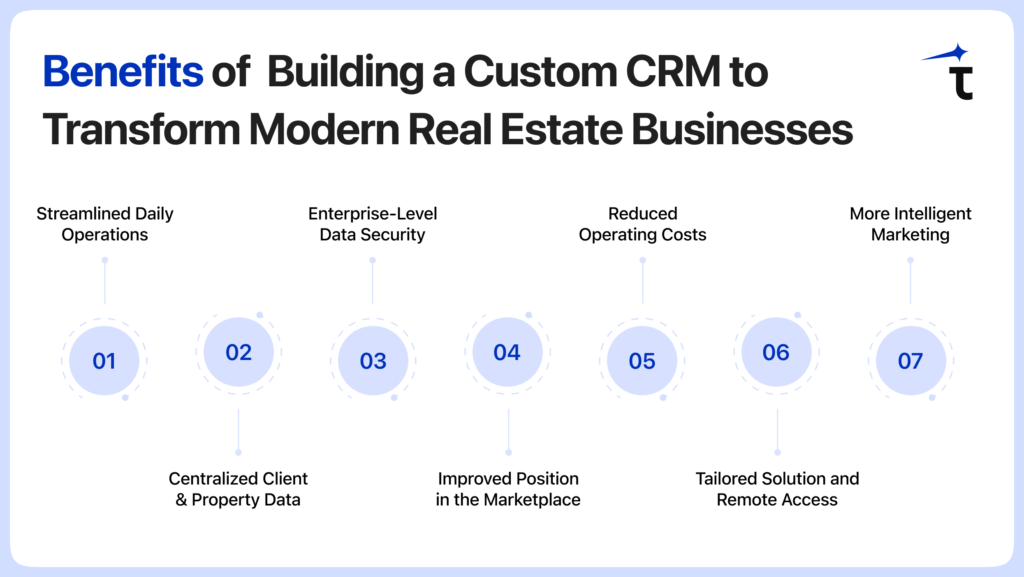
- Streamlined Daily Operations
The automation team can eliminate repetitive, redundant daily operations (e.g., follow-up phone calls, appointment reminders) and spend more time on closing transactions, managing their client relationships, and growing their portfolios. As a result, teams will be able to work faster and more efficiently than ever before.
- Centralized Client & Property Data
Using a CRM, all communication history, preferences, transactions, and property-related documents are stored in a single location. Therefore, agent teams can leverage this consolidated view of their clients and properties to make informed decisions about the best course of action throughout the customer lifecycle.
- Enterprise-Level Data Security
Modern real estate software solutions implement security protocols e.g., role-based access controls, encryption, and audit logs to protect sensitive client and property data in compliance with applicable regional data protection and real estate legislation.
- Improved Position in the Marketplace
By combining market data analysis, predictive analytics, and historical data from your CRM with data analytics, you can look at new ways of determining what buyers want and how they are making purchase decisions. Market data will help you develop more effective pricing strategies, deliver forecasted services, and differentiate your company from competitors in your industry.
- Reduced Operating Costs
By reducing your reliance on manual processes, you will see fewer errors, less time spent on corrections and rework, and lower operating overhead. Integrating a CRM with property management applications allows real estate companies to gain greater visibility into their finances, improve maintenance tracking, and better utilize resources.
- Tailored Solution and Remote Access
A tailor-made solution based on your organization’s workflow, size, and geographic location can be provided with a custom CRM. Using a cloud-based platform allows your entire team to access their listings, lead information, and communications anytime/anywhere, enabling increased productivity for your onsite and remote employees.
- More Intelligent Marketing
By integrating your CRM with the marketing tools you are using, you can create automated marketing campaigns for your company, segment your leads, and track the effectiveness of your marketing efforts. By leveraging data to target your marketing efforts, your company can reach prospects more efficiently and increase the return on investment (ROI) from its marketing budget.
Key Features to Include in Real Estate CRM & Property Management Software
A well-designed CRM created through strategic real estate software development enables property enterprises to work efficiently, manage relationships effectively, and scale with confidence. The right feature set provides smoother workflows, improved data visibility, and increased conversion rates.
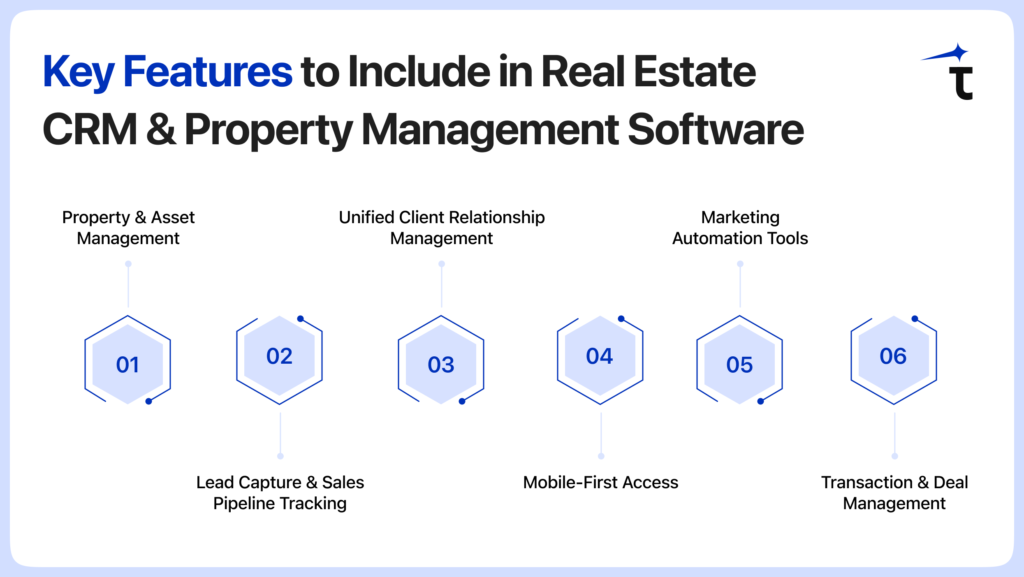
- Property & Asset Management
Property and asset management software within a CRM enables real estate professionals to maintain their property databases systematically. Properly categorized pictures, layouts, pricing, availability status, and any legal documentation provide all team members with current, accurate information about a property’s status. Properly developed coding systems will provide a team with continuous updates concerning new or updated properties.
- Lead Capture & Sales Pipeline Tracking
To maximize the value of a lead generation campaign, CRMs must capture leads from multiple sources to fuel the sales pipeline. These include website visitor registrations, property listing portals, social media sites, and paid advertisements. The CRM system should provide team members with fully integrated reporting tools to assign the right agent to each prospect and track each lead, ensuring a seamless sales process.
- Unified Client Relationship Management
With a successful implementation of CRM, you can store all of your clients’ interactions with your company, including emails, phone calls, and meetings, preferences, and transaction histories, in one single location. Integration with various communication methods, such as email and messaging systems, is critical to achieving this goal because it enables the Agent to use consistent, personalized communications with their Clients, helping build long-term relationships within the real estate software development ecosystem.
- Mobile-First Access
Mobile-friendly real estate software development enables real estate professionals to work on the go. Agents who use mobile devices to access their lead database, update property details, communicate with clients, and track their transactions will be able to do so in real time from anywhere. Mobile-friendly property management solutions increase the efficiency and effectiveness of both on-site and remote teams.
- Marketing Automation Tools
Built-in Automation enables automated email campaigns, text message notifications, and social media promotions via customizable templates and scheduling. Campaign analytics provide insight into a Campaign’s engagement and performance, enabling a business to optimize its marketing strategy and achieve the highest possible ROI with data-driven real estate software solutions.
- Transaction & Deal Management
Transaction and deal lifecycle management covers the entire process, from the initial offer to the final closing. Transaction and deal lifecycle management will also enable storing documents, signing electronically, tracking tasks, viewing payment milestones, and logging communications. By effectively applying real estate software development best practices to transaction management, businesses can reduce manual effort in processing transactions, speed up closings, and enhance transparency within their teams.
Custom Real Estate CRM Software Development Process
To maximize the potential of real estate-specific CRM systems, it is important to understand how customized CRMs are built from the ground up. Custom CRMs developed with a structured approach will better align with your company’s business objectives, workflows, and growth plans.
Below is a step-by-step guide to developing a real estate CRM using modern software solutions.
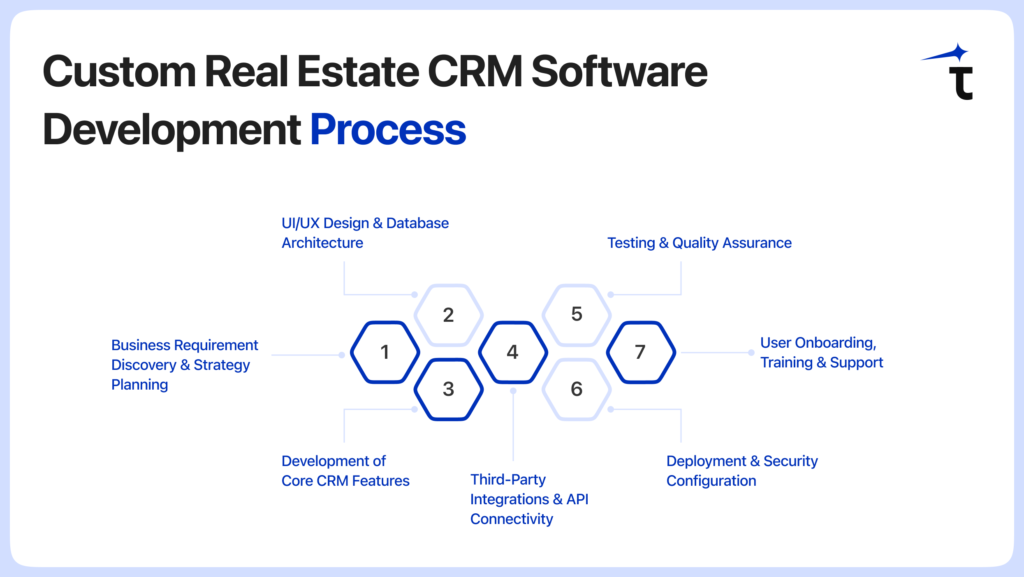
Step 1: Business Requirement Discovery & Strategy Planning
The initial step is to identify your real seat business’s objectives and operations to gain a thorough understanding. With this knowledge, you will be able to identify your biggest challenges and develop your CRM goals, including defining user roles, determining system access and integration needs, setting timelines for CRM development, and allocating funds to create a real estate CRM. A solid plan at this point becomes the basis for a successful real estate software development effort.
Step 2: UI/UX Design & Database Architecture
At this phase, the focus shifts to creating a user-friendly, well-defined way to organize data. Both UI/UX designers and UI developers will collaborate to design an easy-to-use UI that allows users to navigate between activities and the tasks they perform daily. In addition, engineers will create a database architecture that scales easily, so property owners can work with large amounts of property data effortlessly, and clients can visualize it. This is an important part of the robust property management software offered by an experienced software solution company.
Step 3: Development of Core CRM Features
At this stage, we begin writing code for our CRM application. All core functionality identified in the vendor section of the budget proposal is now being coded and customized for a productive real estate business, including features such as lead and client management, listing properties, follow-up tasks, automated processes, and performance tracking. These are core components of a very high-performing real estate software solution.
Step 4: Third-Party Integrations & API Connectivity
The first area we enhance the CRM application is by connecting it to third-party services, such as online mapping, automated email and text messaging, digital media creation and distribution, and analytics. These integrations enable the CRM application to work with integrated applications, providing greater value to your existing business technology ecosystem.
Step 5: Testing & Quality Assurance
Prior to launching the CRM application into production, thorough testing will be conducted to confirm its performance, security, and reliability. The effectiveness of each of the three major modules will be tested for functionality, usability, and data inputs. This is to ensure a high level of quality is achieved before launching the CRM application into production.
Step 6: Deployment & Security Configuration
Once you have completed testing the CRM solution, it will now be released into a production environment, either within your existing IT infrastructure or a dedicated production environment, for you to run your business. During this stage, all security protocols will be implemented to protect your clients’ and property data, including encryption, access controls, and compliance settings.
Step 7: User Onboarding, Training & Support
The last phase centres on adoption and usability. Aspects such as documentation, user manuals, and comprehensive hands-on training sessions are included to help users operate the CRM effectively. By properly onboarding users, the team can maximize the benefits of the custom property management software and enhance productivity.
Elevate Your Real Estate Operations with Technoyuga
Technoyuga provides custom software solutions to help the real estate industry simplify property management through automated lease and maintenance processes and use AI-based analytics to improve how you manage your property.
Are you ready to future-proof your real estate business? Join forces with TechnoYuga and leverage technology as a competitive domain.
Final Thoughts
The digital-first era is coming to real estate. Efficiency, transparency, and customer experience are becoming the key enablers of success. To that end, custom real estate software is now a mandatory investment. Custom software provides a more intelligent, faster, and more secure real estate business, allowing you to increase efficiency through the automation of processes and centralization of data, to improve client relationships,s and to secure client trust.
By investing in a tailored real estate software solution today, your organization will be well-positioned to capitalize on future trends, adapt to the needs of your clients, and deliver the digital experiences that tenants, homebuyers, and investors expect from their real estate professionals. Companies that embrace technology will succeed in the future, while those that do not will struggle to keep pace.
FAQs
1. What is real estate software development?
Real estate software development by TechnoYuga involves creating custom digital solutions for property management, CRM, and other real estate operations. These solutions help businesses streamline processes, improve efficiency, and stay competitive.
2. Why do real estate businesses need property management software?
Property management software from TechnoYuga automates tasks like lease tracking, rent collection, and maintenance management, reducing manual work and enhancing tenant satisfaction.
3. How do real estate software solutions enhance CRM for agencies?
Technoyuga’s real estate software solutions include CRM features that help agents manage leads, track client interactions, and automate follow-ups, boosting conversions and client relationships.
4. What features should I look for in property management software?
Key features include lease and tenant management, automated billing, maintenance tracking, reporting dashboards, and seamless integration with other TechnoYuga real estate software solutions.
5. Can custom real estate software solutions improve business efficiency?
Yes. Custom solutions from TechnoYuga are tailored to your workflows, offering AI-driven insights, scalability, and integrations that generic software cannot.
6. Is real estate software development expensive?
Costs vary depending on features and complexity. However, investing in TechnoYuga property management software and CRM solutions reduces manual processes and long-term operational costs.
7. How secure are real estate software solutions?
TechnoYuga real estate software solutions prioritize data security, encryption, and compliance with industry regulations to protect client, tenant, and property data.
8. Can property management software integrate with other tools?
Yes TechnoYuga property management software can integrate with accounting tools, marketing platforms, IoT systems, and CRM applications for centralized, seamless operations.
9. How does real estate software development help in scaling a property business?
By automating repetitive tasks, providing real-time insights, and centralizing data, TechnoYuga real estate software solutions help businesses efficiently manage multiple properties and expand their client base.
10. What is the future of real estate software solutions?
The future lies in AI-driven analytics, predictive insights, and fully integrated property management and CRM systems.