Today’s insurers face many significant challenges while adapting to a data-driven environment driven by customer-centricity. To meet these challenges, insurers are increasingly looking toward transformational insurance systems to support every aspect of their respective operations, from automating claims processing and improving the accuracy of underwriting to enhancing the effectiveness of risk management. All of these applications of advanced insurance systems will ultimately impact the way insurers do business, compete and grow in an ever-evolving digital economy.
Traditional manual processes and workflows are no longer sufficient for insurers when addressing issues such as large volumes of claims, complex policy structures, and changing regulatory requirements. This is where powerful insurance software applications play an important role in transforming the way insurers conduct business.
Investing in tailor-made insurance software has become crucial as more clients’ demands are for digital-first delivery channels for their insurance services. Digital systems enable a major improvement both in terms of internal processes and external customer experience through seamless integration with various third-party applications.
Below will discuss how insurance software development will enhance the processing of claims, complaints, underwriting policies, and risk management. We’ll address what needs to be included in building custom solutions, specific core functionality to include in those products, and what obstacles will have to be overcome in building and implementing new insurance systems.
Key Takeaways:
- Insurance providers report an average 30-40% reduction in operational costs by using digital insurance platforms, enabling them to spend much less on administrative functions such as manual data entry and paperwork.
- The use of predictive analytics and AI-powered underwriting tools in the insurance industry is increasing underwriting accuracy by 25-35%.
- With the implementation of advanced fraud detection algorithms and real-time monitoring systems, companies can detect fraud with 60% or greater accuracy, reducing the total number of fraudulent claims filed and saving insurance companies billions of dollars each year.
- There is a growing trend toward migrating core systems to cloud platforms for scalability, security, and compliance, with more than 65% of insurance companies moving their operations to the cloud.
- Introducing self-service portals, mobile applications, and transparent claims tracking creates a better customer experience for policyholders and drives policyholder loyalty, resulting in 15-25% higher customer retention rates.
What is Health Insurance Software?
Insurance development entails designing and developing solutions in order to automate and digitize integral processes for an insurance organization so that the insurance company can complete its insurance functions regarding processing claims, underwriting new policies, managing risks, etc. Insurance software solutions use these types of solutions to manage their policies, evaluate the risk associated with those policies, process claims in a timely manner, and ensure that they are compliant with their company’s laws and regulations.
Custom development of insurance software involves working with clients to design programs that meet the client’s specific requirements and needs. These custom software programs must be able to perform many different types of tasks, including but not limited to premium calculations, claims validation, fraud mitigation, and maintaining a client’s customer data, etc. In addition to creating an application that meets the client’s needs, the application must also help to minimize human errors and operational inefficiencies.
Key Types of Insurance Software You Can Develop
There are all sorts of different kinds of insurance software products available that can be built to suit your particular operating requirements. Due to the increasing prevalence of digital transformation, the ability for organisations to provide their customers with more scalable and efficient customised software solutions means that Insurers will now be able to develop and deploy functionally automated and super efficient business processes based on their specific operations.
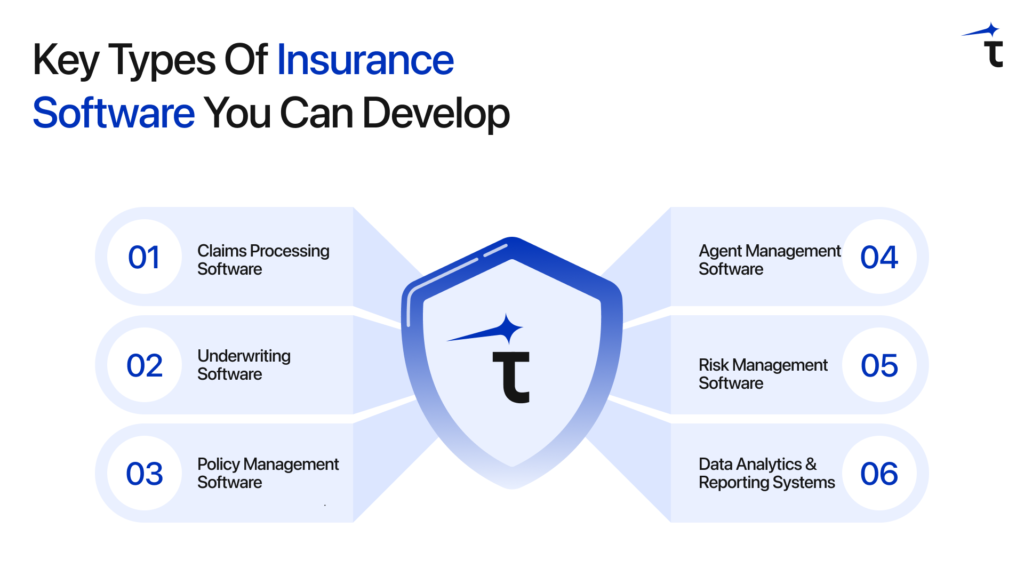
Claims Processing Software
The entire claims lifecycle can be automated using claims processing software. This means that claims can be initiated, processed, and settled much faster while reducing paperwork and ensuring that all approvals are done electronically with automated workflows. Claims processing software utilizes the cloud to enable real-time tracking of claims, enhancing transparency for both customers and insurers.
Underwriting Software
Insurers utilize underwriting software as a means of processing information related to customer profiles, market trends, and risk assessment. Underwriting software employs artificial intelligence and analytics to help underwriters make fast, accurate decisions about how much to charge customers for their insurance coverage and creates personalized products for each individual.
Policy Management Software
The ultimate goal of policy management software is to provide an insurance company with a single system to store all of the information about its policyholders. It allows for easy renewal of policies and simplifies the processes used for creating and modifying them; thus, minimizing the amount of paperwork and administrative work required.
Agent Management Software
Insurers need to manage their agents and agent management software provides a means of tracking agent performance, commission payments, and agent licenses. It also gives insurers the tools they need to efficiently manage their leads, measure agent sales, and increase agent productivity via reports and dashboards.
Risk Management Software
Risk management software helps insurers to identify, evaluate, and mitigate risk through the use of both predictive analytics and historical data. By using risk management software, an insurer can reduce the incidence of fraud, determine the extent of its exposure to certain kinds of risks, and ensure compliance with regulatory requirements.
Data Analytics & Reporting Systems
Insurance software that uses data analytic capabilities provides insurers with valuable insights about customers, claims activity, and product performance by using real-time dashboard reporting systems. Many of the analytics capabilities built into insurance software eliminate the need for manual analysis and are designed to support both compliance and automation.

How Can Insurance Software Development Transform Your Operations?
Digital innovation is changing the way insurance companies do business. By providing insurers with access to advanced insurance software and scalable insurance technology, insurers can streamline their business processes, improve risk visibility, and deliver better service levels.
Here are examples of how today’s modern insurance systems generate measurable value:
Operational Excellence
Modern insurance solutions automate repetitive administrative tasks by eliminating paperwork and manual errors, thereby improving turnaround times for policy issuance and claim approvals, increasing employee productivity, and allowing them to spend more time on strategic decisions rather than routine tasks.
Greater Customer Engagement
Modern policyholders are accustomed to using digital technologies when purchasing and maintaining a policy. Smart portals and other mobile-enabled applications give policyholders access to view their policy documents and receive immediate notifications of policy changes. The implementations of insurance software solutions improve transparency, trust, and long-term customer relationships by leveraging advanced technology.
Centralized & Accurate Data Management
Insurance businesses generate and manage a lot of sensitive data. It is imperative that insurance companies have a comprehensive solution that ensures that policyholders’ information, claims and underwriting records are stored, secured, integrated and synchronized in real-time so that they have accurate data and can make better decisions with it.
Automated Claims Processing
Automated claim processing systems make it easier to verify, validate, and settle claims. The use of intelligent rule engines and AI-based assessment tools helps reduce human error, speed up claim approvals, and create greater uniformity in how an insurer handles claims, leading to increased efficiency and improved customer service.
Automated Regulatory Compliance
Insurers can build their own technology solutions using platform-building tools based on their unique business requirements. Integrated with compliance modules, these platforms provide audit trails, data encryption, and ongoing monitoring of compliance with regulatory requirements, minimizing legal risks associated with operating an insurance business while protecting the integrity and confidentiality of customer data.
Advanced Analytical Capabilities
Modern technology platforms for insurers enable real-time evaluation of operational performance, risk exposure, and potential fraudulent activity. As a result, insurance technology solutions can leverage these advanced analytical capabilities to improve underwriting processes, refine pricing strategies, and develop innovative, competitive products that better meet customer needs.
Also Read: Entertainment & Media Software Development
Important Considerations Before Developing Insurance Software
Evaluating strategic, technical, and operational factors is an important step in initiating your insurance platform project, ensuring your insurance software has the scalability, compliance, and alignment with long-term business objectives required by the insurance industry.
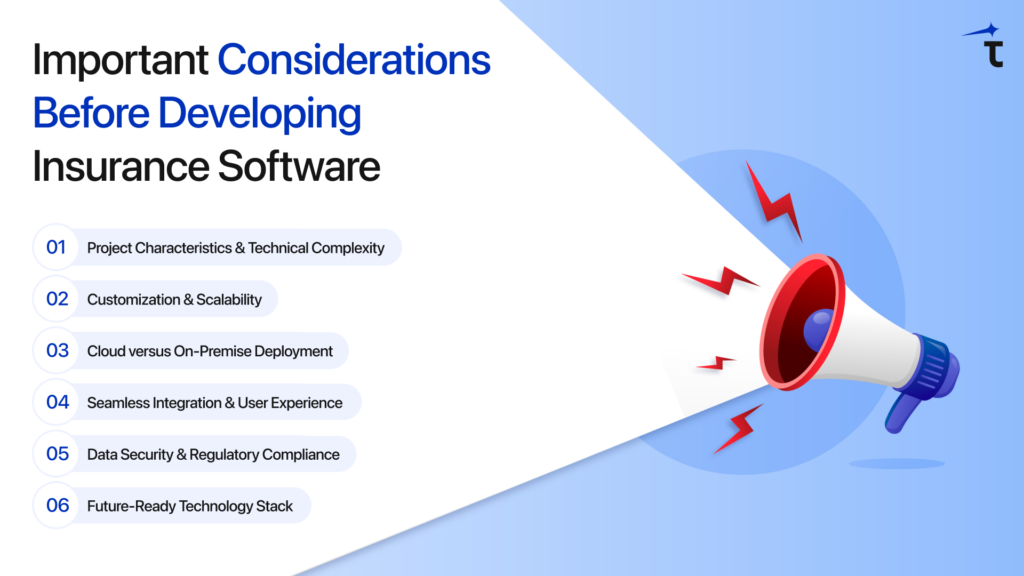
Project Characteristics & Technical Complexity
Insurance systems are complex, particularly when working across multiple workflows, including claims adjudication, underwriting logic, policy lifecycle management, and compliance validation. With custom insurance software development, projects often involve multiple complex calculations, third-party integrations, and continuously changing regulatory requirements, which require a detailed roadmap, clearly defined milestones, and a skilled architecture to succeed.
Customization & Scalability
Each insurance company is unique, with its own product offerings and approval hierarchies. So building insurance technology solutions for your business allows you to create customized workflows, reporting dashboards, and customer portals that can easily adapt to your business’s specific needs. Consider caregivers when assessing scalability, so you have enough capacity to support the growth of your business, the expansion into multiple regions, and the increase in the number of users.
Cloud versus On-Premise Deployment
Choosing the right deployment model for your solution is crucial for its flexibility and cost savings.
- Solutions designed for the cloud will allow remote access, automatically receive updates and backups for disaster recovery, and provide a more scalable solution.
- On-premise systems may offer greater control or ownership of the infrastructure, but they generally require a higher initial investment and ongoing maintenance.
Consider the insurance company’s compliance needs, its budget limitations, and the IT support capabilities of the individual when determining whether to deploy your software solution in the cloud or on-premises.
Seamless Integration & User Experience
Today’s insurance companies use multiple systems, including those for CRM, payment processing, analysis, and other data sources outside their company; therefore, when your platform is properly integrated with these systems, it prevents the creation of operational silos. Intuitive UX design will enable your employees to manage policies effectively while providing your clients with self-service.
Data Security & Regulatory Compliance
Today’s insurance platforms store highly sensitive information, including both personal and financial details about their clients. Therefore, developing custom insurance software will require that your platform be developed with multiple levels of encryption protocols, role-based access controls, and automated audit trails as part of the system. It is always better to build such features into the software system rather than add them later, as this will help minimize your legal risk and allow you to remain compliant with industry standards indefinitely.
Future-Ready Technology Stack
By investing in scalable insurance technology solutions that utilize artificial intelligence, automation, and analytics, you will be prepared for your organisation’s digital transformation. A modern technology stack will provide the flexibility needed to adapt to changing marketplace conditions and provide pricing models to stay competitive. Additionally, this will help you keep pace with emerging trends in insurtech.

How to Build an Insurance Software: Step by Steps Guide
A systematic process, coupled with industry knowledge and an effective execution strategy, is required to successfully build high-quality, powerful insurance software. To continue enjoying the benefits of your insurance software development project in the long-term, follow these detailed processes.
Choose the Right Technology Partner
Choose a technology partner to assist you with your insurance software development project. An experienced technology partner who has successfully delivered high-quality insurance software solutions will provide you with the technical expertise and insurance industry knowledge that will serve as the foundation for your success. Choose to engage with your technology partner via an outsourced software development team, your existing technology partner, or an extension of your internal technology team.
Define Business Goals & Requirements
Determine the exact business goals and functional requirements of the software you are developing before you begin designing and developing it. The conversation with your stakeholders about what they want to accomplish with the software, such as the reasons for compliance, workflow process, and the desired result, will take place at the beginning of your project. Using extensive market research to understand how your customers want to connect and do business with your company will give you a clear understanding of how your custom insurance software development is designed to meet your current operational goals and long-term growth projections.
Finalize the Technology Stack
When determining your tech stack, consider how technology will affect performance, change, and integration of your software. When looking at cloud platforms, back-end frameworks, databases, and security, try to find a tech stack that will provide you with the potential for automation, analytic capabilities, and the ability to integrate with third parties, while allowing your software to grow as new functionality is introduced.
Design an Intuitive UI/UX
User Experience is key to engagement and to how likely others are to use the software. Think of ideas for easy navigation of wireframes, prototypes, and user journeys for the filing of insurance claims, underwriting insurance policies, and managing the insurance policy hyper-efficiently. By using a clean and responsive design, employees and policyholders alike will benefit from the ability to navigate your insurance software across multiple devices.
Develop a Minimum Viable Product (MVP)
Building an MVP of your software can provide you with a focused version that includes core features such as policy management and claims tracking. By building your MVP to test your idea, get meaningful user feedback, and reduce overall development risk before beginning full-scale custom insurance software development your MVP can provide many benefits.
Implement Agile Full-Scale Development
Using an Agile development approach divides the development process into a number of smaller, staged sprints. This allows your product to accumulate incrementally through additional features and functionality built on automation, risk testing, analytics, compliance modules, etc. You can continually gather input from relevant stakeholders and review development against established organisational goals to ensure your new insurance software meets them.
Conduct Comprehensive QA Testing
Prior to releasing any aspect of your new technology, it will be critical for you to validate that it is functioning correctly and performing correctly. The test cycles should consist of functional, integration, security, and user acceptance testing to identify and resolve deficiencies in your insurance solutions. Quality assurance will ensure that your new technology solutions for the insurance industry operate and comply with all relevant regulations in the real world.
Deployment & Continuous Optimization
It may be necessary to create the appropriate technical infrastructure ie, establish server configurations, implement monitoring frameworks, etc., to ensure that the delivery of your service can take place successfully. Once your service is operational and live, it is essential that you continue to collect performance metrics and user feedback to facilitate ongoing improvement by resolving issues and/or optimising the platform.
Must Read: Education Software Development: LMS, eLearning Portals & Virtual Classrooms
What Features Should Be Included in Insurance Software?
Insurance providers need to focus on developing insurance software with intelligent, scalable capabilities that are customer-centric as they accelerate their digital transformation. Modern developments in insurance software include a trend toward increased automation, transparency, and digital experiences for both insurers and their customers.
1. Smart Policy Search & Comparison
Allow users to search and compare millions of policies by coverage limit, premium, benefit, exclusion, and the insurance company’s network providers using advanced filtering. This helps users make smarter decisions while engaging with your insurance software solutions.
2. Digital Policy Issuance & Automated Underwriting
Automate the onboarding process through risk assessment, eligibility verification, and tracking the policy’s status in an instant. Automated underwriting tools will save significant time for you and your staff by eliminating much of the manual process involved in insuring customers and speeding up approval times for developing custom insurance software.
3. Secure Online Payments
Provide secure internet payment options to pay your premiums, set up automatic payment plans, and access your billing history through an encrypted payment gateway. Integrated payment systems are among the most important components of a dependable insurance technology solution.
4. Provider & Network Directory
This allows users to search for providers by specialty field, geolocation, customer rating, and scheduling availability. This feature will greatly increase accessibility and is critical to building trust in your insurance software solutions.
5. Integrated Communication Tools
Include features for secure messaging, chatbot, and video consultation allow for simple three-way communication between the policyholder, their agent, and the insurance company. These highly effective communication tools will improve service efficiency in developing insurance software solutions.
6. Digital Document Management
Centralized storage for policies, ID proofs, claims documents, and compliance records reduces paper file, corporeal log jam and improves retrieval speed. Strong document management capabilities are a core component of custom insurance software development.
7. End-to-End Claims Management
Automated claim submission, tracking, verification, and settlement workstreams reduce errors while increasing processing speed. Detecting insurance fraud through rule-based validation provides users of modern insurance technologies with a degree of assurance.
8. Real-Time Alerts & Notifications
Push notifications help keep users up to date on when their premium is due, when their policy needs to be renewed, when their claim has moved to the next stage, or when compliance requirements are due, thereby increasing user retention and satisfaction.
Key Challenges in Insurance Software Development
Insurance software development comes with many challenges, including regulatory, operational, and technological challenges faced by the industry. Companies that want to build modern platforms in the insurance industry must take the necessary steps to address these challenges if they want their investments to be successful over time and scalable.
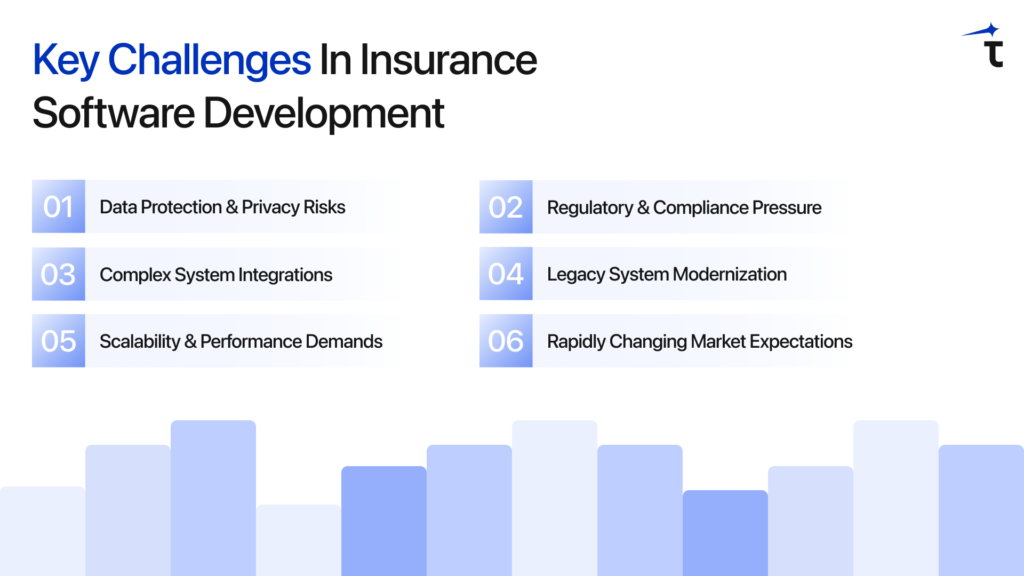
1. Data Protection & Privacy Risks
The insurance industry and the platforms that support it manage some of the most sensitive personal and financial data in the world, and thus need to be protected through encryption, access controls, and secure SQL databases. Insurance technology solutions must be built to protect against data breaches, cyber-attacks, and unauthorized access.
2. Regulatory & Compliance Pressure
Companies in the insurance industry are regulated and are required to comply with legal and regulatory requirements. The insurance industry operates under a set of rules specific to the area in which it does business and the type of product it sells. Companies must stay abreast of the evolving legal environment, track their compliance history, and have built-in compliance processes within their insurance software solutions.
3. Complex System Integrations
Companies in the insurance industry use many different systems to run their businesses, including CRM, payment gateways, processing systems, analytics tools, and third-party data providers. The number and complexity of different systems used can make it difficult to have seamless interoperability in the creation of custom insurance software solutions due to the variance in data formats and APIs
4. Legacy System Modernization
Many insurance companies continue to utilize legacy systems. Consequently, migrating data, re-engineering the workflows for new processes, and ensuring business continuity throughout the entire process represents one of the most significant hurdles in regards to building new, modern insurance software technologies.
5. Scalability & Performance Demands
Insurance technology platforms need to handle a high volume of transactions, particularly during peak periods. Careful planning must occur when designing scalable insurance technology solutions that provide speed and efficiency, regardless of transaction volume through appropriate infrastructure considerations
6. Rapidly Changing Market Expectations
Insurance customers are continuing to expect increasingly rapid response rates, online access to products or services, and customized experiences. Therefore, insurers must continually enhance their insurance software solutions by leveraging new technologies, such as artificial intelligence (AI), automation, and analytics.
Why Partner With Tehnoyuga for Insurance Software Development?
Technoyuga provides reliable, flexible insurance software products designed specifically for insurers, brokers, or agencies. As an expert in building custom insurance software, we offer innovative, high-quality solutions for claims management, underwriting, policy administration, and risk analysis. Whether you need to modernize your existing system or develop brand-new software, we can help you succeed by creating robust technology tools that enable you to reach your business objectives.

Final Thoughts
Digital transformation is rapidly changing the insurance sector, driven by advances in technology, changing customer expectations, and increasingly strict regulations. Investing in solid insurance software development is necessary to remain competitive.
Modern insurance software solutions help reduce costs and improve the accuracy of claims processing, underwriting, and risk management. By investing in custom software development, an insurer can access a secure, scalable platform that meets business requirements.
Using advanced insurance technology solutions will allow companies to streamline their operations, comply with statutes and regulations, and provide customers with an easy-to-use digital experience, thereby paving the way for sustained growth and success.
1. How does claims processing software benefit insurance companies?
Claims processing software automates the entire claims lifecycle, reduces manual errors, speeds up approvals, improves customer satisfaction, and helps insurers handle large claim volumes with greater accuracy.
2. How does risk management software improve insurance operations?
Risk management software identifies potential risks, detects fraud, ensures regulatory compliance, and helps insurers make proactive decisions to minimize financial losses.
3. What are the key features of insurance software solutions?
Key features include claims automation, AI-based underwriting, fraud detection, policy management, data analytics, reporting dashboards, API integrations, and customer self-service portals.
FAQs
Claims processing software automates the entire claims lifecycle, reduces manual errors, speeds up approvals, improves customer satisfaction, and helps insurers handle large claim volumes with greater accuracy.
Risk management software identifies potential risks, detects fraud, ensures regulatory compliance, and helps insurers make proactive decisions to minimize financial losses.
Key features include claims automation, AI-based underwriting, fraud detection, policy management, data analytics, reporting dashboards, API integrations, and customer self-service portals.
Custom insurance software development involves building tailored solutions designed around a company’s specific workflows, compliance requirements, product offerings, and long-term business goals instead of using off-the-shelf products.
Advanced insurance technology solutions automate claim submission, verification, fraud detection, and settlement processes, reducing manual errors and significantly speeding up approvals.
Cloud-based systems offer scalability, remote access, and automatic updates, while on-premise solutions provide greater infrastructure control. The right choice depends on compliance needs, budget, and IT capabilities.
Modern platforms integrate compliance modules, encrypted data storage, audit trails, and role-based access controls to help insurers meet regulatory and data protection requirements.
Major challenges include data security risks, complex third-party integrations, regulatory pressures, legacy system modernization, scalability requirements, and evolving customer expectations.
The timeline for custom insurance software development depends on project complexity, features, integrations, and compliance requirements. MVP development may take a few months, while full-scale systems require longer iterative development.
By offering self-service portals, real-time claim tracking, mobile access, and automated notifications, insurance technology solutions enhance transparency and convenience, thereby increasing customer satisfaction and retention.