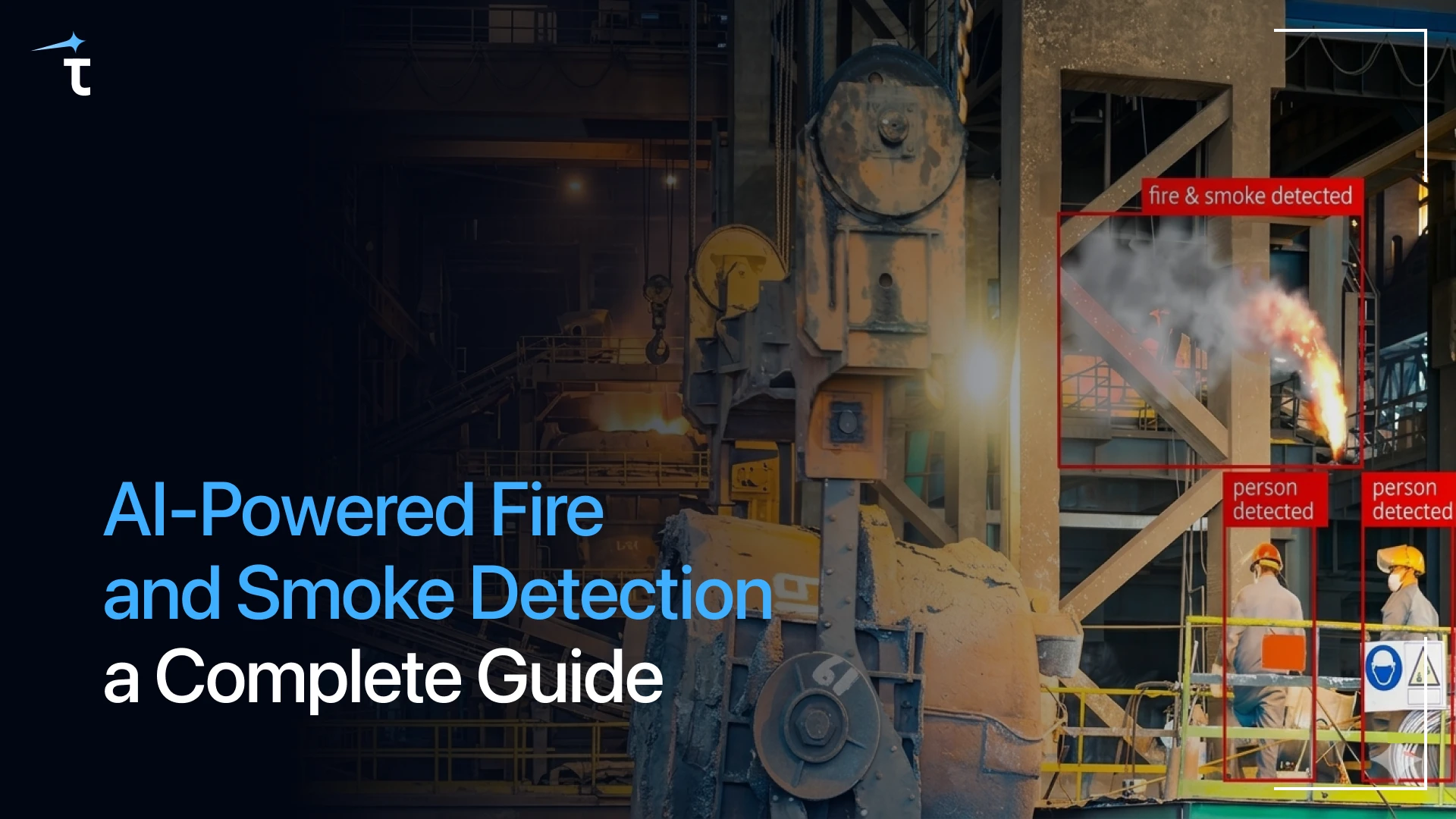
Every year, fire incidents cause billions of dollars in property damage and claim thousands of lives worldwide. The National Fire Protection Association (NFPA) estimates that the average damage in a single industrial fire is more than 128,000 dollars — and this figure is not considering lost time, higher insurance premiums, or the loss of human life that is irreparable.
The tragedy is not just the fire itself. It is the regret that follows — the realization that the damage could have been prevented if the system had detected the threat even a few seconds earlier. Conventional fire detector types wait until smoke reaches some level of density or temperature surpasses a threshold. At this point, it is too late.
This is where AI-powered fire and smoke detection fundamentally changes the equation. Integrating AI video analytics to detect fire incidents with computer vision, deep learning algorithms, and real-time CCTV monitoring systems are able to identify a spark before it turns into a flame, and respond to it much faster than any human.
In this guide, we will discuss it all so let’s start reading!
Key Takeaways
- AI identifies sparks and smoke on the live video, which is faint, conventional sensors will wait until heat or smoke physically arrive at the sensors.
- AI Fire detection using YOLO models detect fire in real-world scenarios with 94%+ accuracy and 35-60 fps processing speed.
- The current CCTV cameras can be enhanced with AI analytics software – no complete hardware change is required.
- AI-Powered Fire and Smoke Detection systems can be used in any industry warehouses, hospitals, oil and gas, hospitality, and open areas.
- Predictive analytics notifies about overheating devices and electricity abnormalities prior to ignition.
Understanding AI-Powered Fire and Smoke Detection
An AI-based fire and smoke detection system is a technology platform which employs artificial intelligence, computer vision and machine learning, to detect fire, smoke, sparks, and thermal anomalies in real-time. In contrast to the traditional detectors that rely on physical sensors that record the heat or the density of particles, AI systems observe live video feeds of cameras and process the visual data to identify threats as soon as they occur.
The core advantage is speed. A conventional ionization detector triggers only when smoke particles reach its chamber. An AI video analytics system for fire detection can identify a small puff of smoke or a small spark as soon as it appears in the camera view – in many cases, — often minutes before a traditional alarm would sound.
How AI-Powered Fire And Smoke Detection Systems Works
Understanding How this AI-based fire and smoke detection system Detects Fire Here is the step-by-step mechanism:
- Always-on video feed analysis
The AI system connects to existing CCTV cameras or dedicated IP camera networks via RTSP (Real-Time Streaming Protocol). It captures and processes live video frames – usually 25 to 60 frames per second – without human directives or oversight. This is the ‘always-on’ layer of protection.
- Instant threat identification and targeted alerts
Each video frame is viewed through deep learning models, which are trained on tens of thousands of fire, smoke, and flame images in a wide variety of real-world conditions. Once a threat is identified, the system immediately transmits area specific notifications to authorized staff through mobile notification, alarm panel, or dashboard. Detection latency in modern systems can be as low as 75–105 milliseconds.
- Autonomous safety response
The system does not stop at notification. The system that uses AI fire detection is integrated with the existing safety infrastructure that includes fire alarms, sprinkler systems, ventilation controls, and emergency lockdowns to activate autonomous responses. This happens without waiting for a human to confirm the alert, dramatically cutting response time.
- Incident logging for post-event investigation
All detection events, alerts, and system responses are automatically recorded with time-stamped video capture and labeled analytics. This data is stored on cloud servers or edge devices for future investigation, compliance auditing, and insurance claims.
- Self-improvement through continuous learning
AI models in fire detection systems improve over time. As the system accumulates data from its specific environment lighting conditions, background movement, typical activities — it learns to distinguish real threats from benign events with increasing accuracy, reducing false alarm rates month over month.
Features That Make AI-Powered Fire and Smoke Detection Systems Stand Out
Real-Time Detection
A system with AI immediately alerts when a hazard is detected in the video feed – a spark, a flame flicker, or a thin line of smoke. Fire detection using YOLO, has a high frame rate system that operates on video frames at a rate of less than 100 milliseconds in multiple zones at once – it does not wait for human verification of the detection. It is a completely autonomous system to detect and respond.
Computer Vision Monitoring Beyond Smoke And Heat
Traditional detectors measure air quality or temperature. AI video analytics for fire detection analyzes the visuals by utilizing Computer Vision flame shape, smoke movement, color patterns, and thermal signatures. With AI fire detection using CCTV, becomes an active fire safety layer of fire protection, no new hardware necessary. This helps to detect fire even in large open areas such as hangars, outdoor yards, and high ceiling warehouses where the traditional sensors cannot be used.
Seamless Integration With Alarms And Suppression Systems
AI fire detection systems integrate with fire alarm panels, sprinkler systems, HVAC controls, and emergency notification platforms. The system can activate suppression, alert personnel and start evacuation procedures all within seconds when fire is identified.
Predictive analytics from historical data
Alongside real-time detection, AI systems learn over time, detecting pre-fire conditions, such as overheating electrical equipment, abnormal heat patterns in machine zones, or frequent spark events in certain areas. This shifts fire safety from reactive to genuinely predictive.
Cloud-enabled remote monitoring
Detection events, video clips and system logs can be viewed remotely through secure web or mobile dashboards. Authorized personnel are able to track various sites anywhere in the world, examine incidents and receive push notifications in real time.
Why Businesses Are Switching from Legacy Detectors to AI-Based Fire Detection System
Early-Stage Threat Detection
This is the single most important benefit. A traditional smoke detector is activated once the smoke concentration has reached a threshold, by which time an actual fire is visible. AI video analytics for fire detection detects a spark, a glow, or a thin smoke trail the instant it appears on camera. This gives responders critical extra minutes.
Reduced False Alarms
False alarms cost businesses money in emergency response fees, staff disruption, and regulatory penalties. The AI-Powered Fire and Smoke Detection trained to differentiate between cooking smoke, steam, fog, and dust versus actual fire have a rate of false alarms 60-80 times higher than traditional sensors without loss in sensitivity to real threats.
Early Fire Prevention
AI fire detection using CCTV does not just detect fire — they detect conditions that precede fire. Overheating equipment, electrical arc signatures, and unusual heat patterns are flagged before ignition occurs. This is true fire prevention, not just fire response.
Instant Automated Response
When seconds matter, removing the human confirmation step saves lives. AI fire detection using YOLO responds as soon as a threat has been detected – sprinklers are activated, alarms are raised, ventilation is locked in a sequence that no human operator can perform as fast.
24/7 Continuous Monitoring
AI systems operate 24/7 without fatigue or distraction. In case any camera or part malfunctions, it alerts automatically to ensure that the gap in the coverage is taken care of. Business can’t be reliable this much on manual monitoring.
Long-Term Cost Savings
Initially, the AI fire detection system costs more than a traditional smoke detector, AI fire and smoke detection system, will reduce the number of false alarm callouts, decrease property loss due to early detection, lower insurance premiums through documented detection performance, and need less physical maintenance than sensor-based systems.
Industries Where AI-Powered Fire Detection System Is Making the Big Difference
Manufacturing
The manufacturing spaces contain heavy machinery, constantly powered electrical systems, and in many cases, flammable gases or cutting fluids. AI fire detection using CCTV cameras patrols equipment areas 24/7, identifying sparks of electrical faults or overheated equipment before it turns into a fire that closes production
Warehousing and logistics
Warehouses present a unique challenge: high ceilings, dense storage, and limited visibility for sensor-based detectors. An AI-based fire detection system equipped with CCTV can cover a complete floor of a warehouse with the already-existing cameras and identify smoke and flames on the floor or close to the storage shelves. Whereas a traditional ceiling-mounted system would have failed to identify an impending danger in its early stages.
Oil, gas, and chemical industries
These environments are the highest-risk fire environments in industry. The use of volatile fuels, pressurized gases, and highly reactive chemicals imply that a small ignition can be disastrous. AI-Powered Fire and Smoke Detection systems in these surroundings are combined with emergency shutdown systems and provide detection latency in less than 100ms – quick enough to stop runaway incidents.
Hospitality
Hotels and restaurants, cloud kitchens, laundries and back-of-house facilities generate a lot of steam, cooking smoke and heat all of which cause false alarms in the older systems. The training of an AI fire detection system in a kitchen setting helps to distinguish between a cooking process and a real fire, eliminating the nuisance of constant false evacuations.
Healthcare facilities
Hospitals and healthcare facilities provide a particular mix of risks: oxygen-saturated spaces, flammable healthcare supplies, and patients unable to evacuate fast. AI-Powered Fire and Smoke Detection systems provide the earliest warning and the system can be connected to facility management systems to trigger controlled, staged evacuation plans.
Public spaces and smart cities
Malls, transit hubs, airports, and stadiums present monitoring challenges at scale. AI video analytics for fire detection can patrol large open spaces with a relatively few cameras, offering cohesive oversight of an overall public location and combining with public announcements and evacuation frameworks.
Possible Challenges and Overcome For AI-Powered Fire and Smoke Detection System
Differentiating Smoke from Dust & Steam
This is the most technically important issue of AI fire detection systems. The initial models could not distinguish between actual smoke and other similar looking materials, such as smoke, fog and fine dust. Training data quality and model architecture is the solution. The latest fire detection using YOLO models, trained on thousands of samples of real smoke and confounding substances on multi-scenario datasets, can reach above 92% accuracy on smoke classification in real-world applications.
Integrating AI with Legacy Cameras
Not every existing camera can be integrated with AI – extremely old analog systems or those with lower than 1080p resolution might deliver video quality that cannot be used to detect with accuracy. The practical solution is a tiered upgrade approach: replace cameras in the highest-risk zones first while using software-only analytics on adequate existing hardware. Cloud-based AI platforms and API-driven integration also make it possible to connect heterogeneous camera networks without full replacement.
Securing video data and controlling access
AI-based Fire detection systems continuously capture and analyze video footage of facilities, which casts valid doubts on the privacy of their data, unauthorized access, and compliance with regulations (especially in Europe in the context of GDPR). Best practice is end-to-end encryption of all video streams and stored footage, access control by role with audit logging. On-premises edge AI deployment where cloud connectivity is not acceptable, and regular third-party security audits of the AI platform.
High initial setup and training costs
Although AI fire detection has a high ROI over time, initial deployment expenses can be high, especially when working with large facilities with a high number of cameras, requiring model training, and integrating into legacy safety systems. Companies can avoid it by identifying the most dangerous areas first, with cloud-based SaaS solutions that can distribute the cost between monthly subscriptions, and vendors who provide a gradual rollout schedule instead of implementing a full-site solution on day one.
Model performance in extreme or unusual environments
AI fire detection models trained on general-purpose datasets can be ineffective in environments that are highly unusual, i.e. facilities with persistent visible steam, facilities which operate on an open flame (foundries, glassworks) or in extremely harsh conditions. The answer is model fine-tuning on actual footage on the deployment location, coupled with multi-sensor fusion (optical cameras with thermal imaging) to ensure detection quality under any visual conditions.
How Technoyuga Can Assist Businesses Using AI Fire Safety Solutions
TechnoYuga assists companies to make their fire safety vision a reality, a fully intelligent and functioning reality. Our team will take the time to learn about your facility, your risk environment, and your existing infrastructure, then the AI fire detection system we develop is specific to your industry and not a generic off-the-shelf product.
Having years of practice in developing AI solutions and computer vision applications, TechnoYuga has dedicated AI developers for hire that remain closely engaged throughout the process, starting with requirement gathering and model selection, deployment, integration, and post-launch support. You do not get shuffled to a support desk, you are the one working with the team that designed your system.
The AI fire detection solutions that we build go beyond just detecting smoke and flames. They integrate seamlessly with your existing alarm panels, sprinkler systems, HVAC controls, and CCTV infrastructure — and they are built to act, not just alert. At TechnoYuga, we create customized scalable AI-based fire detection and control systems that evolve with your business and can fit the specific needs of your industry.
Conclusion
Any fire detection system can only be good as long as it can detect early. The difference between a spark that is caught in one second and smoke that is detected after two minutes is not a matter of convenience — it is the difference between a contained incident and a catastrophic loss. AI-powered fire and smoke detection systems are run by deep learning, computer vision based on the YOLO algorithm, and real-time CCTV analytics. These systems detect threats that a human sensor will never observe, and take action on them automatically, without requiring a human to step in and press a button.
Implementing an AI-powered fire detection system is more than a new addition to your security infrastructure. It is a decision to move from reactive damage control to proactive prevention — and in fire safety, proactive is the only standard worth setting.
FAQs
The traditional fire detectors use physical sensors used to measure the density of smoke particles or temperature. They only trigger when conditions reach a threshold by which point fire is already visible. AI fire detection systems scan live video streams of cameras, identifying visual parts of a fire (sparks, flame flicker, smoke) as soon as they occur – often minutes earlier than a conventional alarm would notify their owner.
Yes, this is indeed one of the best features of AI fire detection. Old ceiling-mounted sensors are not effective in large areas since the smoke spreads out before it reaches the sensor.
The AI video analytics systems take advantage of the already installed CCTV cameras to provide a visual view of a complete floor area to detect smoke and flame at any location in the field of view of the camera, with no regard to ceiling height or ventilation.
Yes, The majority of AI fire detection systems are compatible with existing infrastructure, such as CCTV cameras, alarm panels, sprinkler systems, HVAC controls, and access control systems. Integration can generally be done through APIs, ONVIF protocol support or direct SDK connection. No full hardware replacement is required in most deployments.
Costs depend on size and mode of deployment. Basic CCTV-based AI detection for small businesses starts at $1,500–$5,000. Mid-level enterprise systems that use edge AI and thermal cameras cost between 15,000 and 50,000+.
SaaS subscriptions to the cloud usually cost 200-800 dollars a month. Within 12-24 months, most organizations are able to reap the benefits of return on investment through damage cost reduction and lower insurance premiums.
Not necessarily. Most enterprise AI fire detection platforms are designed for deployment by fire safety integrators or the vendor’s professional services team.
No-code configuration dashboards on cloud-based platforms can be frequently configured with no specific engineering resources. In case of specific integrations with legacy systems, it is advisable to collaborate with an expert AI solutions development partner.
Models such as YOLOv8, which are built with AI, are reported to reach 94%+ mAP50 accuracy and can be enhanced over time as they become familiar with the environment it will be deployed in.
Yes, when paired with thermal cameras, it is effective in total darkness, rain, fog, and harsh outdoor conditions, where conventional sensors cannot perform.
Edge AI runs locally with under 100ms latency and no internet dependency. Cloud-based detection allows having a centralized multi-site monitoring, remote dashboards, and simplified model updates. Most enterprise deployments combine both.
By using end-to-end encryption, role-based access controls, anonymization capabilities and optional fully on-premises edge deployment that has video data not leaving the internet at all.
Basic CCTV-based installations take 1-3 days to complete, enterprise multi-zone integrations take 2-4 weeks to complete, and large greenfield installations require up to 12 weeks to complete, including new hardware and custom system integration.