Selecting the right software is key to determining how efficient your business will be and even dictates how much it grows. Most organisations face the same dilemma when weighing up their choices: do we build bespoke custom software, or opt for off-the-shelf, ready-made software?
Each of those choices offers pros and cons. Custom software is designed specifically for your business processes, is flexible and scalable, while off-the-shelf software will provide the benefit of speed to market and cheaper costs upfront.
The best option for a business is based on overall goals, budget constraints, degree of complexity in operations and long-term ambitions. However, when businesses know where to get the right resources, decisions that lead to sustainable development can be implemented. Well, to help you out with the same, here in this article, we are gonna discuss the same for a better understanding. Keep on reading to know more!
Key Takeaways:
- The decision to implement custom software or off-the-shelf solutions comes down to business objectives, financial considerations and the scalability of your operations.
- Custom software provides you with the desired functionality, adaptability, and long-term competitive edge.
- Commercial, off-the-shelf (COTS) software comes with rapid implementation, lower initialisation investments and user friendliness for all common needs.
- Now if you have something that requires complex workflows or is unique to your business, then going custom-built will work better for you.
- Off-the-shelf tools are usually the preferred choice for startups and small businesses as they offer quick roll-outs at affordable prices.
- TCO, or total cost of ownership, should be considered over initial outlay.
- The right software decision depends heavily on integration, security, and scalability.
- The provider, which is used for this purpose, should be an experienced one like TechnoYuga to achieve successful implementation and long-term value.
Why Choosing the Right Software Matters — Key Drivers & Trends
Choosing between custom software and off-the-shelf solutions may not be merely a technical decision — it can tangibly affect how your business evolves, competes and grows in an age of digital first. These are the main factors affecting this decision:
Digital Transformation & Business Agility
Businesses today are on a fast track toward technology adoption in order to remain competitive. With the right software, you can innovate faster, run smoother operations and be responsive to market inflexions. Bespoke solutions can be more flexible, and off-the-shelf tools can get you transforming right away.
Need for Scalable and Flexible Systems
As businesses grow, the needs in their operation develop. Software must be able to scale without losing services. Custom software can be developed as per the requirement, allowing it to expand along with your business in features and integrations. Off-the-shelf software, on the other hand, may struggle with complex or changing requirements.
Need for Data-Driven Decision-Making
Many organisations today are data-driven in their decision-making processes. The signature software should provide analytics & reporting through which actionable insights can be generated. If you build custom solutions, they can connect to collect the data that is uniquely relevant, whereas out-of-the-box tools often do standardised reporting, therefore may not address business-specific needs.
Maintaining a Customer Experience & Operational Efficiency Focus
A top priority for each organisation is to deliver seamless customer experiences while optimising internal processes. Custom software provides tailored user experiences and optimised processes according to your company’s pipeline. In contrast, out-of-the-box software offers standardised features that often meet the needs for common use cases but might lack differentiators.
Custom Software vs Off-the-Shelf Software — Core Differences
To make the right investment decision based on how your small business functions and its growth plans, you need to dive into what sets custom software apart from off-the-shelf software.
Custom Software
Unlike off-the-shelf software, which is designed as a one-size-fits-all solution, custom software is developed specifically for an individual business, based on its unique processes, objectives and needs. Provides total control over features, integrations and scalability.
Off-the-Shelf Software
Off-the-shelf software is a general-purpose one-size-fits-all solution. It includes ready-made features and can be set up fast without in-depth development.
Key Comparison Factors
Cost structure
Custom development may have a higher initial cost but brings better ROI in the long run. A cost level of off-the-shelf tools with low initial costs, but high recurring or subscription management (licensing) costs.
Deployment time
Off-the-shelf solutions can be deployed fast, while custom solutions require time to design, build and test.
Flexibility & Customization
Custom software is fully customizable to business requirements. An off-the-shelf software solution does not provide sufficient customisation.
Scalability
Custom solutions are easy to scale as per business expansion. As the need becomes more complicated, off-the-shelf tools could be limiting.
Maintenance & updates
While custom software maintenance is handled by the organisation in-house or outsourced to a development partner such as TechnoYuga, off-the-shelf software owes updates and maintenance are vendor-driven.
Security & compliance
It allows for better security and compliance management. Commercial software follows general security standards, but does not always satisfy particular regulatory requirements.

Benefits of Custom Software Development
Custom software an ideal choice for businesses focused on maximising long-term performance, scalability in response to throughput needs and distinctiveness.
For Enterprises & Startups
Goal-oriented customised solutions
Custom software will be built around your workflows, as opposed to a generic system where you need to conform, with each feature being an enabler of your business objectives.
High scalability and flexibility
Custom solutions are easily scalable as your business grows, with new features or integrations to make implementing the solution painless.
Competitive differentiation
Tailor-made software differentiation means you can not only stand out from the rest but also deliver unique value-added features that give your enterprise a competitive advantage in meeting or exceeding industry standards!
Better integration with existing systems
Custom applications can easily connect with your existing tools like CRMs, ERPs, or internal platforms to ensure smooth data exchange and streamlined processes.
Enhanced data security & control
This level of customization is particularly important in industries with rigorous regulations, as it gives you complete control over security protocols, data storage and compliance measures.
For Teams & Operations
Streamlined workflows
Custom software is developed to fit your internal procedures, which streamlines and avoids redundant aspects of daily functions.
Automation of business-specific processes
Task automation allows routine, time-consuming tasks to be performed based on the exact need which increases speed and reduces errors from human intervention.
Improved collaboration and productivity
All teams have role-specific tools to help with communication, task monitoring, and productivity as a whole.
For Customers
Personalized user experiences
Businesses can cater to the specific needs of their customers through customized software based on customer preferences, behavior, and the way they interact with a business.
Quicker and more effective delivery of service
Listeners/businesses never have to worry about their capabilities to handle multiple requests simultaneously.
Better product/service customization
This may help businesses to provide more tailored, flexible products or services, promoting customer loyalty and interaction.
Read More: Retail & eCommerce Software Development: A Comprehensive Guide
Benefits of Off-the-Shelf Software
From pre-integration, Off-the-Shelf software finds a way to store data in the drawing with fewer applications. It’s ideal for organizations have simple operational requirements.
For Businesses
Lower upfront costs
Off-the-shelf software is the ideal solution for startups and cost-sensitive companies, as it not only comes with a ready-to-use license but also requires much less investment than custom (bespoke) development.
Faster deployment & implementation
These are pre-built solutions that can easily and quickly be deployed, allowing businesses to go live without long development cycles.
Proven reliability and tested features
Since this software is used by a lot of organizations, it has been stress-tested, stable and improved constantly based on feedback.
Vendor support & regular updates
Software providers take care of maintenance, security patches, and feature updates so that internal teams can spend time on more critical tasks.
For Teams
Easy onboarding and usability
Since the majority of out-of-the-box solutions come with easy-to-follow user interfaces, employees can leverage them within a short span of time.
Standardized workflows
They align with industry best practices, which assists teams in maintaining operations consistency.
Minimal training requirements
Because numerous people already work with these tools, workers typically need less training and can hit the ground running.
For Customers
Quick access to services
Quick on-boarding ensures users can access services with no lag.
Familiar interfaces and usability
Using familiar interfaces/standard designs, common practices make it simple and comfortable to the customers.
Types of Software Solutions Available
How they are deployed, and the functions served dictates the type of software solution businesses choose within an organisation.
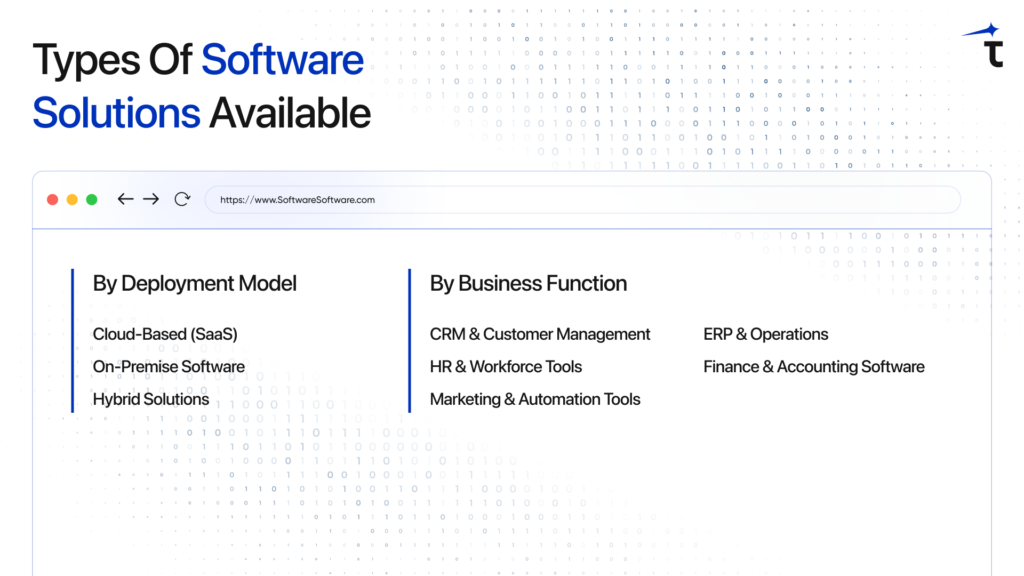
By Deployment Model
Cloud-based (SaaS)
Cloud-based applications that users access over the internet. Its flexibility, accessibility and subscription-based pricing have made it a top choice for modern businesses.
On-premise software
This software is installed & run on internal servers in your organisation. This offers more control over data and security, but also requires more significant infrastructure and maintenance input.
Hybrid solutions
A hybrid of cloud and on-premise systems that enables businesses to find a balance between flexibility and control.A hybrid of cloud and on-premise systems that allows companies to have the best of both worlds. Best for organisations with specialised compliance or operational requirements.
By Business Function
CRM & Customer Management
Its tools create customer interaction, sales pipeline, and relationship management. This is best for businesses looking for customer support management and operations.
ERP & Operations
Essential platforms that unify main business process functions, like inventory, supply chain and operations management.
HR & Workforce Tools
Human capital management: Employee HR data, recruitment, payroll, performance and workforce planning software
Finance & Accounting Software
These are solutions that deal with financial transactions, reports, budgeting and compliance for financial regulations.
Marketing & Automation Tools
Solutions that assist in automating campaigns, monitoring customer actions, and enhancing lead generation and conversion rates.
Must Read: Manufacturing Software Development: A Complete Step by Step Guide
When to Choose Custom Software
When your business needs flexibility, control and solutions more than the standard functionalities, custom software is the way to go.
Unique or complex business requirements
Developing customised software ensures that everything is tailor-made to directly suit your needs if you need very precise processes and no standard tools are able to meet those requirements.
Need for high scalability
Customized solutions also offer the flexibility of scaling with your organization without any restrictions within your capacity.
Requirement for deep system integrations
If you will need to work with many tools or legacy systems, custom software allows for seamless integration and an organised flow of data from one platform to another.
Long-term cost efficiency focus
While the upfront costs are higher, custom software can reduce your reliance on ongoing licenses (which ultimately saves you money) and it also pays off better over time.
Competitive advantage through innovation
The only skill feature gets you much faster to innovate, differentiate and create unique value propositions that are also very hard for any competitor using boring tools to build.

When to Choose Off-the-Shelf Software
Off-the-Shelf software is perfect for companies that need quick, cheap business solutions without requiring a lot of customisation.
Limited budget or startup stage
Off-the-shelf tools offer needed functionality at a lower up-front cost, which is great for startups or small businesses that have budget constraints.
Quick implementation required
These solutions are available off the shelf and can be implemented in no time, enabling businesses to kick-start their operations without any bottlenecks.
Standard business processes
If your workflows adhere to common industry standards, then generic off-the-shelf software will likely be sufficient in the vast majority of cases.
Limited technical resources
Vendor-managed maintenance, updates, and support is useful for companies without in-house IT teams.
Short-term or immediate operational needs
Off-the-shelf solutions provide an efficient and effective way to get the job done without any long-term commitment, especially for temporary projects or quick fixes.
Risks & Challenges in Software Selection
There are risks associated with both custom and off-the-shelf software that must be considered by businesses in order to prevent issues later down the line.
Over-customisation leading to high costs
When you add too many features, custom software can get expensive very quickly as development adds unnecessary weeks and hours to your project, driving up costs.
Vendor lock-in in off-the-shelf tools
Additionally, when a business is heavily reliant on a single vendor, they will need to continuously play by the rules of that vendor, and it makes it difficult (if not impossible) for them to find any wiggle room in switching platforms or customising beyond out-of-the-box functionality.
Integration challenges
Additionally, whether the custom makes it or not, ready-made solutions will have its own challenges in tightly integrated systems if they already exist.
Hidden costs (licensing, upgrades, maintenance)
Off-the-shelf software generally has recurring fees while custom software requires ongoing maintenance and upgrade costs, which can often be less clear at first.
Security and compliance risks
Whether a business chooses proprietary or open source software, failing to implement adequate security measures or comply with industry regulations can lead to data breaches and legal ramifications.
Also Read: Entertainment & Media Software Development: OTT Platforms, Streaming & Content Management
Cost Comparison: Custom vs Off-the-Shelf Software
When you make a choice for either custom or off-the-shelf software, you’ll have short-term and long-term investments to consider; understanding the cost structure is critical.
Custom Software Costs
Development & design
Optimize cost estimation for your project scope, UI/UX design & development. There are so many factors that contribute to the cost.
Infrastructure & hosting
Expense corresponding to servers, cloud services or on-premise infrastructure, depending on how the software is deployed.
Maintenance & upgrades
Iterative costs of bug fixing, performance tuning, feature enhancements, security updates—often by a partner like TechnoYuga.
Off-the-Shelf Costs
Licensing or subscription fees
Monthly or annual recurring fees to use the software, which may increase as you scale your usage.
Customization & add-ons
Charge for the greater features, plugins and little customisation options. The more the options/features integrated in the software, the more willbe the cost.
Integration costs
Cost for integrating the software with other platforms or third-party tools. There are differest aspects that are considered to analyse the exact cost needed for the same.
Total Cost of Ownership (TCO) Analysis
Off-the-shelf software may seem to offer a great short-term price point, but ongoing fees and feature restrictions could lead to greater long-term costs. While custom software tends to require a higher initial outlay, these costs are typically made back and often surpassed through the scalability, flexibility and lower vendor lock-in of custom solutions.
Implementation Approach — Step-by-Step Decision Framework
A structured decision-making approach will help you in determining whether custom development or off-the-shelf software would be better suited to support your specific business goals.
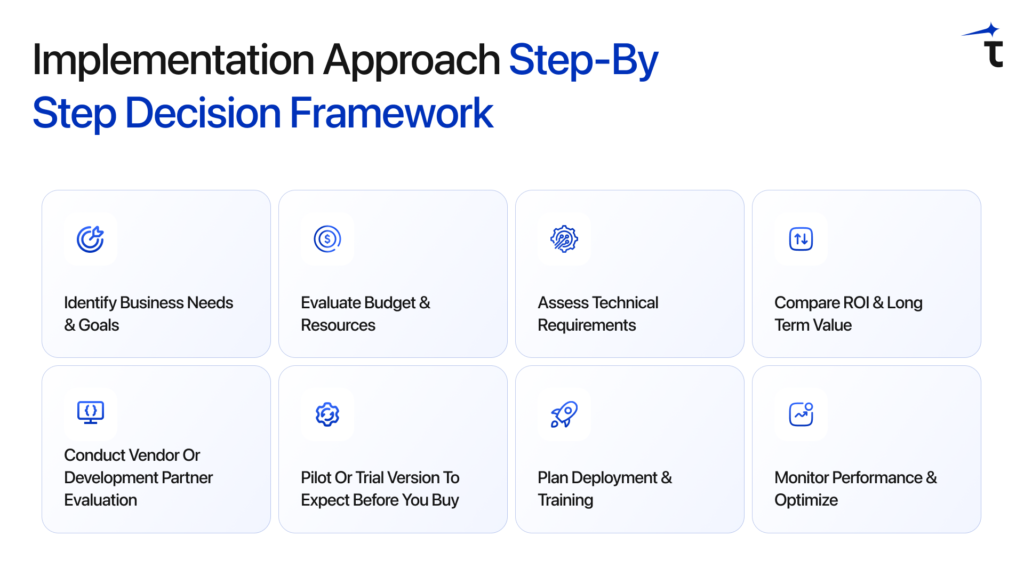
Identify Business Needs & Goals
Identify your business challenges, goals and the problem that needs to solve using software.
Evaluate Budget & Resources
Survey your budgetary ceiling, opportunities of in-house talents, and willingness to pay for sustained growth or recurring subscriptions.
Assess Technical Requirements
What you require out of the software will vary based on how scalable your business needs to be, how much customisation is needed, what integrations are desirable and so forth.
Compare ROI & Long-Term Value
Think in terms of costs vs. the bigger picture: What are your long-term return on investments (ROI) if you factor in efficiency gains, scalability and operational impact?
Conduct Vendor or Development Partner Evaluation
Buy off-the-shelf only if you can shop for vendors. If you have some custom solutions in mind then an experienced partner with a track record of delivering results, like TechnoYuga is the name to trust on.
Pilot or Trial Version to Expect Before You Buy
As far as possible, run a pilot, demo or trial to confirm usability and performance and also fit with your requirements.
Plan Deployment & Training
Review how you will implement the solutions and train your staff so that you are set up for a successful adoption.
Monitor Performance & Optimize
Constantly monitor performance feedback and adapt the software where required to ensure it meets expectations.
Best Practices for Choosing the Right Software
Selecting software is a strategic approach that depends on present and future operations attention.
Make sure applications support long-term business strategy
Choose a solution that embraces not only your immediate challenges but also prepares you for long-term goals and growth strategy.
Prioritize scalability and flexibility
The software should be able to grow with your business as well or downsize with you if you need it and minimize disruption in both scenarios.
Evaluate integration capabilities
Test the software with your other systems like CRM, ERP or third-party tools for integration.
Ensure data security & compliance
Do note that the answer must continue to follow the industry standards and regulatory requirements for protecting sensitive business and client information.
Consider user experience & adoption
An intuitive interface is a huge factor in speeding adoption, improving productivity, reducing training.
Plan for future upgrades and expansion
Choose software that can easily add updates and new features, as well as scale with your organization so you won’t be facing regular system change headaches later.
Relatable Read: Insurance Software Development: A Complete Guide for 2026
Key Features to Evaluate in Any Software Solution
Before being sure which you should consider custom versus off-the-shelf software, you need to analyse the features influencing performance/profitability, usability and long-term value.
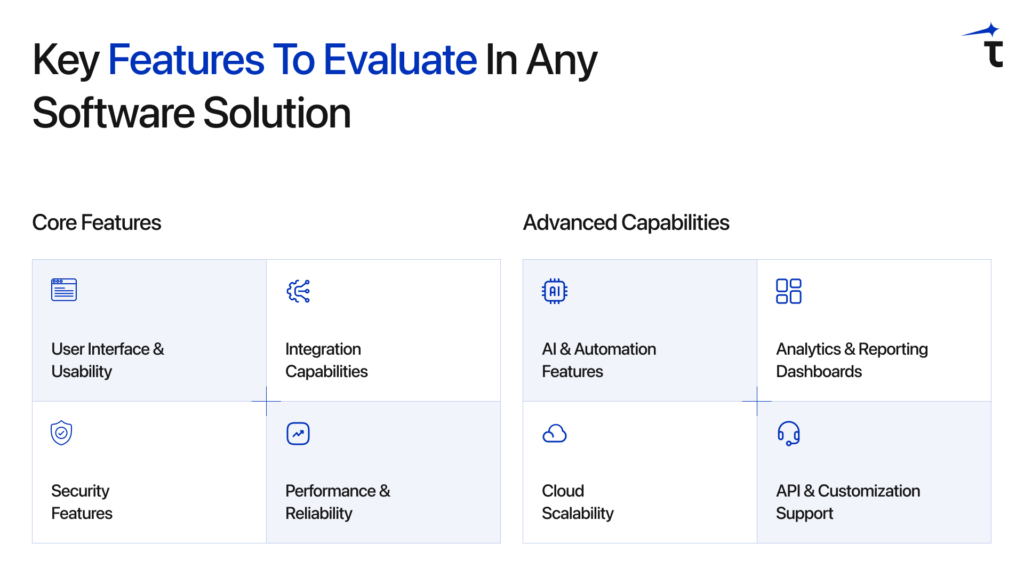
Core Features
User interface & usability
The software needs to be intuitive and easy to use so that members of your team can quickly adopt it with minimal training.
Integration capabilities
Integration with existing systems (CRM, ERP, third-party tools) for smooth data flow.
Security features
The application of robust security measures like data encryption, access controls and compliance standards is crucial for safeguarding sensitive data.
Performance & reliability
The system must provide reliability, high uptime, and scalability.
Advanced Capabilities
AI & automation features
Therefore, modern software done right usually includes automation and intelligence to minimize manual effort.
Analytics & reporting dashboards
Custom reports and real-time insights to aid decision-making and performance tracking
Cloud scalability
The elasticity of resources allows the software to expand with your business requirements.
API & customization support
The extensible nature of the software is further enhanced by multiple API and customization options, which enables businesses to expand functionality as per their requirements over time.
Emerging Trends in Business Software
Business software is evolving quickly in response to the demand for speed, flexibility and intelligent decision-making. Here are the main trends that will define what’s next:
AI-powered software solutions
Enabling Smarter Automation — Big Data + AI is helping organizations determine how the records are linked and leading to smarter automation, predictive insights, and a more flexible user experience, leading businesses to work better.
Low-code & no-code platforms
These platforms enable businesses to create applications with little coding, which cuts down on development time and accelerates innovation.
Cloud-native applications
Modern software has been progressively developed for cloud architecture, providing higher scalability, performance, and remote access.
API-first ecosystems
As a result, enterprises have shifted their focus towards software solutions with API-driven integration, bringing together disparate tools into more interconnected and fluid digital environments.
Automation & intelligent workflows
Automation can help to bestow repetitive tasks and facilitate more agile, accurate operations across departments.
SaaS ecosystem expansion
SaaS solutions are becoming increasingly popular, offering businesses countless ready-to-use tools that can be implemented in a cost-effective and seamless manner.
Custom Software vs Off-the-Shelf — Decision Matrix
One approach to determining whether custom software is a fit for your company versus off-the-shelf software comes down to assessing priorities on the primary drivers of any business:
Business size vs software type
Mid-sized and large enterprises are likely to prefer custom-built software, which offers more help in handling the complexity of operations, while startups and small organisations typically use off-the-shelf solutions due to simplicity and cost.
Budget vs flexibility
When the budget is constrained, off-the-shelf software works well. But when flexibility and customisation are key, a custom software investment pays off.
Time-to-market vs customization
The off-the-shelf type of tools allows fast deployment—perfect for pain points that need to be attended to right away. While custom software can have a longer implementation window, it provides solutions tailored specifically to your workflows.
Long-term ROI vs short-term cost
Off-the-shelf software is usually cheaper up-front, but licensing fees do add up over time. Though higher upfront cost, custom software offers better ROI in the long run because of its scalable nature and less reliance on the vendor.
Choosing the Right Development Partner (For Custom Software)
A reputable development partner will ensure your custom software is valuable, scalable and sustainable in the longer run.
Technical expertise & industry experience
Pick a partner with strong technical competencies and proven solutions in your industry to educate them on your business needs.
Portfolio & case studies
Look at their previous work and case studies to judge if they can provide effective and scalable solutions.
Scalability & support capabilities
It is highly recommended that the partner will take care of any future enhancements, scaling requirements, and technical support needed by ASP.Net developers.
Communication & project management approach
The project should be done quickly and on time through transparent communication, flexible working methods and structured work management.
Post-launch support & maintenance
Time to find a trustworthy partner like TechnoYuga that will continue ensuring your software’s functionality and performance with regular updates and optimisation.

Conclusion
To sum up, if you choose custom software or off-the-shelf software can finally be resolved as a result of the mix of your business targets, budgetary limitations and operational complexity. Standardised requirements for industries like tier-2 suppliers work well with off-the-shelf solutions, but will be less effective in differentiated processes, where bespoke software presents a better solution by providing flexibility and competitive advantage.
The decision you make, in turn, is strategic: It dictates efficiency, customer experience and long-term growth. It is a decision each department needs to make after considering their specific requirements and what they wish for the future.
Although custom software development demands more resources and time, the flexibility of designing it specifically for your company and project yields a strong return on investment (ROI) in the long run (despite initial high costs), which is why any organisation seeking scalable solutions should rely on specialists like TechnoYuga.
FAQs
Custom software is purpose-built for your unique business needs, whereas off-the-shelf software has been mass-produced, without customisation or specialisation, to address generic needs across a broad audience.
From a long-term perspective, a custom software application usually promises better ROI as compared to off-the-shelf software.
Depends on complexity, but very often it takes anywhere from a couple of months to more than 1 year for fully scalable solutions.
Yes, but it could become restrictive as your business scales or needs advanced customisation.
Many tools offer limited configurability — through plugins, for example, or configurations — but not the extent of flexibility available with custom software.
Custom software provides greater security and compliance control, while both can be secure if developed correctly.
Assess your budget, timeline, scalability requirements and complexity of the business to choose.
Industries with complicated operations like healthcare, fintech, logistics and enterprisewide businesses gain the most.
This can cause inflexibilities and make the process much more expensive, less integrated, and less scalable.
We are a team of expert developers working with the latest technologies to develop scalable, secure, and customised software solutions that meet your business requirements.