We are a part of a generation where the Education Software development has turned out to be the backbone of modern learning because institutions all over the world are now adopting digital transformation to enhance accessibility, efficiency, and learning outcomes. The old classroom structures are fast transforming into technology-enriched ecosystems that are being operated by Learning Management System Development, eLearning Platform Development, and Virtual Classroom Software Development. This change is supported by the need to have flexibility in education, whereby students and professionals have the ability to study anywhere, anytime. Hybrid, remote, and online learning models have now taken over academic institutions, corporate training programs, and skill development platforms, and provide students with individualized learning opportunities and real-time collaboration.
In this article, we will help you to know about the transformation in the education industry after the introduction of Education Software Development. Stay tuned with us till the end to know more in detail!
Key Takeaways:
- The Education Software Development allows a scalable, accessible, interactive learning to revolutionize the education of schools, universities and corporate enterprises around the world.
- Individualized LMS, eLearning, and virtual classes enhance interaction along with adaptive learning paths, gamification, and real-time feedback to students.
- The modular platforms that are cloud-based are flexible, scalable and can easily integrate new features or technologies into the platform as the needs of the education change.
- Data-powered analytics give information on the progress of learners, enabling teachers to see what needs to be improved and to streamline instruction and learning results on the whole.
Why Investing in Education Software Matters Now — Key Drivers & Trends
In the past few years, it has been seen that a lot of strategic emphasis has been put on Education Software Development as models of learning continue to change fast. Learning Management System Development, eLearning Platform Development, and Virtual Classroom Software Development are some of the areas that institutions, enterprises, and governments are venturing into to address the emerging demands of the learners.
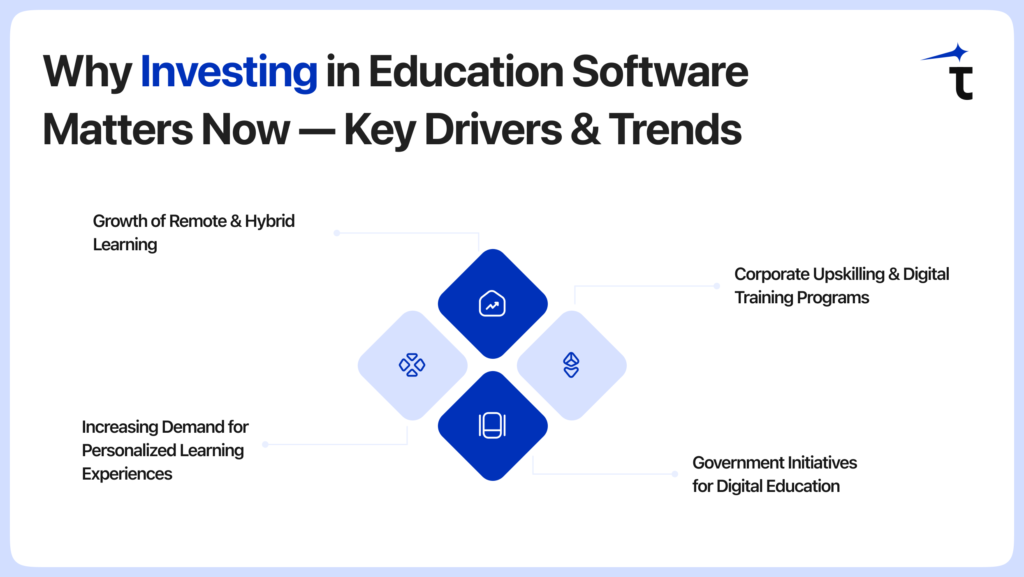
Growth of Remote & Hybrid Learning
The remote and hybrid models of learning have become an irrevocable element of education and training. The education software development promotes these models by the use of cloud-based LMS systems, virtual classroom systems, and collaboration tools. It is necessary to ensure the smooth delivery of content, attendance, and assessment with the help of an LMS.
Increasing Demand for Personalized Learning Experiences
Students are gradually demanding education to be at their own speed, with their objectives and their preferences, and eLearning Platform Development and Custom Education Software Solutions allow them to pursue education individually, with dynamic assessments and real-time evaluations.
Corporate Upskilling & Digital Training Programs
Businesses are spending high amounts on online training to train their staff to be competitive. Education Software Development facilitates organizations to implement Learning Management System Development solutions to onboard, comply, and develop their skills continuously. This is helpful for the generation in upskilling themselves and achieving the benchmarks they have set for their learning trajectories.
Government Initiatives for Digital Education
The eLearning programs initiated by government of countries and online learning sites are encouraging digital education globally. The development of Education Software is playing a significant role in building up secure, scalable, and inclusive systems of public education.
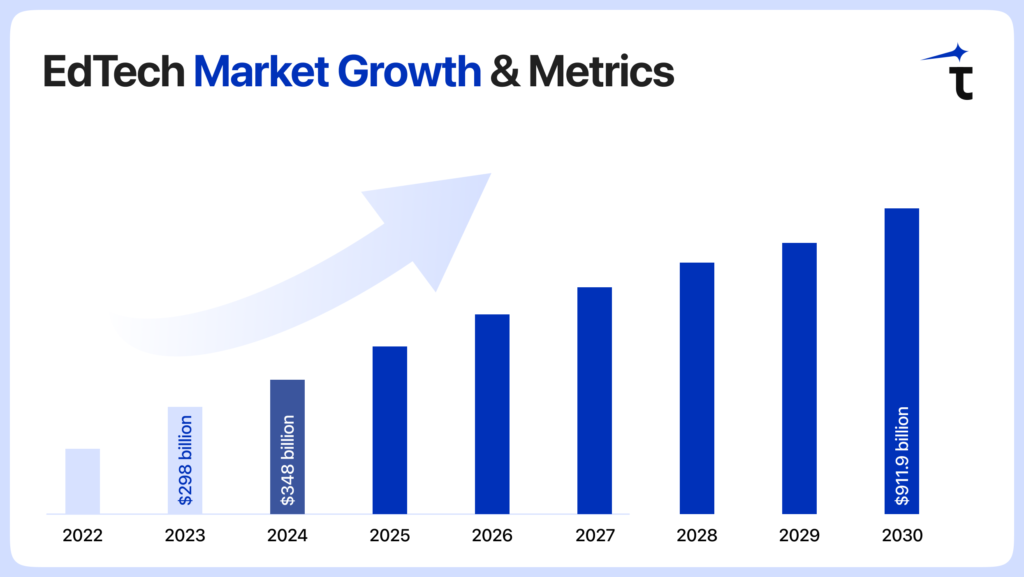
EdTech Market Growth & Metrics
- The development of Education Software is influencing the measurable expansion of the global learning systems. The EdTech market is projected to expand with great strength over the decade to a total of about $163 billion in 2024, and is indicative of high investment in digital learning platforms.
- Learning Management System Development and eLearning Platform Development is also large-scale: 87% of organizations utilize cloud-based LMS tools, and 80% of enterprises train employees with the help of LMS.
- Development of Virtual Classroom Software is mainstream, about 78% of universities include digital coursework, and ~65% of K–12 schools leverage LMS tools for blended learning.
- Businesses claim to see 25-60% better knowledge retention and use of online learning platforms to train employees quicker, proving to be a great ROI of Education Software Development.
- Although the number of people who want to learn digitally increases, there are still problems: about 63% mention the issue of data security, and about 57% mention barriers to integration. Nevertheless, Custom Education Software Solutions has growth opportunities on the basis of personalization and analytics.
Benefits of Education Software Development
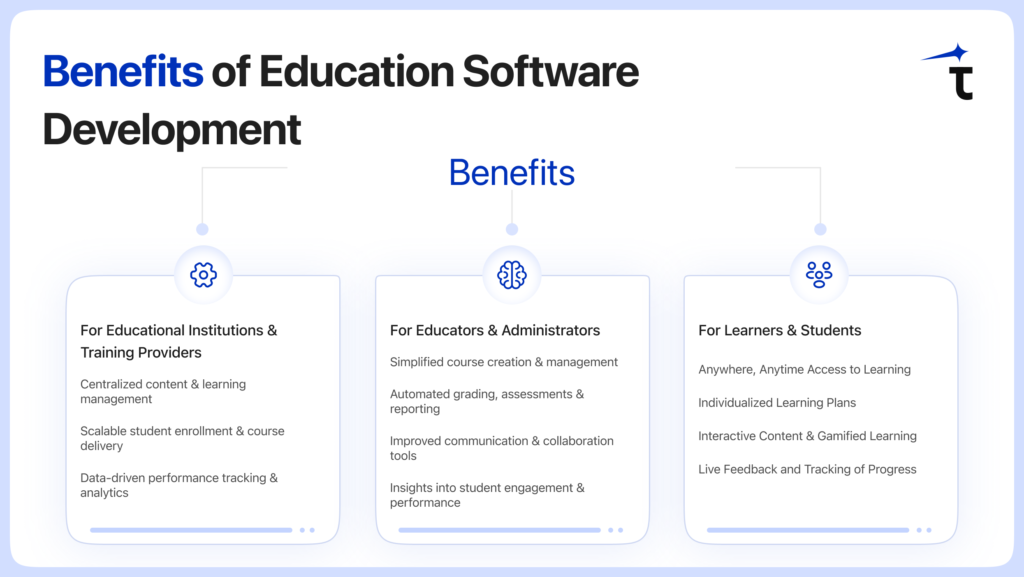
For Educational Institutions & Training Providers
Education Software Development helps institutions in upgrading the delivery of education by removing the unmanaged systems and providing scalable & unified digital systems.
Centralized content & learning management
Education Software Development enables learning institutions to put up the courses, materials, users, and updates in one platform so that there is consistency, easy accessibility, and management of the institution using the LMS Development.
Scalable student enrollment & course delivery
Institutions can add thousands of learners at a time with eLearning Platform Development, add new courses without any difficulty, and deliver content without any physical restrictions or performance problems.
Data-driven performance tracking & analytics
Education Software Development offers real-time data on learner progress, completion rates, and engagement so that institutions can evaluate outcomes and keep improving course performance.
Reduced operational & infrastructure costs
Undoubtedly, the development of education software helps in removing the necessity of physical classrooms, printed materials, and manual administration. These digital platforms turn out to be a cost saver for institutions with the reduction of costs by means of automatization and delivery via clouds.
Global reach & accessibility
Virtual Classroom Software Development allows institutions to access learners all over the globe, giving them access to multi-devices, flexible time, and inclusive learning in spite of location or time zone.
For Educators & Administrators
Education Software Development gives educators and administrators the power to have the intuitive tools to oversee the teaching and running of the operations. The institutions can use it to simplify their working process, enhance collaboration, and obtain actionable insights that would help them to improve learning outcomes.
Simplified course creation & management
Education Software Development allows instructors to easily develop, update, and manage courses on centralized dashboards, reusable content modules, and role-based access, which minimizes manual work and increases consistency of the content.
Automated grading, assessments & reporting
Assessment, quizzes, and evaluations can be graded automatically with Learning Management System Development, which generates instant reports, saves time, and gives a precise measurement of performance.
Improved communication & collaboration tools
The eLearning Platform Development is a combination of discussion forums, live chat, announcements, and virtual classes where educators, administrators, and learners engage in online and hybrid learning with ease.
Insights into student engagement & performance
Education Software Development provides real-time attendance, participation, and progress analytics to aid educators in recognizing learning gaps and enhancing their engagement strategies, and customizing the instruction appropriately.
For Learners & Students
Education Software Development assists the institutions in designing learner-centric digital experiences that encourage flexibility, engagement, and continuous improvement. With it, students get more control over the process, time, and content of learning.
Anywhere, Anytime Access to Learning
The development of Education Software enables students to receive courses, lectures, and resources on any given device enabling them to learn even after they leave the classroom without interruption via the eLearning platforms, which are web-based and mobile devices.
Individualized Learning Plans
Through the eLearning Platform Development, the learners are provided with personalized materials, flexible tests, and feedback depending on the progress, the level of skill and knowledge, and the learning objectives, enhancing knowledge and memory.
Interactive Content & Gamified Learning
Virtual Classroom Software Development facilitates the use of videos, quizzes, simulations, and gamification features, which enhance the level of engagement, motivation, and active involvement in a learning process.
Live Feedback and Tracking of Progress
The Education Software Development offers immediate feedback, a performance dashboard, and achievement reports, which allow the learners to track their progress, recognize the gaps, and be motivated to continue their learning course.
Types of Education Software Solutions
When we start exploring the field of education Software Development, it has a variety of solutions to address the requirements of institutions, educators, and learners. Organizations can choose Learning Management System (LMS) Development, eLearning Platform Development, and Virtual Classroom Software Development to choose the platforms that suit their goals, and provide scalable, engagements, and compelling learning experiences.
By Platform Type
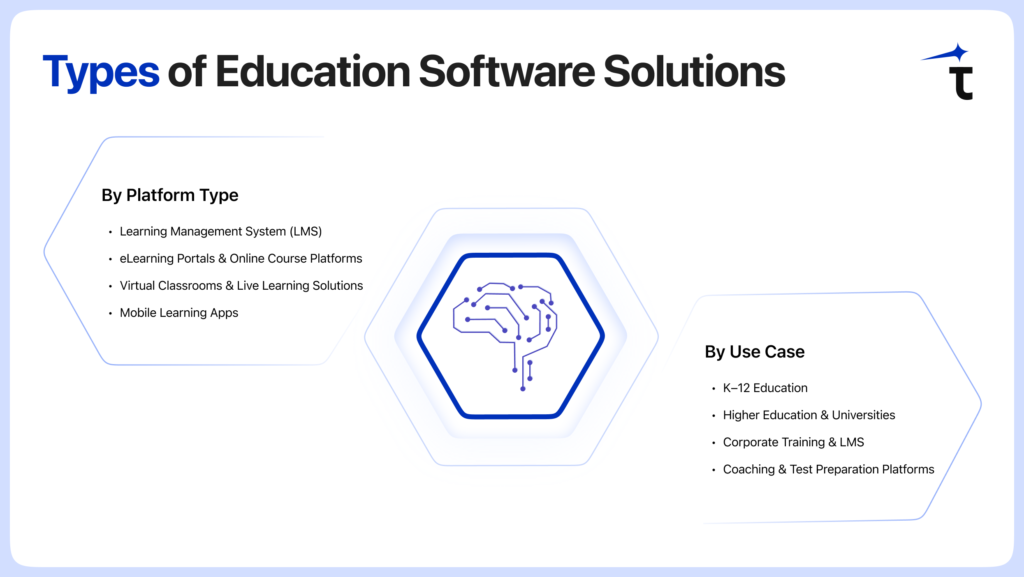
Learning Management System (LMS)
LMSs store the content of courses, keep a list of students, monitor their progress, and perform administrative functions. The Education Software Development makes these systems scalable, secure, and customizable to academic and corporate purposes.
eLearning Portals & Online Course Platforms
eLearning Platform Development allows institutions to house interactive courses, multimedia material, and certifications on the internet, thereby offering flexible education that is self-paced and accessible in any part of the world.
Virtual Classrooms & Live Learning Solutions
Virtual Classroom Software Development facilitates live teaching, interactive and real-time collaboration, and is used to simulate classroom activity online.
Mobile Learning Apps
Custom Education Software Solutions consist of mobile on-the-go learning apps, offline learning, notifications, and gamified learning to enhance learning and retention.
Evaluation Systems & Examination Systems
Education Software development incorporates automated tests, quizzes, and examinations that allow proper evaluation, instant grading, and performance analytics of the learners and teachers.
By Use Case
K–12 Education
Education Software Development supports K-12 institutions in the Learning Management System Development as well as eLearning Platform Development, which can provide interactive lessons, attendance tracking, and progress monitoring to improve classroom and remote learning experiences.
Higher Education & Universities
Universities use Education Software Development to operate large courses and research programs, as well as student interactions. Virtual Classroom Software Development facilitates real-time lectures, team assignments, and accessibility of students to higher education worldwide.
Corporate Training & LMS
Learning Management System Development and Custom Education Software Solutions is an enterprise-wide method to implement onboarding, compliance, and upskilling programs that are cost-effective in training employees and yield a significant ROI.
Coaching & Test Preparation Platforms
Education Software Development offers coaching centers, eLearning Platform Development, and assessment tools, including mock tests, interactive content, and performance tracking, as a way of enhancing exam preparedness and student performance.
Skill Development & Certification Platforms
Virtual Classroom Software Development and Custom Education Software Solutions are advantageous to all skill-based learning platforms, which provide structured education, certifications, and real-time feedback in order to enhance professional development and lifetime learning.
Key Features of Modern Education Software
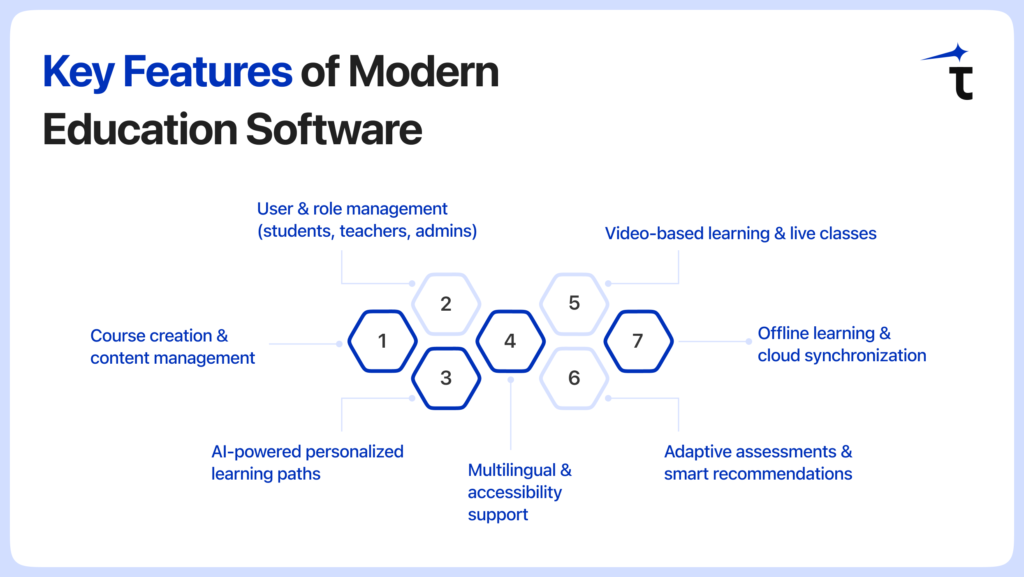
Education Software Development provides customized, interactive and scaleable learning programs. The development of Learning Management System, eLearning Platform, and Virtual Classroom Software offers core and advanced features.
Core Features
User & role management (students, teachers, admins)
Education Software Development provides user access (role-based) to students, teachers, and admins, and secure user permissions, actions, and platform data management and operational efficiency within LMS and eLearning platforms.
Course creation & content management
The development of LMS and eLearning platforms eases the course development, content structure, and maintenance. Teachers are able to post multimedia, design modules, and have a central library to facilitate easy teaching-learning processes.
Video-based learning & live classes
Virtual Classroom Software Development enhances the live classes, recorded classes, and interactive video lessons, helping to provide real-time interaction and flexibility to the learning of live and online learners.
Assessments, quizzes & certifications
Education Software Development incorporates automated tests, quizzes, and cert materials in order to monitor learners, deliver real-time testing, and certify their skills affordably.
Progress tracking & reporting dashboards
In LMS and eLearning platforms, data dashboards can give real-time analytic information about learner engagement, performance, and course completion that assists educators in optimizing instruction and learners in tracking their progress.
Advanced Capabilities
AI-powered personalized learning paths
Education Software Development implements the benefits of AI to optimize learning journeys through the use of learner performance, preferences, and goals, and develops adaptive and personalized learning to achieve better results.
Adaptive assessments & smart recommendations
eLearning Platform Development is a solution that includes dynamic assessment and smart content recommendations to enable filling in gaps of knowledge, increasing the efficiency of learning, and increasing engagement.
Gamification & engagement tools
The Custom Education Software Solutions are comprised of gamification such as badges, leaderboards, and challenges that improve the motivation, interaction, and retention of knowledge among learners.
Multilingual & accessibility support
Education Software Development helps to make learning inclusive, through offering multilingual choices and accessibility interventions so that learners of every origin and capacity can effectively interact with learning content.
Offline learning & cloud synchronization
Virtual Classroom and LMS platforms enable offline learning, which is automatically synchronized to the cloud, such that the learners can access the content at any time and place without losing progress and updates.
Role of AI & Emerging Technologies in Education Software
The use of AI and emerging technologies in Education Software Development is becoming more and more popular in improving the learning experience.
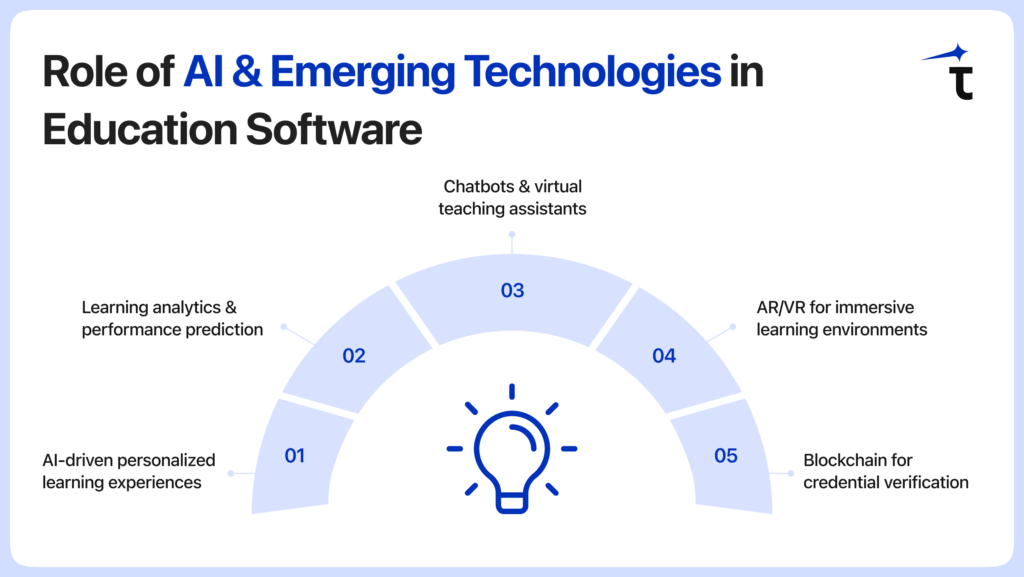
AI-driven personalized learning experiences
The Education Software Development with the help of AI will examine the behavior, performance, and preferences of the learners and develop individual learning routes. Dynamic content, personalized suggestions, and live modifications will allow every student a personalized learning experience.
Learning analytics & performance prediction
Using AI and analytics, Education Software Development monitors the engagement of learners, predicts the outcomes, and pinpoints knowledge gaps. Learning Management System Development and eLearning platforms offer practical information to instructors to streamline the teaching method and overall performance.
Chatbots & virtual teaching assistants
The Virtual Classroom Software Development uses AI chatbots and virtual assistants to respond to inquiries, direct learners, and offer immediate assistance. These devices help to lessen the efforts of the educator and provide 24/7 support to achieve smooth learning.
AR/VR for immersive learning environments
Education Software Development uses AR and VR technologies in order to develop immersive simulations and virtual labs, as well
as interactive experiences. This boosts the comprehension, interest, and use of skills, particularly in science, engineering, and vocational training.
Blockchain for credential verification
Education Software Development incorporates the use of blockchain to issue, store, and verify certificates and credentials in a secure way. Custom Education Software Solutions make sure that the credential is authentic, avoid fraud, and that learners, institutions and employers can easily share the credential.
How to Develop Education Software — Step-by-Step Process
Software Development in the field of education entails an organized mode of operation so as to be able to guarantee scalable, interactive, and safe platforms of learning. These steps are essential for Education Software Development.
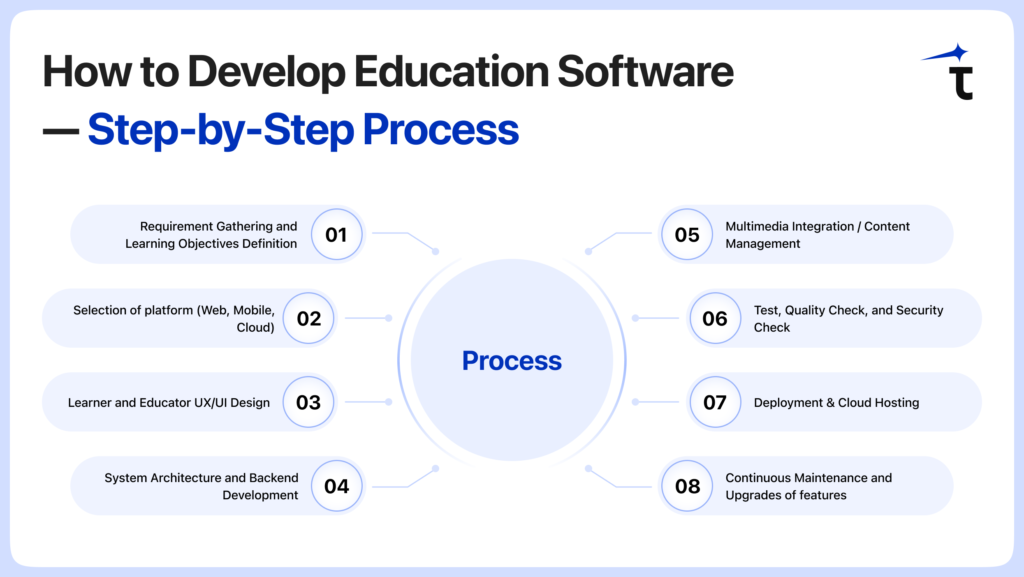
Requirement Gathering and Learning Objectives Definition
The initial one is to be familiar with institutional purposes, intended learners, and specified learning outcomes. Education Software Development should be adequate to define the functional requirements, features desired, and performance expectations.
Selection of platform (Web, Mobile, Cloud)
The appropriate choice of platforms guarantees scalability, performance, and accessibility. Education Software Development is used to assess web, mobile, and cloud-based solutions to offer uninterrupted learning experiences.
Learner and Educator UX/UI Design
The goals of Education Software Development include user-friendly interfaces, simple navigation, and usability. Learning Management System Development would contribute to user engagement, satisfaction, and the effectiveness of learning in general.
System Architecture and Backend Development
Well-built backend architecture offers seamless functionality, data safety, and scalable performance. Education Software Development is used to ensure that Learning Management System are maintained in a stable, reliable, and maintainable manner.
Multimedia Integration / Content Management
Education Software Development incorporates videos, quizzes, interactive modules, and documents in platforms. LMS Development and eLearning Platform Development provide interactive, structured, and user-friendly content to the learners.
Test, Quality Check, and Security Check
Strict testing provides performance, usability, and security. Learning Management System Development and Virtual Classroom Software Development are verified with Education Software Development that uncovers bugs, vulnerabilities, and gaps in functionality before implementation.
Deployment & Cloud Hosting
Education Software Development deploys platforms on stable servers or cloud platforms. Learning Management System Development, eLearning Platform Development, and Virtual Classroom Software Development have the advantage of scalable hosting because they allow access 24/7 and anywhere in the world.
Continuous Maintenance and Upgrades of features
Platforms are kept up to date, bugged, and new features are constantly being added to ensure they remain relevant and efficient. Learning Management System Development and Virtual Classroom Software Development continue to be updated with the needs of users and changes in technology.
Cost, Timeline & Resource Estimation
Understanding cost, timeline, and resource requirements is essential to planning education software projects. Proper estimation can ensure a smooth development, efficient resource allocation and predictable deployment for scalable and effective learning platforms.
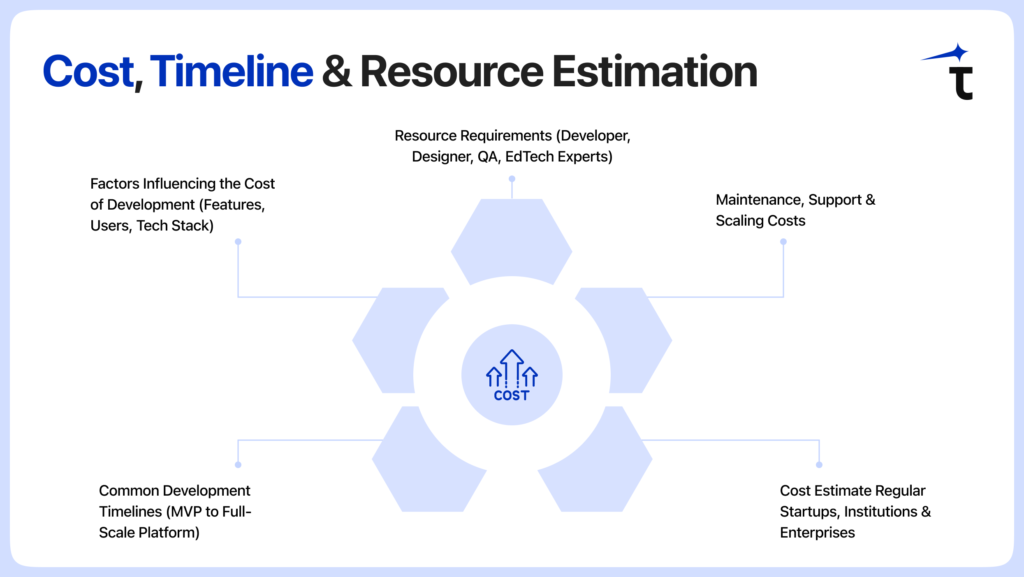
Factors Influencing the Cost of Development (Features, Users, Tech Stack)
Development cost varies depending on platform features, number of users, complexity, and technology choice. Advanced functionalities, multimedia integration, AI personalisation, and cloud hosting are some of the factors that add to the cost, whereas the more basic platforms with basic content management capabilities are more affordable.
Common Development Timelines (MVP to Full-Scale Platform)
Developing software for education usually begins with an MVP, in 8-12 weeks, with subsequent additions. Full-scale deployment can take 4-6 months, depending on complexity, integrations, & testing requirements for robust and reliable learning platforms.
Resource Requirements (Developer, Designer, QA, EdTech Experts)
Successful development requires a cross-functional team: software developers, UI/UX designers, QA engineers, EdTech specialists, etc. Collaboration ensures that the platform is functional, user-friendly, secure, and aligned with educational goals.
Maintenance, Support & Scaling Costs
Post-launch, ongoing maintenance, updates, and technical support are critical. Scaling infrastructure to support additional users and content results in additional costs, which must be considered when budgeting for a project for long-term sustainability.
Cost Estimate Regular Startups, Institutions & Enterprises
Startups can spend between $15,000 – $40,000 on basic platforms, institutions can spend $50,000 – $120,000, and large enterprises can spend $150,000 and up, depending on customization, integrations, and feature complexity. Accurate planning is the way to ensure investment is matched to functionality, scalability, and user expectations.
Conclusion
In conclusion, the future of the digital learning ecosystem is high, and Education Software Development, Learning Management System (LMS) Development, eLearning Platform Development, and Virtual Classroom Software Development have a transformative role in the field of education across the world. These platforms provide scalable, dynamic, and customized learning and reach learners in any geography, and provide a measurable impact to the institutions, teachers, and students themselves.
Digital learning tools enhance engagement, knowledge retention, and overall learning outcomes by centralizing content and automating administrative functions, in addition to real-time analytics. It is necessary to have long-term scalability and constant innovation to maintain the growth, support more users, and incorporate new technologies, including AI, AR/VR, and blockchain.
FAQs
1. What is Education Software Development?
Education Software Development is the development of online platforms, including LMS, eLearning portal, and virtual classroom. These platforms contribute to scalable, interactive and customized learning of learners, educators, and institutions.
2. Which are the most important education software solutions?
The prime ones are Learning Management Systems (LMS), eLearning portals, virtual classroom, mobile learning applications, and evaluation platforms. All of them cater to various learning requirements, such as course delivery, performance monitoring, and skill building.
3. What are the benefits of LMS Development to educational institutions?
LMS systems consolidate content, automate administratively, monitor student progress, and give analytics. They enhance operational efficiency, scalability, and accessibility, and allow individual student outcomes through personalized learning.
4. Are remote and hybrid learning possible in virtual classrooms?
Yes, Virtual Classroom Software Development makes the live sessions and interactive collaboration as well as real-time engagement possible. It guarantees engagement of learners no matter the location, and thus, remote and hybrid learning is smooth and adaptable.
5. To what extent are eLearning platforms customizable?
Custom Education Software Solutions enable institutions to customize content, features, and integrations based on specific learning objectives. This guarantees a branded, scalable, and unique online learning experience for both students and educators.
6. What is the place of AI in learning software?
AI supports custom learning experience, dynamically graded testing, predictive analytics and virtual learning assistants. The use of AI will drive engagement, increase the learning process, and offer information-driven insights to educators.
7. What is the level of security of education software platforms?
Contemporary platforms are encrypted and authenticated securely and adhere to the regulations like FERPA and GDPR. This is to guarantee that sensitive student and institution data is not breached.
8. How long does it normally take to create an education platform?
Typically, an MVP is created in 8-12 weeks and then it is enhanced over time. The actual deployment can last 4-6 months based on features, integrations and testing demand.
9. What are the ways institutions can make money off their education platforms?
The monetization models are subscription-based access, course-based fees, freemium upgrade, corporate licensing, and certification testing. The strategies bring in income and value to both the learners and organizations.
10. Why TechnoYuga as a choice of education software development?
TechnoYuga is an end-to-end E-Technology Software developer providing custom LMS, eLearning portal and virtual classrooms. We provide scalable, secure and engaging platforms that are based on institutional, corporate and learner needs because of our expertise.