The transition to digital media is affecting every area of the entertainment industry, and the industry is adapting to how it engages with audiences. Technology is evolving rapidly, providing media companies with innovative digital tools that enable them to distribute, manage, and present their content in a cohesive format across all devices worldwide.
There has been tremendous growth in the use of video streaming software, so entertainment organisations can now manage the many types of both live and on-demand content they have access to more easily than ever before. Modern platforms enable a seamless workflow from video ingestion to playback and provide viewing statistics to the user. By using centralised systems, teams can work together more effectively, manage content rights, and provide a consistent customer experience across all distribution channels.
The creation of streaming platforms has changed how people access entertainment. Viewers can now see whatever they choose at their convenience on the device of their choice, and streaming platforms have added features like recommendations based on personalised preferences; the ability to watch programmes from any country in a variety of languages; the ability to download content for offline viewing; and the ability to adjust video quality based on connection speed. All of these features have allowed consumers to enjoy a more significant experience with digital entertainment.
In addition to access, content management systems provide media companies with secure methods for storing, managing, and distributing digital assets, allowing them to store and organise content within these systems. With these content management systems, media companies can monitor and report on viewer behaviour, content performance, and monetisation metrics in real time.
Here, we will discuss the impacts of streaming platform development on the media industry through over-the-top (OTT) platforms, video streaming software, and content management solutions. Specifically, the article will discuss how these technologies impact audience engagement, help companies operate more efficiently, and support scalable growth potential for the media industry by investing in the development of custom streaming platforms.
Key Takeaways:
- Media and entertainment software provides a comprehensive platform for managing all aspects of on-demand services (OD). Media companies can leverage these software solutions to manage all aspects of content management, delivery, analytics, and monetisation from a single platform.
- Streaming companies that use modern AI to generate personalised recommendations for individual users see a 25% increase in user engagement.
- By 2025, more than half of internet users will be using OD services. This indicates how important and fundamental streaming services have become to overall digital media consumption.
- Data on the streaming industry indicate that mobile applications and connected televisions account for 40% and 35% of total OD content consumed, underscoring the need for streaming services to create a multi-device experience.
- There is an explosion in live and interactive streaming services, with an estimated 45-50% year-over-year increase in live viewing via OD platforms. This growth is creating a plethora of new opportunities in live events, live sports, and real-time content viewing.
What is a Media & Entertainment Software
Software in the media and entertainment industry includes a wide range of digital products that help professionals create, manage, and deliver high-quality content. Media and entertainment software is designed to keep pace with the industry’s evolving needs, enabling faster, more flexible workflows and creating seamless digital experiences for today’s audiences.
In general, media and entertainment software includes a range of tools for content creation, post-production, and video streaming, used to deliver content to audiences. The ability to create video or audio content in post-production is enabled by editing systems that let content creators enhance video and audio quality using tools for color correction, sound mixing, visual effects, and motion graphics. These tools are essential to the production of film, television, advertising, and digital media.
Beyond post-production tools, 3D animation and interactive media software can be used to create and develop games, simulations, and immersive visual content. Most often, these platforms include tools and virtual production environments. As demand for immersive content continues to grow, many companies are partnering with an experienced OTT software development company to integrate these assets into their digital platforms in a scalable way.
Another key area where media and entertainment software is used is in creating streaming platforms, which have become a major part of the entertainment industry. Custom-developed OTT platforms and distribution systems allow content creators and content businesses to publish, distribute, and monetise their content directly, whilst also reaching audiences on any digital device, including web, mobile, and smart TV.
Why Custom Entertainment & Media Software Development Is Transforming OTT Platforms & Streaming Ecosystems
Significant investments are being made to develop and deploy software-based media, entertainment, and programming solutions across the media and entertainment industry, driven by the growing market for time-shifted and on-demand OTT video content consumed on internet-enabled devices
Cloud computing, artificial intelligence, machine learning, automation, and APIs are now integral to the media industry. Partnering with an OTT software development company enables media companies to develop differentiated products and services through innovative technologies, ultimately supporting their future growth and success.
By enabling organisations to create and implement customised solutions that improve the efficiency of their operations, provide deeper insights into viewing behaviour, and offer superior connected user experiences through web, mobile, and smart TV ecosystems, customised video streaming software allows content producers, broadcasters, and OTT service providers to maintain uniform streaming quality, stream content more quickly, and maximise viewer satisfaction.
Entertainment companies are increasingly turning to specialised platforms to manage large digital content libraries through centralised content management systems. These solutions provide a single point of access for content ingestion, encoding, metadata management, scheduling, and delivery across multiple channels, while maintaining consistency in quality and compliance.
Using management tools to interact with viewers and subscribers will strengthen relationships between media companies and their viewers. The benefits of use include the ability to implement personalised recommendations, manage subscriptions, automatically notify subscribers about new content, and provide engagement analytics that enhance viewers’ watch time, decrease subscriber churn, and increase subscriber revenue.
Security and compliance are critical to success in the entertainment industry. Media enterprises will rely on custom-developed media software that ensures the secure delivery of content through DRM, access controls, and encryption, and in accordance with local and/or regional data privacy laws, licensing agreements, digital broadcast standards, and regulations.
By automating repetitive tasks, e.g., publishing content, transcoding, creating reports, and managing subscribers, businesses can streamline their media operations, resulting in improved productivity and reduced operational costs throughout the organization.
In addition, custom-built entertainment and media platforms provide users with an easy-to-use, secure, and consistent digital experience that meets the expectations of today’s on-demand audiences. By purchasing scalable video streaming software from an experienced OTT software development company, businesses can meet changing viewing habits and create a future-proof digital media plan.
Key Drivers & Trends of Why Custom Entertainment & Media Software Development Matters Now
Streaming platforms and content creators are increasingly focusing on custom solutions for open-ended entertainment by developing proprietary platforms and partnering with a reliable OTT software development company to build better-performing platforms that can keep pace with changes in consumer behaviour.
In addition to traditional content hosting and third party video players solutions available to media companies, many new digital media solutions are now available, including the development of proprietary OTT solutions.
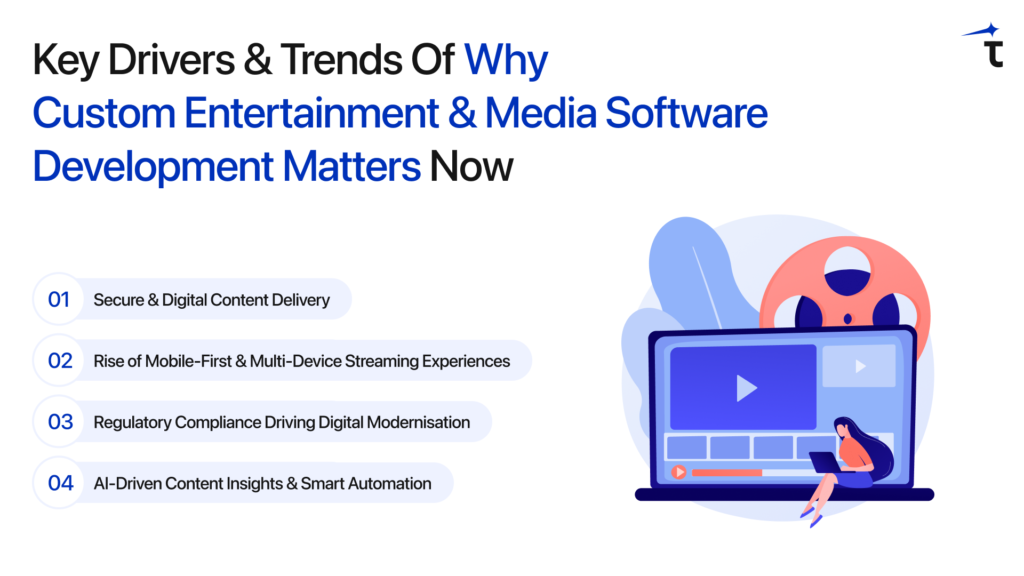
- Secure & Digital Content Delivery
Innovation in custom entertainment and media software has changed how content creators, distributors, and audiences communicate. Deployed across secure streaming, subscription management, digital rights management, live event broadcasting, and content access on many devices, modern streaming platforms can perform multiple functions.
In developing a modern streaming platform, these capabilities should be included:
- Safe payment option for managing subscriptions and/unlockable digital items
- Content to be delivered securely through a DRM-based network and via secured data transmission
- Building on a cloud-based and scalable infrastructure
- Real-time digital publishing of original works, along with live action content, to markets
- Automatic notifications to users, access rights, and the overall workflow should be automated
- Rise of Mobile-First & Multi-Device Streaming Experiences
People consume entertainment today more through mobile devices than ever before. Consumers typically will use their smartphone, tablet, smart television, or the Internet to:
- Find on-demand or live video
- Pay for their subscriptions
- Get personalized recommendations on what to watch
- Download a video for offline use
- Interact with content creators or platforms in real time
Due to this movement towards mobile-first consumption, media companies are moving towards video streaming software solutions that are:
- Mobile-friendly and user-friendly
- Integrated with analytic tools and other tools to measure and engage with audiences
- Authenticated securely across devices
- Optimized for viewing on smart televisions, wearables, and other connected devices
- Regulatory Compliance Driving Digital Modernisation
Entertainment and media businesses must comply with multiple regional and global regulations related to content licensing, data privacy, digital payments, and broadcasting rights. Compliance requirements typically include:
- Content licensing and copyright regulations
- Data protection and privacy laws
- Digital payment and subscription compliance
- Advertising and monetisation guidelines
Legacy systems often struggle to support these requirements. Custom streaming platform development enables:
- Automated rights and license management
- Secure storage and controlled access to digital assets
- Real-time audit trails and compliance reporting
- Accurate billing, taxation, and revenue reporting
- Standardised integration with third-party platforms
- AI-Driven Content Insights & Smart Automation
Utilising advances in AI and data analysis, the entertainment marketplace has changed drastically. Streaming media organizations continue to incorporate the use of AI within the platforms that they have developed, which offer businesses several specific options, including the following:
- Personalised content recommendations
- Viewer behaviour analysis and churn prediction
- Automated content tagging and metadata generation
- Monetisation and ad-performance optimisation
- Fraud detection in subscriptions and payments
The implementation of AI-driven functions helps reduce manual workload, enhances decision-making, and provides businesses with a deeper understanding of user data, laying the foundation for the future development of next-generation OTT platforms and intelligent video streaming software.
Benefits of an OTT Software Development Company for the Entertainment & Media Industry
With advancements in software development, the entertainment media industry has entered a new digital age. The emergence of custom-built platforms has changed how we create, manage, and distribute content. Companies can tap into scalable, secure, and future-ready digital solutions by working with an experienced OTT software development company. Below are some of their advantages.
- Intelligent Content Management
Modern entertainment software has simplified how digital assets such as video, audio, and multimedia are organized, stored, and delivered. Advanced content management systems enable efficient management of large media libraries. Streaming platform development also enables media companies to efficiently manage metadata, versioning, and workflows, ultimately leading to accurate, rapid content publishing across channels.
- Next-Generation Streaming Services
Streaming platforms powered by advanced video streaming software have changed the way we view entertainment. With streaming services providing users with instant access to on-demand and live content, along with features such as adaptive streaming, multi-device support, and personalized recommendations, streaming platforms offer media companies a high-quality experience that continues to exceed consumer expectations.
- Immersive & Interactive Experiences
Entertainment software is providing greater opportunities for more immersive audience engagement through new and emerging technologies, including augmented reality (AR), virtual reality (VR), and interactive content. Emerging technologies allow for new ways of interacting with media and provide new ways to create experiences for audiences, such as virtual concerts and interactive storytelling.
- Mobile-First Entertainment Applications
Mobile applications are the primary way entertainment content is delivered to consumers today. As mobile devices continue to change how consumers access and use entertainment, custom-built mobile applications with scalable video streaming software give users immediate, easy, uninterrupted access to entertainment on their devices.
- Advanced Data & Audience Analytics
The use of data analytics is critical for media companies to understand how and why audiences engage with the media content they view. Using specialized dashboard and reporting tools, entertainment software can transform large amounts of unstructured data into actionable intelligence. Entertainment software enables content personalization, giving businesses the tools to leverage audience data in their decision-making to increase engagement and the likelihood of audience return.
- Content Security & Digital Rights Management
For media companies, safeguarding digital material is critically important. New-age entertainment channels offer digital content with robust security solutions and DRM systems to protect it from unauthorized access or distribution. Developing secure systems with an experienced OTT software development partner would allow organizations to protect their intellectual property, meet compliance requirements, and safeguard revenue streams while still providing users with a seamless experience.
Key Features to Include in Entertainment & Media Software for OTT, Streaming & Content Management
A strong media software solution for entertainment and media comprised of strategic streaming platform development to help content owners, broadcasters, and digital media brands expand as they have never experienced before, connect with their audiences as efficiently and effectively as possible, and monetize their content as effectively and efficiently as possible.
Below are the combined features that will deliver a smooth workflow, secure content, high performance, and, ultimately, an excellent viewing experience on all devices
- Content & Digital Asset Management
Managing content and digital assets is at the core of any successful media platform. Sophisticated media software will allow your teams to create a central repository for storing, organizing, tagging, and retrieving audio, video, and images in one place.
If you work with an OTT software company with extensive development experience, your media library will support real-time updates, allow you to publish content quickly, and make it easy for you to distribute all of your content at scale with minimal barriers to entry.
- Video Streaming & Playback Management
High-quality video streaming software will provide you with an easy-to-use platform that delivers consistent video playback with no buffering and adaptive streaming across all devices and under all network conditions. Specifically, sophisticated media software will provide capabilities such as adaptive bitrate streaming, integration with a CDN, and real-time monitoring to guarantee your customers receive high-quality video playback consistently.
Additionally, a well-structured video streaming platform will support all types of streaming architectures. These include, but are not limited to, live streams, VOD streams, and hybrid content models.
- User & Audience Engagement Management
Platforms will have one single point of access to view user behaviour, preferences, watching history and engagement patterns on their platform across all devices. Integration with communication channels, including email, push notifications, and in-app messaging, will enable personalised recommendations and targeted content delivery for users. This overall provides a strong viewer retention experience and supports building long-lasting viewer loyalty in the entertainment ecosystem that is enabled by advanced streaming platforms.
- Mobile-First & Multi-Device Accessibility
By utilising a mobile-first approach, Entertainment software solutions can provide seamless access to content across Smartphones, Tablets, Smart TVs, and Web Platforms. Once users have access to their content, they can stream it, manage their subscriptions, resume where they left off, and receive real-time notifications on any device.
The architecture is scalable, which supports consistent performance, and mobile optimizations are very important for today’s OTT and digital media platforms.
- Monetization & Marketing Automation Tools
Built-in monetization features support subscription models, pay-per-view, ad-based streaming, and hybrid revenue strategies. Automation tools enable promotional campaigns, personalized offers, email workflows, and push notifications using performance analytics. With data-driven insights, media companies can optimize campaigns, improve conversions, and maximize revenue using intelligent video streaming software solutions.
- Content Security, DRM & Compliance
Built into the media applications, monetisation tools support subscription, pay-per-view, ad-supported, and hybrid revenue models. The media companies have access to all analytics to use the marketing automation tools at their disposal for promoting marketing campaigns and creating personalised offers for customers.
Use of email workflows and push notifications, as well as leverage the performance analytics from the previous quarters, and use them for optimising the next marketing campaign, improving conversion rates, and to use for maximising revenue generated per customer with the use of intelligent streaming video software.
- Analytics & Performance Insights
Real-time insights into viewership trends, engagement metrics, content performance, and revenue data are available through advanced analytics tools, enabling businesses to make informed decisions about content strategy, optimize their platforms, and target their audiences. The development of streaming platforms uses intelligent analytics to continually improve and experience long-term growth.
Custom Entertainment & Media Software Development Process
To build an effective OTT platform and media management system, you must take a well-organized approach to programming and select a technology stack that best suits your OTT development needs. By custom-developing software for your entertainment and media business, you will build a direct link between your content strategy and your audience engagement goals.
The following is a step-by-step approach to developing entertainment and media software for OTT platforms, video streaming, and content management platforms using the latest technology.
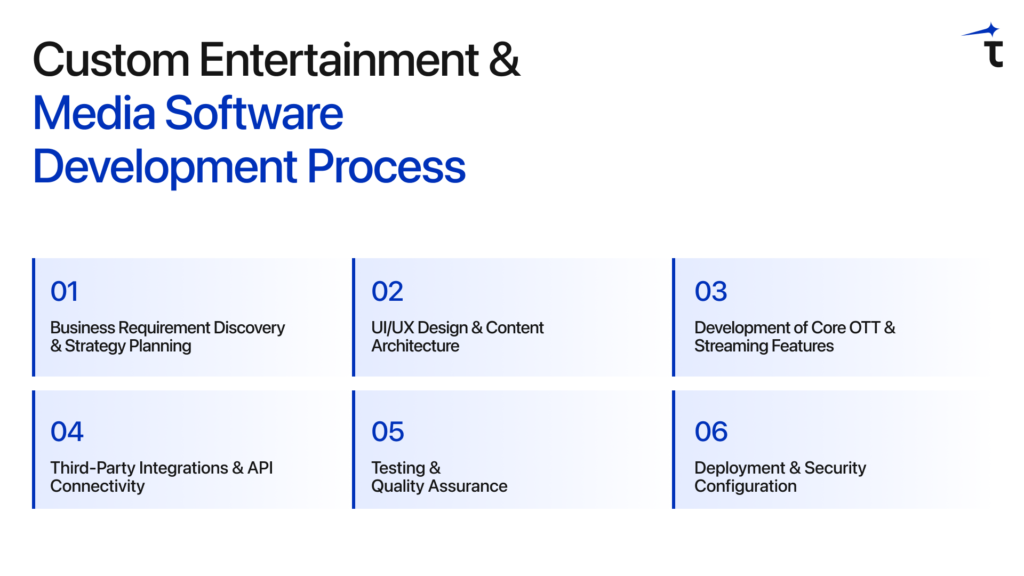
Step 1: Business Requirement Discovery & Strategy Planning
First, identify the business requirements and establish a strategy for creating a media platform. Before developing your OTT platform, you should have a thorough understanding of your media business model, content goals, and audience expectations. You will also need to identify the type of platform you are creating, your user roles, subscription model, monetization strategy, platform integration requirements, development timeline, and budget. By completing this step, you will have laid the groundwork for a successful OTT streaming development project by engaging a knowledgeable OTT software development company.
Step 2: UI/UX Design & Content Architecture
Designers and engineers work together in this phase to develop an easy-to-use, viewer-focused interface. UI/UX teams will develop seamless navigation, content discovery, and smooth playback across multiple devices; meanwhile, developers are creating a scalable back-end architecture to manage the large number of video assets, metadata, thumbnails, and associated licensing. A well-developed back end will enable quick content retrieval and provide a consistent user experience across web, mobile, and smart TVs.
Step 3: Development of Core OTT & Streaming Features
Programming the platform’s core functions occurs at this point. Develop and customize the following key functions: user authentication, content upload, video encoding, adaptive streaming, search and recommendations, watch history, subscriptions, and analytics. High-quality video streaming software will ensure low latency, no buffering during playback, and playback on multiple devices; this combination is critical for a high-performance entertainment platform.
Step 4: Third-Party Integrations & API Connectivity
The use of APIs to connect third-party services to enhance the capabilities of the platform. Payment gateways, CDN services, analytics tools, marketing automation, DRM providers, and cloud storage are examples of services that will be connected to your OTT platform via APIs. These integrations will provide a seamless operation of your OTT platform within your existing digital ecosystem. This will improve scalability, performance, and monetization of your OTT platform.
Step 5: Testing & Quality Assurance
Before your platform’s launch, comprehensive testing will be conducted to confirm its reliability, performance, and security. Functional testing confirms the quality & availability of streaming, that content reaches your users as expected, and that all user flows and payment systems work as intended. Performance testing establishes your platform’s ability to process high volumes of traffic, and security testing confirms the protection of customer data and digital assets.
Step 6: Deployment & Security Configuration
When testing is complete, your platform can be deployed in a cloud or hybrid production environment, depending on your business needs. During deployment, advanced security measures will be implemented on your platform, including encryption, DRM, access control, and configurations to comply with industry-standard requirements. These advanced security measures will protect the rights of the content you use, safeguard your customers’ data, and ensure secure delivery of your content across all channels.
Elevate Your Entertainment & Media Platforms with Technoyuga
Technoyuga delivers custom entertainment and media software solutions that empower businesses to launch scalable OTT platforms, optimize video streaming performance, and manage digital content efficiently. From seamless content delivery to AI-driven audience analytics, we help media brands enhance engagement and maximize monetization.
Ready to future-proof your entertainment ecosystem? Partner with Technoyuga, your trusted OTT software development company, and turn technology into your competitive advantage in the streaming era.
Conclusion
The entertainment media field has undergone a rapid transformation. The rise of OTT platforms and other digital content delivery systems means that to retain their audience, media companies must now rely heavily on creating high-quality, seamless, secure, and personalized experiences through advanced video streaming technologies and custom-built streaming applications.
Working with an established OTT application development partner will enable media organizations to future-proof their platforms, manage their content more efficiently and effectively, and expand their operations faster than ever as the digital marketplace continues to grow more competitive.
FAQs
1. What is entertainment and media software?
Entertainment and media software refers to digital solutions used to create, manage, distribute, and monetize content such as videos, music, live streams, and interactive media across multiple platforms, including OTT and mobile applications.
2. How does OTT software benefit media and entertainment businesses?
OTT software enables businesses to deliver on-demand and live content directly to users over the internet, improving audience reach, personalization, monetization options, and overall user experience.
3. Why is custom streaming platform development important?
Custom streaming platform development allows businesses to build scalable, secure, and feature-rich platforms tailored to their content strategy, audience behavior, and monetization goals, rather than relying on generic solutions.
4. What features should modern video streaming software include?
Modern video streaming software should include adaptive bitrate streaming, multi-device compatibility, content management systems (CMS), DRM protection, analytics dashboards, and seamless third-party integrations.
5. How does an OTT software development company support scalability?
An experienced OTT software development company designs platforms with cloud-based architectures, modular components, and performance optimization to support rapid growth and high concurrent user traffic.
6. Can entertainment and media software support live streaming?
Yes, advanced entertainment and media software supports live streaming with features like real-time chat, low-latency delivery, live analytics, and scalable infrastructure for events, sports, and broadcasts.
7. How does content management work in OTT platforms?
Content management systems in OTT platforms help organize, tag, store, and distribute digital assets efficiently, ensuring faster publishing, better discoverability, and smooth content updates.
8. Is OTT software secure for paid content?
Yes, professional OTT platforms integrate DRM, encrypted streaming, secure payment gateways, and access controls to protect premium content and prevent unauthorized distribution.
9. How does analytics improve OTT and streaming platforms?
Analytics tools provide insights into viewer behavior, content performance, watch time, and engagement, enabling data-driven decisions for content strategy, marketing, and platform optimization.
10. Why choose TechnoYuga for entertainment and media software development?
TechnoYuga is a trusted OTT software development company offering end-to-end video streaming platform development solutions tailored to business goals, scalability needs, and evolving digital media trends.