The retail and eCommerce environment is changing at a greater pace than ever, amidst the shifting consumer demands, online-first purchase behaviour, and severe rivalry in the marketplace. The modern consumer requires a hassle-free shopping experience, which can be in the form of online shopping, shopping at a physical location, or shopping in more than one channel. In order to achieve these expectations and be able to run businesses effectively, they can no longer afford linked systems or manual operations.
It is here that POS systems, inventory management and loyalty program platforms like Retail and eCommerce software solutions have extremely important roles to play. These solutions are the digital backbone of the present-day retail activities, which allow real-time monitoring of sales, accurate inventory view, expedited checkout, and personalized customer experience. Retail software integrations work to make businesses simplify, eliminate mistakes, and grow large with confidence, regardless of scale, whether small retail outlets or large omnichannel brands.
With the rise in competition and narrowing of margins, going with the appropriate retail technology is no longer a choice anymore; it is quite a strategic requirement. This article discusses the role of POS, inventory and loyalty solutions in changing the face of retail and eCommerce-based businesses, the advantages that they come with and how companies can successfully adopt them in the long-term to grow.
Key Takeaways:
- Integrated POS, inventory, and loyalty programs simplify processes and minimize mistakes.
- Real-time analytics assist in the optimization of inventory, pricing, and promotion.
- Repeat purchases are encouraged by loyalty programs and recommendations created by AI.
- Simplified, pay-as-you-drive solutions are cloud-based and do not require significant IT investments.
- The online, offline, and mobile connectivity enhances customer experience.
- Effective training of the staff will make sure that the software is as efficient and valuable as possible.
- The implementation risk is diminished due to experienced vendors possessing integration, support, and security knowledge.
Market Statistics & Industry Insights
The worldwide retail and eCommerce software market is steadily growing with a primary focus on automation, omnichannel preparedness, and data-driven choices in business. Among the industry know-hows, one should note that the use of technology is transforming the way people conduct their retail business nowadays:
Market Statistics & Insights
- The retail software market is also experiencing a consistent year in year growth that is supported by POS, inventory, and loyalty solutions.
- Retail applications are increasingly using cloud-based platforms since it is scalable, flexible, and has low infrastructure costs.
- In comparison to other companies that operate in single-channel retailing, omnichannel retailers have recorded improved accuracy in inventory and increased speed in order fulfillment.
- Promotions and loyalty programs are more personalized to the customers of data-driven retailers.
- Automated inventory systems allow minimizing the number of stock outs, stock outs and manual reconciliation errors.
Why Retail Software Adoption Matters Now — Key Drivers & Trends
Modern software applications are also being embraced more rapidly than ever before by retail and eCommerce businesses under the pressure of operations, escalating customer expectations, and mounting competition. The reasons why adoption becomes essential at this moment are as follows:
Key Drivers & Trends
- Quick automation and increased productivity: POS billing, inventory updates and reporting are automated, which helped in minimizing the work by humans and errors.
- Real-time data visualization: Centralized dashboards offer real-time insights into the sales, stock, and store performance.
- Competitive differentiation: Data intelligence assists retailers in making the best prices and assortment,s and promotions.
- Customer customization: Loyalty programs facilitate personalized offers, rewards and customer-specific interaction.
- Omnichannel preparedness: Integrated systems facilitate a smooth online, in-store and mobile shopping.
- Scalability and expansion: Retail software based on the cloud enables businesses to add stores or channels without having to make significant system redesigns.
Retail Software Market Growth & Metrics
The eCommerce and retail software market is growing at a high rate because businesses are updating their operations and switching to integrated digital systems. The growth indicators and performance measures are:
Market Growth & Adoption
- Incorporation of integrated POS, inventory, and loyalty systems is in the uptake of retailers in both SMBs and enterprises.
- Omnichannel companies are more technologically advanced than single-channel retailers.
- New rollouts are dominated by cloud-based retail software because it can be rolled out faster and is cheaper to maintain.
ROI Benchmarks and Success Indicators
- Better inventory accuracy results in fewer stock losses and stock overages.
- Rapid check out and lean operations boost sales throughput.
- The personalization based on loyalty enhances the customer lifetime value and repeat purchases.
Challenges & Opportunities
- Legacy system integration is still an issue.
- Early investment businesses can achieve a competitive edge due to the knowledge-based data and automation.
Types of Retail & eCommerce Software Solutions
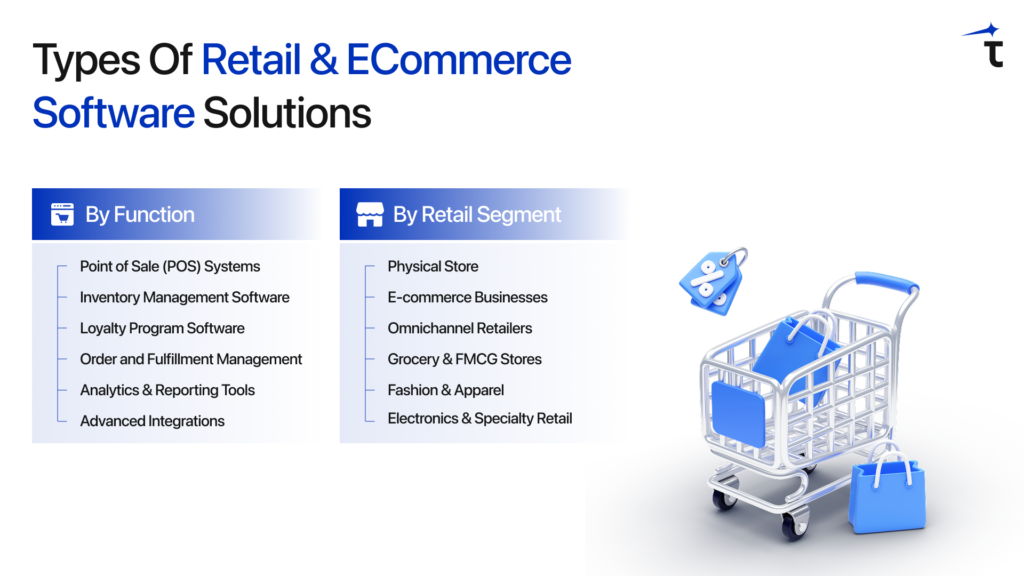
By Function
A wide range of software modules is used by retail and eCommerce companies to streamline operations, provide customers with high-quality experiences, and enable growth. The key functional groups are:
1. Point of Sale (POS) Systems
- Manages billing, refund, payments and returns effectively.
- Serves a variety of terminals and stores, making the check-out processes seamless.
- Interacts with inventory and loyalty systems to automatically refresh inventory and automatically issue customer rewards.
2. Inventory Management Software
- Tracks inventory in the stores, warehouses, and online.
- Notifies about low inventory automatically and aids in demand prediction.
- Minimizes inventory, stock-outs, and human errors.
3. Loyalty Program Software
- Operates rewards, cashback and customer points management.
- Allows offer segmentation and customized offers to maximize retention.
- Comes with POS and eCommerce integration to use during checkout.
4. Order and Fulfillment Management
- Manages online order processing, returns and shipping processes.
- Omnichannel endorses such fulfillment methods as ship-from-store or click-and-collect.
- Enhances the speed, precision and satisfaction in customers delivery.
5. Analytics & Reporting Tools
- Gives information about sales pattern, products sold and customer behavior.
- Measures KPIs in terms of revenue per store, conversion, and loyalty.
- Allows the use of data in the decision-making process in pricing, promotions, and inventory planning.
6. Advanced Integrations
- Integrates POS, inventory, and loyalty systems to CRM, ERP, payment gateways and marketplaces.
- Secures real-time information alignment of all business operations.
- Scalability and operational efficiency.
By Retail Segment
Retail and eCommerce software is programmed to match the requirements of various lines of business, guaranteeing business operation efficiency and streamlined customer interactions:
Physical Store: POS and inventory technology will simplify the checkout process, in-store inventory, and loyalty programs to boost frequent attendance.
E-commerce Businesses: Online stores are based on the order management, inventory synchronization, and analytics to process high-volume orders, as well as to monitor the customer behavior.
Omnichannel Retailers: This is the combination of online and offline channels that operates through integrated software that ensures an efficient update of inventory, customer data, and the continuity of pricing and promotion.
Grocery & FMCG Stores: FMCGs stock control, automatically replenishing, and expiry notification in real time will keep the stock fresh and minimize waste.
Fashion & Apparel: The sizes, color, and the variants of style are controlled efficiently, and the individualized loyalty offers and seasonal deals.
Electronics & Specialty Retail: POS, warranty, and product-related promotion guarantee the smooth functioning and customer satisfaction.
Also Read: Manufacturing Software Development Guide
Benefits of Retail & eCommerce Software Solutions
The modern retail and eCommerce software is known to have quantifiable advantages to the business, employees and even customers.
Retailers and Business Owners:
- Centralized processes: A single POS, inventory and loyalty management saves on manual efforts and errors.
- Real-time stock tracking: This is because real inventory in stores and warehouses enhances planning.
- Informed decisions: The information on sales, consumer behaviour, and offers will maximize profitability.
- Scalability: Systems expand with business to accommodate new stores, channels, and markets.
For Store Managers & Teams
- Repetitive tasks are automated: Billing, updating stock, and reporting are automated.
- Improved workflow: The staff will be able to work on the customer service rather than the manual operations.
- Performance monitoring: Dashboards assist in tracking the KPIs, sales, and staff efficiency.
For Customers
- Individualized experience: Loyalty programs and offers are enhanced to increase satisfaction.
- Time-saving: Rapid check-out and precise inventory data increase the level of shopping comfort.
- Regular interaction: Omnichannel experience ensures the continuity of interactions among touchpoints.
How to Develop Retail & eCommerce Software — Step-by-Step Process
The successful application of a retail and eCommerce program involves proper planning, organized implementation and follow-up. The following is a step-wise strategy which would guarantee the process is smoothly adopted and maximum ROI is achieved:
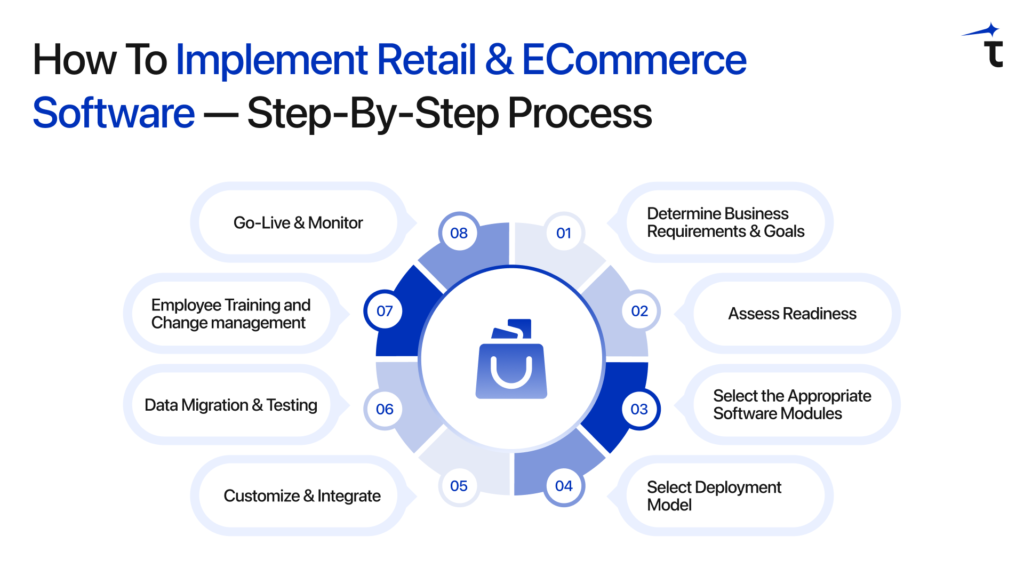
1. Determine Business Requirements & Goals
Begin with the evaluation of your existing operations. Determinants like slow checkout procedures and stock variances or poor client retention are identified as pain points. Establish specific objectives of the software such as better inventory accuracy, billing automation or loyalty program.
2. Assess Readiness
Portfolio assess infrastructure, hardware, and internet connectivity and staff preparedness. Make sure that you have reputable sources of data and a strategy of how your current records can be transported without any mistakes.
3. Select the Appropriate Software Modules
Choose what you require, POS or Inventory, Loyalty programs, Analytics or a comprehensive solution. It is better to prioritize the modules that will deal with your most urgent problems.
4. Select Deployment Model
Select cloud deployment, on-premise deployment or hybrid deployment depending on the scaling, cost and IT resources. Cloud solutions become simpler to scale whereas on-premise can have more control.
5. Customize & Integrate
Optimize the software to fit the business workflows. Connect with payment gateway, eCommerce software, ERP or CRM software to guarantee data flow amongst functions.
6. Data Migration & Testing
Enter data of inventory and customers cautiously. Carry out pilot tests to ensure functionality, iron out glitches, and to verify correct reporting.
7. Employee Training and change management
Educate workers in the functioning of POS, updating of inventory, and management of loyalty programs. Promote the use by providing good advice.
8. Go-Live & Monitor
Implement the system in different locations. Measure performance metrics, detect problems early and streamline work processes. The ongoing enhancement will provide the software with operation effectiveness, enhanced customer experiences, and scalable growth.
Have a Eye: Insurance Software Development: A Complete Guide for 2026
Risks & Challenges in Retail Software Implementation
The adoption of retail and eCommerce software can change the way operations are done, but businesses need to know the risks and challenges that may arise to make it a success.
1. Integration Issues:
Most of the retailers have legacy systems, including old POS or ERP systems. Implementation of new software into these systems may be tricky, which results in inconsistencies of the data, sluggish synchronization and hindrance of operations otherwise.
2. Data Quality & Accuracy:
The accuracy of data is very critical in retail software. Low quality or missing data may result in inaccurate inventory management, inaccurate reports, and inappropriate customer knowledge. This distorts the decision making process and may influence stock level and loyalty program success.
3. Staff Training & Adoption:
The most effective software will fail in case of poor employee training. It can be slowed down by resistance to change, technical incompetence or unfamiliarity with new systems that might decrease productivity during the early adoption.
4. Cost & Resource Management:
It may involve large amounts of money in licensing, customizing, hardware and support to be implemented. Companies should estimate budgets and resources well to prevent budget overruns.
5. Security & Compliance Risks:
Managing the data of customers, payments, and loyalty programs demands a solid cybernetic security system and compliance with the regulations. Weaknesses may result in breach of data, loss of money, and damaged reputation.
6. Scalability and Future proofing:
Selecting a system which is not capable of scaling with an increase in growth or future functionality can constrain future value. Flexible and modular solutions are required in the businesses to enable them to respond to market changes.
Best Practices for Successful Retail Software Implementation
The implementation of retail and eCommerce software is not simply a question of installing a system but it needs planning, implementation and further optimization. Adherence to best practices will make sure that businesses achieve their maximum efficiency, minimise errors and enhance customer experiences.
1. Start Small and Strategically
A full scale roll out may be dangerous to launch without any testing. Start with the most important modules such as POS, inventory and loyalty management in a single store or business unit. A pilot enables teams to detect the problems in workflows, integrations, or reporting, and scale it to all locations. When the pilot has been proven to be successful, add incrementally, with more sophisticated components like analytics or omnichannel fulfillment.
2. Define Clear ROI Metrics
Establish goals that are measurable before the implementation: it could be faster checkout times, it could be lower stock discrepancies, it could be better retention of customers, or it could be increased engagement with the loyalty program. Monitoring these KPIs allows monitoring the system that brings real benefits and supports the continued investment.
3. Focus on Staff Training and Change Management
The most sophisticated software is useless when the employees are not able to use it effectively. Train and carry out practical training, use step by step manuals and allocate champions of support in individual stores. Dispel any resistance to change by demonstrating how automation will decrease redundant work and permit employees to concentrate on customers.
4. Garner Integration and Interoperability
It is essential to seamlessly integrate with payment gateway systems, eCommerce systems, CRM systems, and ERP systems. It is well integrated so that the inventory is updated in real-time, reports are correct, and customer information is consistent across channels.
5. Emphasize on Data Quality and Governance
Precise data that is clean is paramount to the tracking of inventory, sales reporting and personalized offers. Also, perform validation checks during migration, and set policies of continuous data governance in place to ensure system reliability.
6. Monitor, Evaluate, and Iterate
Performance needs to be constantly observed post-launch. Monitor sales and stock numbers and loyalty activity using dashboards. Gather employee and customer feedback and make future workflows more refined, address loopholes, and refine features.
Key Features & Capabilities of Modern Retail Software
The present retail and eCommerce software surpasses simple billing and inventory tracking. Its capabilities are meant to be used in streamlining operations, improving customer experiences, and making data-driven decision-making actionable.
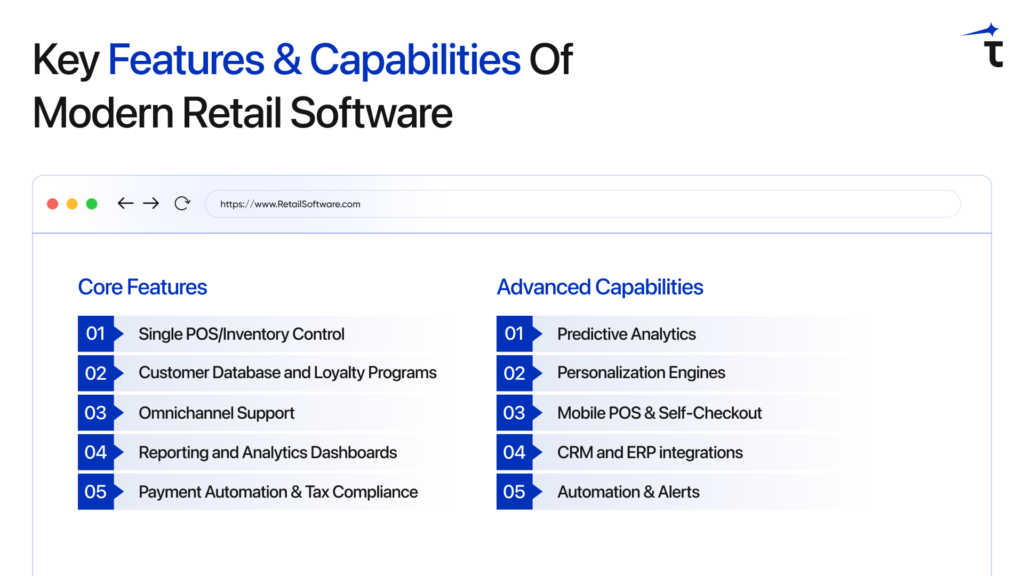
Core Features
Single POS/Inventory Control:
This is because real-time integration keeps inventory updated in stores and warehouses immediately sales are made thus preventing stockouts and overstocking. Multi-terminal support is the ability to check out and conduct operations in a variety of places.
Customer Database and Loyalty Programs:
A store is able to monitor the history of purchases, to divide customers, and to operate points, benefits or cashback programs. This allows targeted marketing, promotional activitie,s and increased retention of customers.
Omnichannel Support:
The retailers can deal with the in-store sales, online sales, and mobile sales through the same platform. This makes pricing, promotions, and stocks uniform and observed across channels.
Reporting and Analytics Dashboards:
Managers are able to track the performance of the sales, employees, inventory and profitability of goods and services in real time. The automation of reports will assist in determining the products and areas that are performing and those that require enhancement.
Payment Automation & Tax Compliance:
Allows paying through various options, such as a digital wallet, card payments, and EMIs, as well as calculating taxes automatically and making sure that they meet the requirements of regulations.
Advanced Capabilities
Predictive Analytics:
It involves the use of previous sales history to predict demand, minimize inventory turnover, and limit the wastage.
Personalization Engines:
AI-based suggestions allow making a personal offer, cross-selling, and upselling to enhance customer interaction.
Mobile POS & Self-Checkout:
Provides the customer with increased convenience and saves time during checkouts.
CRM and ERP integrations:
Ensures a smooth flow of information within customer management, accounting and supply chain systems.
Automation & Alerts:
Automatic low-level notifications, reorder and promotion will decrease the time spent on monitoring and decision-making.
Must Read: Entertainment & Media Software Development
Emerging Trends in Retail & eCommerce Software
The retail and eCommerce software is developing fast due to technological innovations and changing customer expectations. Companies embracing new trends become efficient in their operations, understand their customers better, and have a competitive advantage.
1. AI-based Retail Analytics:
Significant innovations in the modern retail world focus on artificial intelligence applications to forecast demand and usage, sales trends, and price optimization. Predictive analytics assists retailers in minimizing stockouts, overstocking and seasonal promotions are planned more precisely.
2. One-to-one Loyalty Programs:
Loyalty programs are no longer generic in terms of points and rewards. Segmentation based on AI allows offering unique deals, dynamic promotions, and personalized tips, as well as enhancing repeat purchase and customer lifetime value.
3. Omnichannel Integration:
Balanced retail platforms involve online, offline and mobile channels, which offer uniform product offerings, prices, and promotions. Such features as click-and-collect, ship-from-store, and real-time inventory visibility promote the smooth shopping process.
4. Mobile POS and Self-Checkout:
Mobile POS software and self-checkout terminals will improve the length of waits and convenience, as well as enable employees to concentrate on customer service.
5. Higher Automation:
Automated reorder notifications, low stock notifications, and workflow automation lowers manual labor, errors, and supply chain activities.
6. Cloud-Based and Scalable Systems:
Cloud solutions can be readily deployed, managed remotely and scaled so that retailers can increase their operations without significant IT investments.
7. Marketplaces and Third-Party Service Integration:
Modern software is integrated with eCommerce platforms, payment gateways, delivery services, and ERP systems so that all data flows and operations run smoothly.
ROI & Business Value of Retail Software
One of the most consistent returns of investing in retail and eCommerce software is the increase in efficiency in operations, customer interaction, and revenue. The value is multiplied in various aspects of the business, and it is not a simple tool but rather a strategic asset of the business.
1. Cost Reduction and Operational Efficiency
Combined POS and stock control systems decrease human operations, mistakes, and inventory deviations. Billings, reporting, and reorder alerts can also be automated so that the staff can concentrate on the customers. It lowers the cost of labor and losses incurred in overstocking or stockouts, which has a direct influence on profitability.
2. Revenue Expansion and Up-Selling Prospects
The personalized marketing and loyalty programs allow the use of targeted offers, upselling, and cross-selling. Recommendations based on AI assist customers in finding the pertinent products that boost the average order value. Retailers are likely to experience an increased conversion rate and repeat buying, which builds up to a sustainable revenue increase.
3. Data-Driven Decision Making
Real-time analytics dashboards would give information about sales and the behavior of customers and product performance. Pricing, inventory and promotion can be streamlined and this results in more planning and a higher turnover of inventory. Decisions that are supported by data minimize wastage and optimize profitability.
4. Customer Retention and Experience
The shopping experience is maximized by the seamless omnichannel operation and the customized loyalty programs. Quick checkout, correct stock listing, and regular promotions via both online and offline will gain trust and loyalty, which will enhance customer lifetime value.
5. Strategic Scalability
Cloud-based systems enable the company to add additional stores, sales channels or implement sophisticated features without substantial investment in IT. This flexibility is such that growth is not accompanied by the bottlenecks of operations or extravagant expenses.
Choosing the Right Retail Software Development Partner
The choice of appropriate software partner is a key factor in the deployment and performance of retail and eCommerce systems. The existence of a solid partner facilitates a good implementation process, integration and support.
Expertise in the Technical Field and Knowledge
Identify development companies that have a history of experience in retail and eCommerce software. They must know POS, inventory, loyalty, and omnichannel operations, and you should be able to tailor solutions based on your business requirements.
Scalability and Integration
The partner must offer solutions that can work well with the existing systems, like ERP, CRM, payment gateways, and marketplaces. Scalable solutions enable you to add more stores, new modules, or even implement new technologies with ease.
Security and Compliance
Data security is critical. Make sure that the vendor will comply with advanced cybersecurity practices and adhere to the local regulations of payment processing, customer data, and loyalty programs.
Post-Implementation Support
Continuous support, training, and updating of software are necessary. A trusted partner will provide committed support, troubleshooting, and advice to maximize performance in the long-term.
Vendor Reputation and References
Client portfolio reviews, case studies and checking client portfolios. Testimonials of current customers will give information on the reliability, quality of the services and successful implementations.
Also Read: Travel & Hospitality Software: Booking Engines, PMS & Guest Experience Tools
Conclusion
Retail and eCommerce software is no longer merely a tool, but a strategic facilitator that is a source of efficiency, growth, and customer retention. Combined POS, inventory, and loyalty programs are systems that are integrated to simplify operations, cut down on error and offer actionable information to support data-driven decision making.
Through scalable, cloud-based, and AI-powered solutions, retailers will be able to improve the experiences of the omnichannel, personalized customer interactions, and optimize resources. A selection of the appropriate software and implementation partner is the way to successful deployment and success in the long term. A competitive advantage, high revenues, and customer relations are the advantages that a business will have by investing in a strategic manner in retail software in the current dynamic market.
FAQs
Retail software is an online tool that assists companies in running transactions of POS, inventory, loyalty program, and analytics under a single platform.
Cloud-based solutions are scalable, remote, and cheaper to install. On-premise systems have more contro,l but they are costlier to maintain.
Prices are dependant on modules, number of stores, integrations, and customizations. SMBs may begin with basic modules, but businesses might require entire suites.
Yes, software today has the ability to match sales on and offline, which guarantees the presence of stock and price consistency and a single customer record.
Absolutely. The management of points, rewards, cashback, and targeted promotions can be made effortlessly to increase customer retention.
Yes, with good training, there is a smooth adoption, fewer errors, and higher efficiency.
Yes, it will give real-time visibility of the stock levels at the locations and warehouses to reduce shortages or overstocking.
Yes, dashboards monitor sales patterns, customer patterns, employee patterns, and the profitability of products.
Yes, scalable solutions can enable small retailers to begin with the basic features and expand with the growth.
There are also modern systems that are encrypted, handle secure payments ,and adhere to data protection laws to protect sensitive information.