Patients go to hospitals each day to seek treatment. But for thousands of these people, the hospital is where they’re injured, not due to their condition, but because they’ve fallen.
One patient attempts to get up in the middle of the night to go to the bathroom. A frail woman recovering from hip replacement falls over. A stroke survivor, disoriented and confused, moves too fast. In just a few moments, a minor incident becomes a medical crisis.
It occurs more frequently than you may think. Falls are the most common adverse events in hospitals. Until recently, hospitals and other care facilities have had few ways to prevent them. But these are now on the way out, thanks to AI.
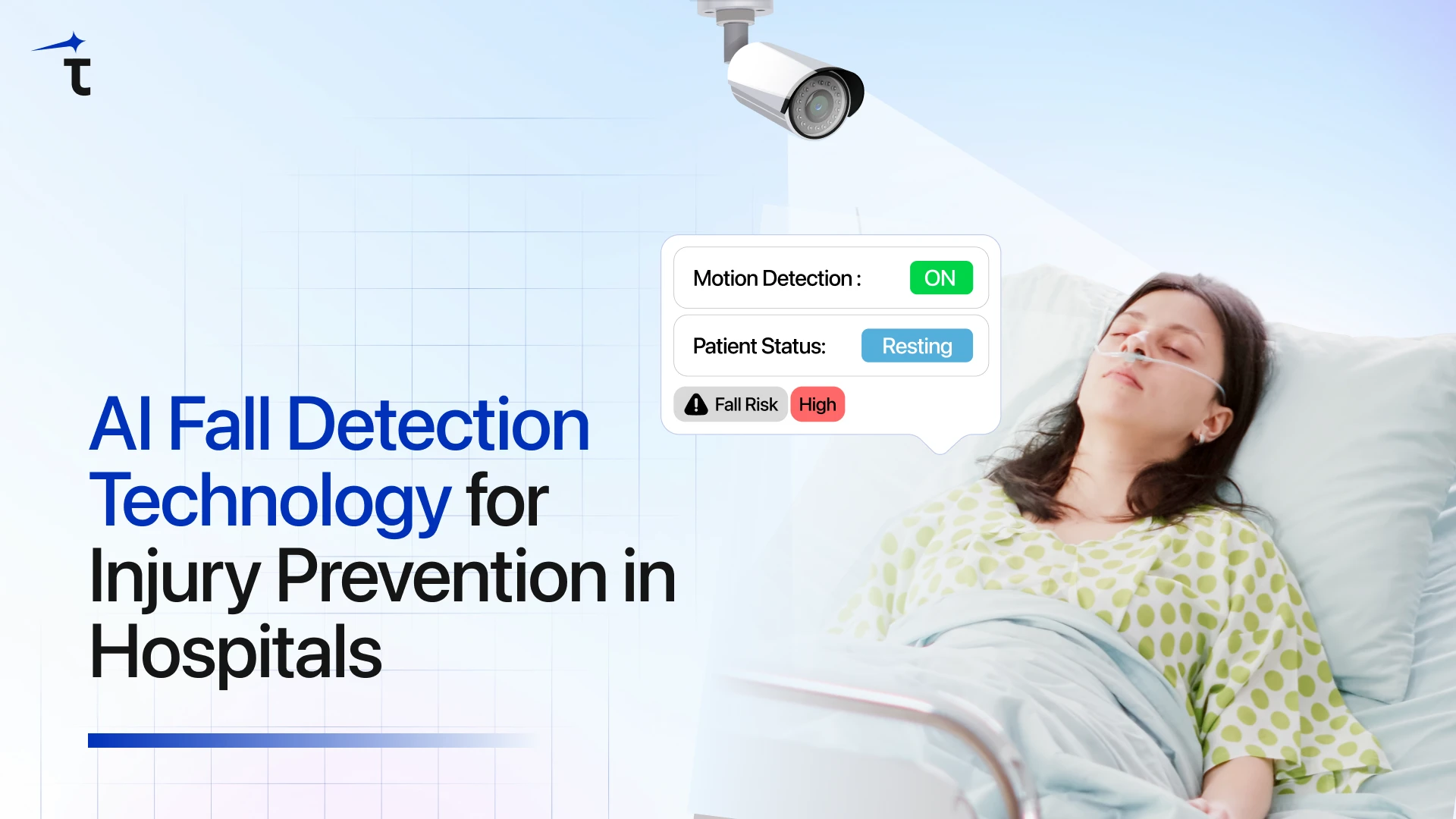
AI fall detection technology combines computer vision, machine learning, wearable sensors, and predictive analytics to monitor patients around the clock. The technology can detect risk factors in the moment and notify people before a patient falls.
This guide covers everything, from the scale of the problem to how the technology works to what hospitals can do right now to get started.
How Big Is the Hospital Fall Problem?
The Numbers Are Alarming
According to research published in Frontiers in Digital Health, roughly 1 million patient falls happen in U.S. hospitals every single year. That results in around 250,000 injuries and up to 11,000 deaths annually.
About 2% of all hospitalized patients fall at least once during their stay. Of those falls:
- 25% result in some form of injury
- 10% are classified as serious, including fractures, head injuries, and internal bleeding
Some patient groups face a much higher risk. Stroke patients, for example, have a fall rate between 14% and 65% during hospitalization. And among adults aged 65 and older, one in four falls every year, with each fall making the next one 50% more likely.
What Does a Single Fall Actually Cost?
A single injurious fall adds over $35,365 in costs per patient, according to JAMA Health Forum. Looking at the bigger picture, the total cost of treating fall-related injuries in older adults is projected to exceed $101 billion by 2030.
Beyond the money, falls lead to:
- Longer hospital stays
- Higher risk of hospital-acquired infections
- Extra tests, surgeries, or rehabilitation
- Permanent loss of mobility, up to half of patients over 65 who fall and break a hip never fully recover
There’s also a legal side. The Centres for Medicare & Medicaid Services (CMS) classifies serious fall injuries as “never events”, meaning hospitals receive no extra reimbursement for treating them. The financial and reputational damage can be enormous.
Why Traditional Fall Prevention Isn’t Working
Hospitals have been trying to prevent falls for decades. Standard tools include the Morse Fall Scale, bed exit alarms, non-slip socks, and keeping high-risk patients near the nursing station. These methods have their place, but they come with real limitations.
Risk Scores Are Subjective
One nurse may rate a patient as high risk. Another might not. There’s no consistent standard across shifts, wards, or hospitals. That inconsistency costs patients.
A Single Assessment Doesn’t Tell the Whole Story
A patient’s fall risk changes throughout the day, based on medications, fatigue, hydration, and health status. A morning assessment tells you very little about what’s happening at midnight.
Most Tools React Instead of Predict
Bed alarms go off after a patient has already started getting up. By the time staff respond, it’s often too late. Physical restraints, once used as prevention, are now discouraged because they can cause agitation and sometimes increase fall risk.
Nurses Are Stretched Too Thin
Nursing shortages are a growing global crisis. Expecting already-stretched staff to maintain constant one-on-one monitoring of every at-risk patient isn’t realistic. Healthcare needs technology that extends what care teams can do.
How AI Fall Detection Technology Works
AI fall detection isn’t a single tool, it’s a combination of technologies working together. Here’s how each piece fits in.
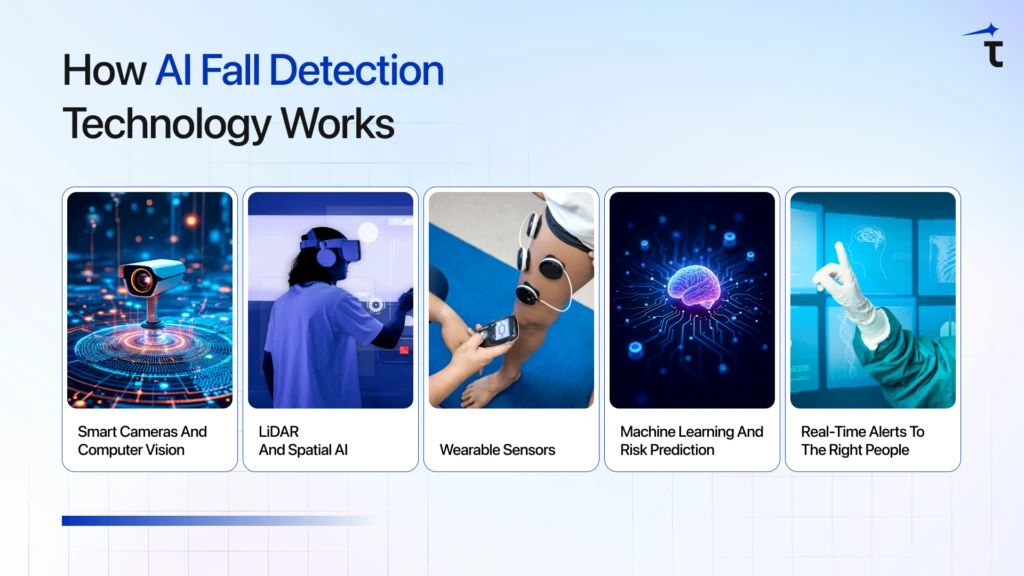
Smart Cameras and Computer Vision
AI-powered cameras in patient rooms track body position and movement in real time. These systems can:
- Detect unusual posture or body positioning
- Identify sudden movements that signal a fall
- Recognize when a patient is preparing to get up without support
Many systems protect privacy using blurred or anonymized images; the AI reads movement data without storing identifiable footage of patients.
LiDAR and Spatial AI
LiDAR (Light Detection and Ranging) uses infrared laser pulses to create a 3D map of a room. Unlike cameras, it captures no visual images at all, only movement and position data.
This makes it completely private while remaining highly accurate. Spatial AI using LiDAR can detect when a patient’s centre of gravity shifts, like leaning forward from a chair or swinging legs off a bed, and alert staff before anything goes wrong.
Wearable Sensors
Smart wristbands, pendants, and clip-on sensors track:
- Sudden changes in speed or direction
- Gait patterns and walking stability over time
- Early signs that fall risk is increasing
Wearables work well in settings where cameras aren’t practical or appropriate.
Machine Learning and Risk Prediction
This is where AI goes from detecting falls to preventing them entirely.
Machine learning models analyze each patient’s data, age, diagnosis, medications, mobility history, vital signs, and previous falls and generate a personalized risk score that updates in real time throughout the day.
These models are trained on millions of historical patient records, learning which combinations of factors predict a fall, often spotting patterns no human would catch. Staff see the scores on a live dashboard and can act before risk becomes reality.
Real-Time Alerts to the Right People
All this monitoring only works if the right person hears about it fast enough. Modern AI fall prevention systems connect directly with:
- Nurse call systems
- Staff smartphones via mobile apps
- Bedside alert panels
- Central monitoring stations
What the Research Actually Shows
The evidence for AI fall detection is solid and growing fast.
A comprehensive 2025 review in Safety Science found that AI-driven systems reduce hospital fall rates by 15% to 40%. Even the lower end of that range means tens of thousands of injuries prevented every year.
VirtuSense’s system has reportedly helped more than 1 million patients, prevented over 100,000 falls and saved healthcare facilities nearly $800 million.
It’s not all about the falls. AI monitoring eliminates the need for costly patient sitters, alleviates alarm fatigue (if correctly set up), and allows nurses to engage more with patients.
What About Patient Privacy?
This is a completely fair concern. People are vulnerable when they are sick. We don’t like being observed 24/7, and we have laws, such as HIPAA, that require privacy of patient information.
The good news is that modern AI fall detection systems are designed specifically with privacy in mind.
Blurred or Anonymized Images
The AI presents the data of body motion without generating images. Staff never see footage, only alerts.
LiDAR Instead of Cameras
Infrared spatial sensing captures movement with no visual imagery at all. Systems like VirtuSense’s VSTAlert are built to be fully HIPAA-compliant by using LiDAR rather than cameras.
On-Device Processing
The AI analysis is done on the device, no data is transmitted to the cloud. This ensures faster response times, improved reliability, and stronger patient data privacy compliance.
Patient Consent
Hospitals can include monitoring as part of the admission process so patients and their families understand how it works and what it doesn’t measure.
It’s possible to keep privacy and patient safety intact. Hospitals can have both with the right technology.
The Real Challenges of Getting This Right
The evidence is strong, but implementation isn’t simple. Hospitals should go in with honest expectations.
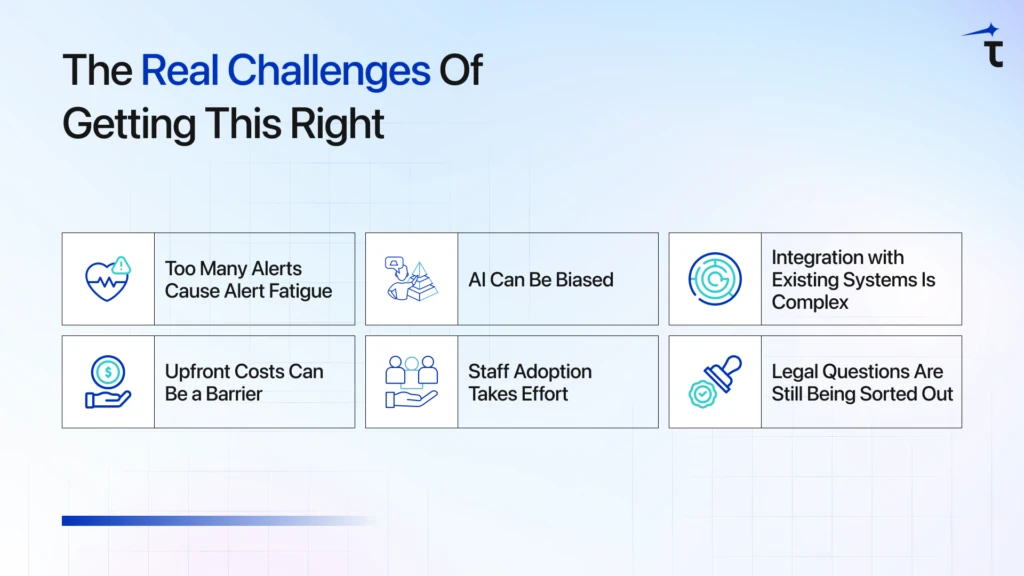
Too Many Alerts Cause Alert Fatigue
If an AI system sends too many false alarms, staff will start ignoring them, which defeats the whole purpose. The best systems use continuous model learning and careful calibration to keep alerts accurate and actionable.
AI Can Be Biased
A model might work for one population of patients, but not for another. Hospitals should ensure a system has been evaluated across different populations, and should anticipate audits in the future for bias.
Integration with Existing Systems Is Complex
Most hospitals have several EHR systems and clinical processes that are not designed for integration with AI. Integration takes time and effort by IT staff, clinical informaticists and vendors.
Upfront Costs Can Be a Barrier
Initial infrastructure costs are real, especially for smaller hospitals. But the ROI case is increasingly clear, Verso Vision estimates that a 200-bed hospital can see a return on investment in just 2 to 6 months, based on reduced falls, shorter stays, and avoided litigation.
Staff Adoption Takes Effort
Tech doesn’t work if it’s not accepted. Training, giving staff time to participate in the implementation process and explaining what the system can and cannot do are all critical.
Legal Questions Are Still Being Sorted Out
If an AI system misses a high-risk patient who then falls, who bears responsibility? These questions don’t have settled answers yet. The safest approach is treating AI as a decision-support tool that works alongside clinical judgment, not one that replaces it.
Where AI Fall Prevention Is Headed
The technology is evolving quickly. Here are the developments worth watching over the next few years.
Explainable AI
Clinicians want to know why a patient has been flagged as high risk, not just that they have been. Explainable AI models provide plain-language reasoning alongside their predictions, making it easier for staff to act on the information and for hospitals to trust the system.
Federated Learning for Better Models
This approach lets AI models learn from patient data across many hospitals, without centralizing any sensitive information. Each hospital trains locally and shares only model improvements, not patient records. The result: more accurate models that remain fully private.
Smarter Sensor Combinations
Combining cameras, LiDAR, wearables, and EHR data into a single unified model will deliver better accuracy than any one system alone. This “multimodal” approach is where the field is heading.
Expanding Beyond the Hospital
AI fall prevention is moving beyond inpatient wards into nursing homes, rehabilitation centers, and home care settings. Wherever vulnerable patients are, the same logic applies, continuous monitoring, early risk identification, and fast response leads to fewer falls and better outcomes.
A Practical Roadmap for Hospitals Ready to Act
If you’re a hospital leader thinking about implementing AI fall detection, here’s a clear and straightforward path forward.
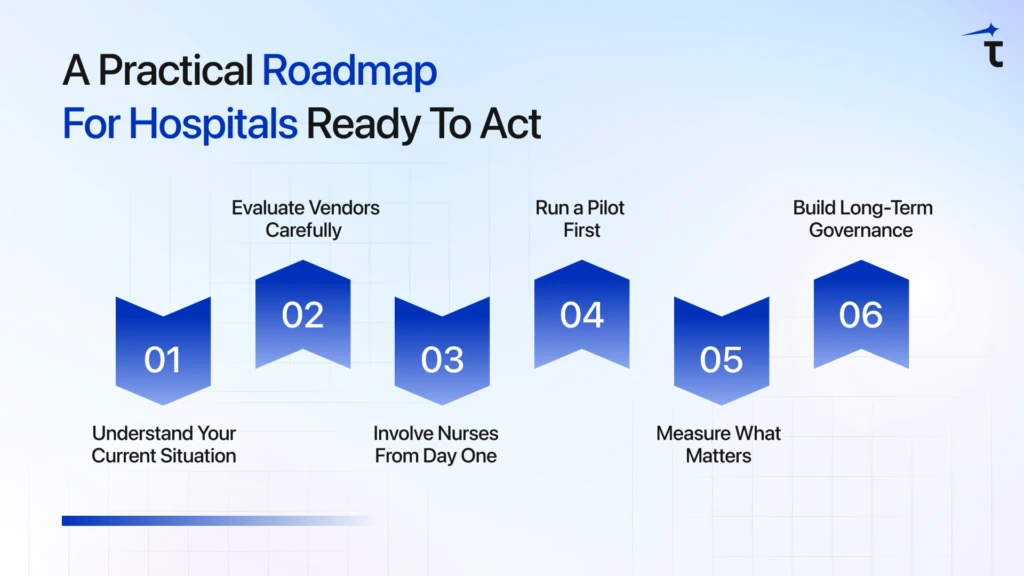
Step 1: Understand Your Current Situation
Start by knowing your current fall rates, which units are most affected, and what monitoring you already have in place. Use incident reports and EHR data to find where the biggest gaps are.
Step 2: Evaluate Vendors Carefully
Don’t take marketing materials at face value. Ask for peer-reviewed evidence. Get references from hospitals with similar patient populations. Look closely at false alarm rates and how the system performs across different types of patients. Make sure HIPAA compliance is built in: not bolted on afterward.
Step 3: Involve Nurses From Day One
The nurses and care coordinators who will use the system every day are your most important partners in making it work. Their feedback on alert routing, dashboard layout, and workflow fit will determine whether the technology actually gets used.
Step 4: Run a Pilot First
Pick one or two units with the highest fall rates and run a structured trial. Collect data carefully, address what isn’t working, and use the results to build support for expanding the program.
Step 5: Measure What Matters
Before you launch, define what success looks like. Track fall rates, fall-with-injury rates, alert response times, false alarm rates, and time saved for nursing staff. Review regularly and use the data to keep improving.
Step 6: Build Long-Term Governance
AI systems need regular maintenance, retraining, and monitoring over time. Assign clear ownership and make AI fall prevention a formal part of your patient safety governance structure, not just a one-time project.
Conclusion
Patient falls are one of the most common, and most preventable, sources of serious harm in hospitals today. The tools to fix this exist right now. AI fall detection technology is already being deployed in hospitals across the world, with real results: fewer falls, fewer injuries, lower costs, and nursing teams that have more time to focus on actual patient care.
Hospitals that move on this aren’t just protecting their patients better. They’re setting the standard for what modern, intelligent hospital safety looks like. The technology is ready. The question is whether healthcare is willing to embrace it.
FAQs
AI systems use sensors, cameras/LiDAR, and machine learning to monitor patient movements 24/7, detecting falls or risks (e.g., bed exits) and alerting staff in seconds for prevention.
No, many use anonymized LiDAR/radar (no images stored), on-device processing, and HIPAA compliance; blurred vision or thermal imaging protects dignity.
90-100% detection rates with 5-20% false alarms when tuned; ML like YOLO or ResNet outperforms traditional alarms (e.g., 95% in VirtuSense pilots).
TechnoYuga builds custom HIPAA-ready systems: sensor-ML integration, EHR alerts, predictive models, recovering stalled projects for 30-80% fall reductions.
Expert rescue (300+ projects), AI-first engineering (LLM/RAG, cloud), free audits, tailored for Indian/U.S. hospitals with 3-month ROI.