Banking has changed. Users no longer want to stand in queues or wait days for approvals. They expect instant onboarding, real-time transactions, and full control from their mobile devices. This shift has created massive demand for digital-first banking experiences.
Neobanks are leading this transformation. They remove physical barriers, reduce operational overhead, and deliver faster, simpler financial services. For businesses, this is not just a trend. It is a clear opportunity to build scalable fintech products with global reach. If you are planning neobank app development, this guide will help you understand every step, from strategy to execution.
Key Takeaways
- Start with a clear business model and target audience before you build a neobank app from scratch, as this defines your strategy and growth path.
- Focus on essential features and launch an MVP first, then scale with advanced functionalities based on user needs.
- Compliance and security are critical in neobank app development, so prioritize KYC, AML, and data protection from the beginning.
- Development cost depends on features, integrations, and platform choice, so plan your budget with scalability in mind.
- A strong architecture and the right development partner ensure your neobank app is secure, scalable, and ready for long-term success.
What Is a Neobank?
A neobank is a fully digital financial institution that operates without physical branches. It delivers banking services through mobile apps and web platforms, often in partnership with licensed banks or through its own banking license.
But it is more than just an app. A neobank combines user experience, financial infrastructure, compliance, and data-driven insights into one ecosystem. It focuses on speed, transparency, and simplicity. This is why businesses are investing in hiring mobile app developers to build a neobank app from scratch and compete in the digital banking space.
Why Businesses are Investing in Neobank App Development?
The rise of digital banking is driven by changing user expectations and business needs. Companies are entering this space to create new revenue streams and deliver better financial experiences.
- Growing demand for digital-first banking
Users prefer mobile-based financial services with instant access and real-time updates. - Lower operational costs
Without physical branches, businesses save significantly on infrastructure and staffing. - Scalable business model
Neobanks can expand across regions without major physical investments. - Multiple revenue streams
From subscriptions to lending and interchange fees, monetization opportunities are strong.
Businesses that invest in neobank app development or professional AI banking software development services are positioning themselves for long-term growth in fintech.
Types of Neobanks: Choosing the Right Business Model Before You Build
Before you start to build a neobank app from scratch, you need clarity on your business model. This decision defines your regulatory responsibilities, development complexity, time to market, and long-term scalability. Many businesses fail at this stage because they jump into development without aligning their model with their goals.
Each neobank type serves a different purpose. The right choice depends on your budget, compliance readiness, and target audience.
Full-Stack Neobank (Licensed Digital Bank)
A full-stack neobank operates with its own banking license. It manages everything from deposits to lending and compliance internally. This model gives complete control over operations and revenue streams.
- Best for: Large enterprises or well-funded startups
- Key advantage: Full ownership of financial products and user data
- Challenge: High regulatory burden and long approval timelines
To build and manage such complex platforms efficiently, many businesses choose to hire full stack developers who can handle both frontend and backend systems while ensuring seamless integration across banking operations.
This model works well if you want to build a long-term financial institution and have the resources to handle compliance and infrastructure.
Neobank with Banking-as-a-Service (BaaS)
This is the most popular model for startups entering fintech. Instead of getting a license, you partner with licensed banks and use their infrastructure through APIs. This allows you to focus on user experience and product innovation.
- Best for: Startups and mid-sized businesses
- Key advantage: Faster launch with lower compliance complexity
- Challenge: Dependency on third-party providers
If your goal is to quickly build a neobank app from scratch and validate your idea, this model offers the best balance of speed and cost.
Niche Neobank (Targeted User Segment)
Niche neobanks focus on a specific audience instead of serving everyone. This could include freelancers, small businesses, students, or high-net-worth individuals. The product is tailored to solve specific financial needs.
- Best for: Businesses targeting a defined user group
- Key advantage: Strong differentiation and user loyalty
- Challenge: Limited market size if not scaled properly
This model works well when you want to stand out in a competitive market with a focused value proposition.
Hybrid Neobank Model
Some businesses combine multiple approaches. They may start with BaaS for a quick launch and later move toward partial licensing or expanded services. This allows flexibility as the business grows.
- Best for: Businesses planning long-term expansion
- Key advantage: Flexibility to evolve the business model
- Challenge: Requires careful planning and system upgrades
To support this transition across platforms and ensure a consistent user experience, many companies invest inhybrid app development services that enable faster updates and unified performance.
Must-Have Features That Define a Successful Neobank App
When you plan to build a neobank app from scratch, features are not just add-ons. They directly shape user trust, engagement, and long-term retention. A strong neobank app focuses on simplicity for users while handling complex financial operations in the background.
The right feature set should balance usability, security, and scalability. Below are the core and advanced features every modern neobank app should include.
Core Banking Features (Foundation of Your App)
These features form the base of your product. Without them, the app cannot deliver essential banking services.
- Digital Onboarding with eKYC
Users should be able to sign up within minutes using secure identity verification. A smooth onboarding experience increases conversion rates and reduces drop-offs. - Account Management Dashboard
Provide real-time access to balances, transaction history, and account details. The dashboard should be clean, simple, and easy to navigate. - Instant Payments and Transfers
Enable fast and secure money transfers, both domestic and international. Speed and reliability are key expectations in modern digital banking. - Card Management Controls
Allow users to manage debit or virtual cards, set spending limits, and block cards instantly. This adds control and improves security. - Real-Time Notifications and Alerts
Send instant updates for transactions, account activity, and security alerts. This builds transparency and user confidence.
Advanced Features (Drive Engagement and Differentiation)
These features help your app stand out and improve user experience beyond basic banking.
- AI-Based Spending Insights
Analyze user transactions and provide insights into spending habits. This helps users manage finances better and adds value to your app. - Budgeting and Financial Planning Tools
Allow users to set budgets, track expenses, and achieve financial goals. This increases user engagement and retention. - Multi-Currency and Global Payments
Support multiple currencies and cross-border transactions. This is essential for users who travel or operate globally. - In-App Chat Support and Assistance
Provide instant customer support through chat or AI-based assistants. Quick support improves user satisfaction. You can also avail professional AI chatbot development services for seamless integration. - Fraud Detection and Risk Monitoring
Use AI to detect unusual activity and prevent fraud. Security features are critical in neobank app development.
A successful neobank app is not built by adding every feature at once. Start with a strong core, launch your MVP, and then expand based on user needs. This approach ensures your neobank app development stays focused, scalable, and aligned with real-world usage.
Must-Have Compliance & Security Requirements
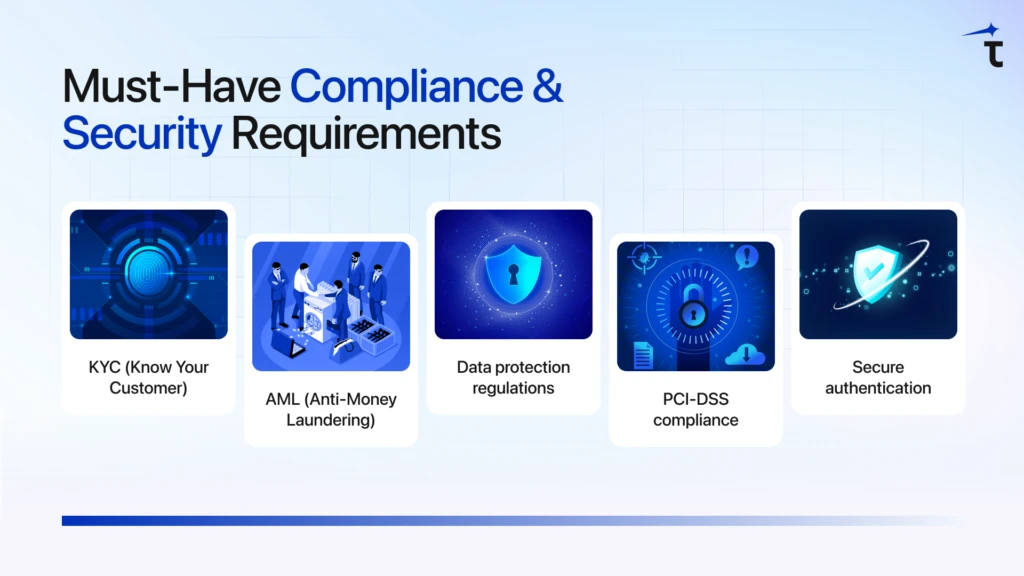
Compliance is one of the most critical aspects of neobank app development. Financial applications must meet strict regulatory standards.
- KYC (Know Your Customer)
Verify user identity during onboarding. - AML (Anti-Money Laundering)
Monitor transactions to prevent illegal activities. - Data protection regulations
Ensure user data is stored and processed securely. - PCI-DSS compliance
Required for handling card payments. - Secure authentication
Use multi-factor authentication and biometrics.
Ignoring compliance can lead to legal issues and loss of user trust.

Neobank App Architecture: How the System Works
When you build a neobank app from scratch, the frontend is only a small part of the system. The real strength lies in the architecture that powers transactions, security, and integrations in real time. A well-designed architecture ensures your app is fast, secure, and scalable from day one.
Instead of thinking of it as one system, a neobank works as a combination of multiple layers that communicate seamlessly. Each layer has a specific role, and together they create a smooth banking experience for users.
Presentation Layer (User-Facing Experience)
This is where users interact with your app. It includes mobile apps for iOS and Android, and sometimes a web dashboard. The focus here is on speed, clarity, and ease of use.
The interface should be simple enough for first-time users, yet powerful enough to handle complex actions like transfers, card control, and financial tracking. A strong presentation layer improves engagement and retention in neobank app development.
Application Layer (Business Logic and Operations)
This layer acts as the brain of your neobank. It processes user requests, manages transactions, and applies business rules. Every action, from sending money to updating account details, is handled here.
It ensures that operations are executed correctly and consistently. A well-structured application layer helps maintain performance even as user traffic grows.
Backend & Data Layer (Core System Infrastructure)
The backend handles data storage, account management, and transaction records. It works with databases and cloud infrastructure to ensure data is available and secure at all times.
This layer must support high volumes of transactions without delays. Scalability is critical here when you build a neobank app from scratch, as your user base will grow over time.
Integration Layer (Connecting External Services)
Neobanks rely heavily on third-party services. This layer connects your app with banking APIs, payment gateways, KYC providers, and card issuing platforms.
Smooth integration ensures real-time processing and expands your app’s capabilities without building everything from scratch. It plays a major role in speeding up neobank app development.
Security Layer (Protecting Data and Transactions)
Security is not a separate feature. It is embedded across all layers. This includes encryption, authentication, fraud detection, and access control.
Financial apps require strong protection to prevent breaches and ensure compliance. A robust security layer builds user trust and safeguards sensitive data.
Analytics & Monitoring Layer (Improving Performance)
This layer tracks user behavior, system performance, and transaction patterns. It helps you identify issues, optimize features, and improve user experience.
With proper analytics, you can make data-driven decisions and continuously enhance your product after launch.
Step-by-Step Roadmap to Build a Neobank App From Scratch
Building a neobank is not only about writing code. It is about aligning business goals, compliance, technology, and user experience into one structured process. When you build a neobank app from scratch, every step should reduce risk, improve clarity, and move you closer to a scalable product.
Below is a practical roadmap that helps you move from idea to launch without confusion or delays.
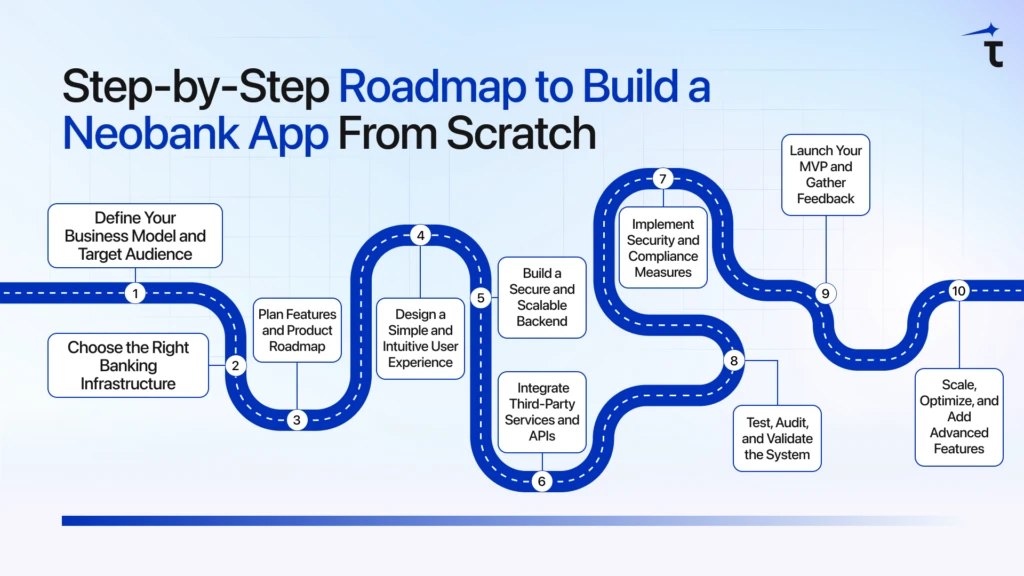
Step 1: Define Your Business Model and Target Audience
Start with clarity on who you are building for and why your product should exist. Identify your target users, such as individuals, freelancers, or businesses, and define the problem you are solving for them.
A clear value proposition helps you stand out in a competitive market. This step sets the direction for your entire neobank app development journey.
Step 2: Choose the Right Banking Infrastructure
Decide whether you will operate with a banking license or partner with a Banking-as-a-Service provider. This choice affects your compliance responsibilities, development timeline, and cost.
Most startups choose BaaS to launch faster, while larger organizations may opt for licensing for full control. Making the right decision here avoids future roadblocks.
Step 3: Plan Features and Product Roadmap
List the features you need for your initial launch and prioritize them based on user value. Focus on building a Minimum Viable Product with essential functionalities instead of adding everything at once.
A clear roadmap ensures your neobank app development stays focused and avoids unnecessary complexity.
Step 4: Design a Simple and Intuitive User Experience
User experience plays a major role in adoption. Design an interface that is easy to navigate, visually clean, and that builds trust.
Users should be able to complete actions like onboarding, transfers, and account management without confusion. A strong UX improves retention and engagement.
Step 5: Build a Secure and Scalable Backend
The backend is the foundation of your neobank. It handles transactions, user data, and integrations.
Focus on building a system that can manage high traffic and ensure data security. A scalable backend is essential when you build a neobank app from scratch for long-term growth.
Step 6: Integrate Third-Party Services and APIs
Neobanks rely on external services for payments, KYC verification, and card issuing. Integrate these services carefully to ensure smooth functionality.
Proper integration improves performance and allows you to offer advanced features without building everything internally.
Step 7: Implement Security and Compliance Measures
Security is critical in financial applications. Implement encryption, multi-factor authentication, and fraud detection systems.
Ensure your app meets regulatory requirements such as KYC, AML, and data protection standards. This builds trust and prevents legal issues.
Step 8: Test, Audit, and Validate the System
Before launch, test your app thoroughly. Check for performance issues, security vulnerabilities, and usability gaps.
Conduct compliance audits and ensure all systems are working as expected. This step reduces the risk of failure after launch.
Step 9: Launch Your MVP and Gather Feedback
Release your app with core features and monitor user behavior. Collect feedback to understand what works and what needs improvement.
Launching early helps you validate your idea and make informed decisions for future updates.
Step 10: Scale, Optimize, and Add Advanced Features
After validation, start scaling your product. Introduce advanced features like AI insights, lending, or investment tools.
Continuously improve performance and expand your offerings. This ensures your neobank stays competitive and relevant in the market.
Following this structured approach helps you build a neobank app from scratch with clarity and confidence. It reduces risks, improves efficiency, and ensures your product is ready for real-world usage.

Cost to Build a Neobank App: Detailed Breakdown for 2026
When you plan to build a neobank app from scratch, cost becomes one of the most important decisions. There is no fixed price because every neobank is different in terms of features, compliance needs, and technical complexity. The final budget depends on how advanced, secure, and scalable you want your product to be.
On average, neobank app development cost ranges from $50,000 to $300,000+. A basic MVP stays on the lower side, while a fully-featured, enterprise-grade neobank requires higher investment. The key is to start lean and scale gradually based on user demand.
Estimated Cost Breakdown Based on App Complexity
| App Type | What It Includes | Estimated Cost |
| MVP (Basic Neobank App) | Onboarding, account management, payments, basic security | $50K – $100K |
| Mid-Level App | Advanced UI/UX, analytics, multi-currency, integrations | $100K – $180K |
| Advanced / Enterprise App | AI features, fraud detection, lending, and full compliance systems | $180K – $300K+ |
How to Optimize Your Neobank Development Cost
- Start with an MVP instead of building everything at once
- Choose the right tech stack and scalable architecture
- Partner with an experienced team to avoid rework
- Focus on features that deliver real user value
A smart approach to budgeting ensures that your neobank app development stays efficient while still delivering a high-quality product.
How Neobanks Make Money: Monetization Strategies That Drive Growth
When you build a neobank app from scratch, having a clear revenue model is essential. Neobanks do not rely on a single source of income. They combine multiple strategies to create steady and scalable revenue streams.
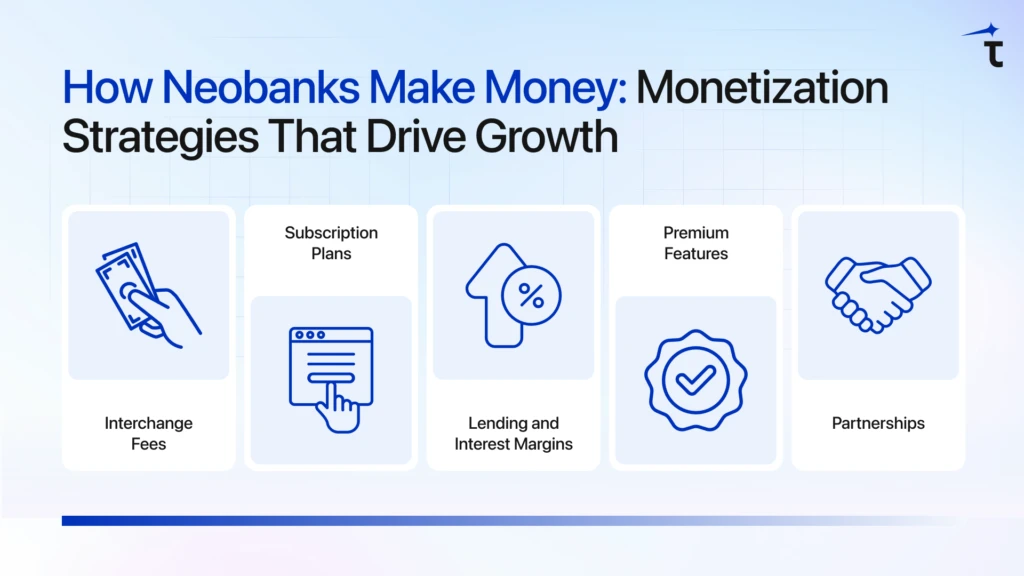
Interchange Fees
Neobanks earn a small percentage every time users make card payments. As transaction volume grows, this becomes a consistent revenue source.
Subscription Plans
Premium plans offer added features like higher limits or advanced insights. Users pay a monthly fee, creating a predictable income.
Lending and Interest Margins
Neobanks generate revenue by offering loans or credit services. Interest earned from these services contributes significantly to profits.
Premium Features
Advanced tools like financial analytics or faster services can be offered as paid add-ons. This helps monetize active users.
Partnerships
Collaborations with financial and service providers generate commission-based income. It also expands the overall ecosystem.
A balanced mix of these strategies ensures your neobank app development remains profitable while delivering value to users.
Real-World Neobank Examples: What Successful Digital Banks Do Differently
Understanding how leading neobanks operate helps you make better decisions when you build a neobank app from scratch. These companies did not grow by adding features randomly. They focused on user needs, simple experiences, and scalable business models.
Each example below shows a different approach to neobank app development, from zero-fee banking to global financial ecosystems.
Chime: Simplicity and Zero-Fee Banking
Chime built its success by removing common banking pain points. It offers no hidden fees, early direct deposits, and a clean mobile experience.
Its focus on transparency and ease of use helped it attract millions of users, especially in the US market.
Revolut: All-in-One Financial Super App
Revolut goes beyond basic banking. It offers multi-currency accounts, stock trading, crypto, and budgeting tools in one platform.
This approach turns the app into a complete financial hub, increasing user engagement and revenue opportunities.
N26: Clean UX with Strong European Presence
N26 stands out for its minimal design and seamless onboarding experience. It focuses on providing fast account setup and intuitive money management tools.
Its strong compliance and user experience helped it scale across multiple European markets.
Why TechnoYuga Is the Right Partner for Neobank Development
Choosing the right development partner defines how smoothly your idea turns into a scalable product. TechnoYuga brings strong expertise in neobank app development, combining secure architecture, compliance-focused processes, and user-centric design. The team works across the full cycle, from strategy and MVP launch to scaling advanced fintech features. With a focus on performance, data security, and seamless integrations, TechnoYuga helps businesses build a neobank app from scratch that is reliable, compliant, and ready for real-world growth.
Conclusion
Building a neobank is not only about launching a digital banking app. It is about creating a seamless financial experience that users trust and rely on every day. From choosing the right business model to defining features, ensuring compliance, and planning monetization, every step plays a role in long-term success. A structured approach helps you reduce risks, control costs, and deliver a product that meets real user expectations.
If you plan to build a neobank app from scratch, start with a clear strategy and focus on solving real problems for your users. Launch with essential features, gather feedback, and scale gradually with advanced capabilities. With the right technology, planning, and development partner, you can build a neobank that stands strong in a competitive fintech market and delivers consistent value over time.

FAQs
Start by defining your business model, target audience, and features, then choose the right banking infrastructure. Follow a structured process, including design, development, compliance, and testing, for successful neobank app development.
The cost to build a neobank app typically ranges from $50,000 to $300,000+, depending on features, integrations, and compliance requirements. Starting with an MVP helps reduce initial investment.
Neobank app development usually takes 4 to 9 months based on complexity and features. Advanced apps with AI and integrations may take longer.
Key features include digital onboarding, account management, payments, card controls, and security systems. Advanced features like AI insights and budgeting tools improve user engagement.
No, you can partner with licensed banks using Banking-as-a-Service to launch faster. However, having your own license gives more control but requires strict compliance.