Imagine deploying a system that doesn’t just follow instructions, it actually figures out what needs to be done and does it. No human nudge required. No scripted responses. Just autonomous action toward a real business goal.
That’s agentic AI. And while it might sound futuristic, it’s already operational in enterprise workflows across finance, healthcare, logistics, retail, and IT, quietly cutting processing times, reducing errors, and handling decisions that once required entire teams.
But before you commit to a full-scale AI build, there’s a smarter move: an Agentic AI Proof of Concept (POC). It’s how the most successful companies test the waters without betting the entire budget, validating whether autonomous AI can genuinely work inside their specific environment.
Nearly 62% of enterprises are already engaged with agentic AI, either scaling it or actively experimenting. Organizations running structured POCs are projecting an average ROI of 171% from their deployments. The question isn’t whether to explore it. It’s how to do it right.
This guide gives you everything you need, from understanding what agentic AI actually is to selecting your use case, choosing the right tools, building your POC, and knowing what comes next. Nothing padded. Every section earns its place.
What Is Agentic AI?
Most AI tools you’ve used so far are reactive. You type something, they respond. Agentic AI is fundamentally different. These systems are proactive, goal-oriented, and capable of executing multi-step tasks with minimal human supervision.
A standard AI chatbot answers your question. An agentic AI reads the incoming email, checks your calendar, searches your CRM, drafts a reply, flags conflicts, and sends it, autonomously, from start to finish.
The Five Core Traits of an Agentic AI System
- Autonomous decision-making, the agent determines the next step based on its goal, not a preset script
- Multi-step task execution, it can plan, break down complex workflows, and carry them to completion
- Tool and API integration, agents connect to databases, CRMs, calendars, email, and external services
- Memory and context retention, they learn from prior interactions and improve over time
- Adaptability, when something unexpected happens, they adjust rather than fail
According to the 2025 Cisco AI Readiness Index, 83% of organizations had already planned to deploy agentic AI systems.
Agentic AI vs. Traditional AI vs. Generative AI
| Feature | Traditional AI | Generative AI | Agentic AI |
| Responds to input | Yes | Yes | Yes |
| Takes autonomous action | No | No | Yes |
| Multi-step task execution | No | Partial | Yes |
| Uses external tools/APIs | Rarely | Sometimes | Core capability |
| Adapts in real time | No | Limited | Yes |
| Requires constant prompting | Yes | Yes | No |
What Is an Agentic AI POC?
A Proof of Concept (POC) is a focused, time-bound experiment designed to answer one practical question: Can this autonomous agent deliver real business value inside our actual environment?
It’s not a demo. It’s not a prototype. It’s not a full product. A POC is a controlled test, narrow in scope, serious in method, that gives your organization evidence before commitment.
Why Agentic AI POC Development Matters for Business
Skipping straight from idea to full deployment is one of the costliest mistakes a company can make. Gartner predicts 40% of agentic AI projects will face cancellation by the end of 2027, not because the technology fails, but because organizations underestimated production complexity and didn’t validate before scaling.
A well-run POC gives you three things that no whiteboard discussion or vendor pitch can replace:
- Strategic clarity: You align the AI initiative to a measurable business goal, not just excitement about autonomous agents
- Controlled risk: You test in a limited, safe scope before exposing real customers or committing real budget
- Stakeholder confidence: You bring leadership evidence, not assumptions. That evidence is what unlocks the bigger investment
When a POC Is Absolutely the Right First Step
- You are exploring a genuinely new use case with no internal precedent
- The workflow touches regulated data (finance, healthcare, legal)
- Multiple systems would need to be integrated for the agent to function
- Leadership needs evidence before approving a larger AI budget
- Your team hasn’t built agentic systems before and needs to assess what’s realistic
When a POC Might Not Be Necessary
- You’re implementing a well-documented, off-the-shelf agent solution with proven results in your industry
- The use case is extremely simple (single-step automation, not multi-step agentic behavior)
- You already have internal data proving feasibility from a prior experiment
In those cases, a direct pilot or phased rollout may be the more efficient path.
The Agentic AI POC Development Process
The most successful POCs follow a consistent, disciplined structure. Here’s exactly how it works:
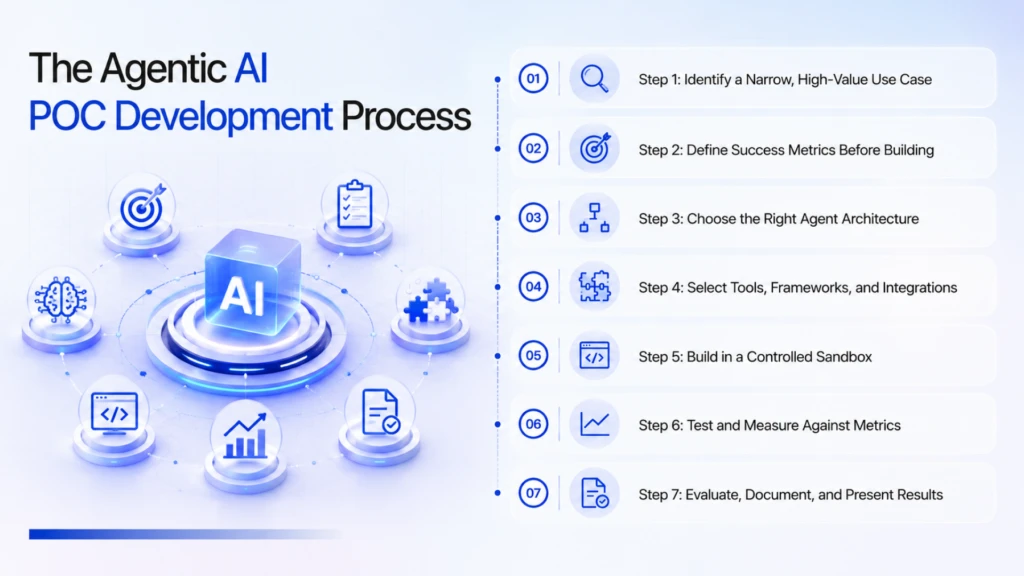
Step 1: Identify a Narrow, High-Value Use Case
The most common POC failure is scope creep. Teams try to validate too many things at once and end up with results that prove nothing clearly. The tighter your scope, the cleaner your evidence.
Choose one workflow that is repetitive, data-driven, and currently causing real friction or cost. Strong candidates include: invoice processing, support ticket routing, document review, procurement approvals, lead qualification, or compliance checking.
Step 2: Define Success Metrics Before Building
Before writing a single line of code, align your team on what a successful POC looks like. This step is skipped more often than you’d think, and it’s why many POC results are ambiguous.
Define metrics such as:
- What percentage of cases does the agent handle correctly end-to-end?
- How often does the agent’s output match the expected outcome?
- How does agent processing time compare to the current manual process?
- How often does the agent make a mistake that requires human correction?
- What percentage of cases does the agent escalate to humans, and is that within an acceptable range?
Set specific numbers. ‘Good enough’ is not a success criterion.
Step 3: Choose the Right Agent Architecture
Not all agentic systems are built the same. Your architecture choice shapes everything from development effort to reliability in production.
- Single agent, one autonomous agent handles the entire task end-to-end. Best for simpler, well-defined workflows.
- Multi-agent, multiple specialized agents collaborate, each handling a subtask. Best for complex workflows with distinct phases. This now represents 66.4% of the enterprise agentic AI market.
- In a human-in-the-loop hybrid, the agent handles routine decisions autonomously and escalates edge cases to a human. This is the recommended architecture for regulated industries or any POC where full autonomy is still being validated.
For a POC, starting with a human-in-the-loop model is almost always the right call. It lets you observe the agent under real conditions while maintaining control, and it builds stakeholder trust faster.
Step 4: Select Tools, Frameworks, and Integrations
Your agent needs to connect to real systems, not simulated ones. Plan your integrations before building, this is where the most time is lost if left until later.
Key decisions at this stage:
- Which LLM will power the agent’s reasoning? (GPT-4o, Claude, Gemini, or a fine-tuned model)
- Which agent framework handles orchestration?
- What data sources and APIs must the agent access?
- What are the security and access control boundaries?
- How will you log, trace, and monitor agent actions during the POC?
Step 5: Build in a Controlled Sandbox
Start with the simplest version of the agent capable of attempting the task. Test on real data in a sandboxed environment, never in production systems for a POC.
A basic single-agent workflow can typically be prototyped in 1–2 weeks. A more complex multi-agent POC usually takes 2–4 weeks with a focused team. The goal is not a polished product, it’s enough functionality to generate meaningful test results.
Test edge cases from day one. Unexpected inputs reveal far more about reliability than ideal-scenario tests. Document every failure mode; they’re as valuable as the successes.
Step 6: Test and Measure Against Metrics
Run the agent through enough test cases to generate statistically meaningful results, not just a handful of handpicked examples. Include ambiguous inputs, incomplete data, and edge cases that a human would struggle with.
Compare results against the metrics you defined in Step 2. Be rigorous and honest. A POC that surfaces a 30% failure rate on edge cases isn’t a failed POC, it’s valuable information that shapes the next phase.
Step 7: Evaluate, Document, and Present Results
The final deliverable of a POC is not a working demo, it’s a decision-ready document. Your evaluation report should cover:
- What the agent can reliably handle autonomously
- Where human oversight is still necessary and why
- Projected ROI if the system were scaled to production volume
- Integration effort required for a full deployment
- Security, compliance, and governance considerations surfaced during testing
- Recommended next step: scale, pivot the use case, or pause
Leadership should be able to make a confident, evidence-backed decision after reading this document.
Timeline and Cost
One of the most common questions decision-makers ask before approving a POC is: how long will this take, and what will it cost? Here’s an honest breakdown based on real industry data.
Timeline by POC Complexity
| POC Type | Description | Typical Timeline |
| Simple single-agent | One agent, one workflow, minimal integrations | 1–2 weeks |
| Standard POC | Single agent, 2–3 integrations, real data testing | 2–4 weeks |
| Multi-agent POC | Agent collaboration, complex workflow, enterprise integrations | 4–8 weeks |
| Regulated-environment POC | Healthcare, finance, or legal, an additional compliance layer | 6–12 weeks |
Cost Ranges
The industry average for an agentic AI POC ranges from $5,000 to $20,000 over 2–8 weeks, depending on complexity and whether you’re using pre-built frameworks or building from scratch.
Key cost drivers:
- LLM API usage: Costs have dropped approximately 80% year-over-year since 2024, but high-volume testing still adds up. Monthly API costs in production typically run $100–$5,000+, depending on volume.
- Development effort: The largest cost driver. Teams using established frameworks (LangGraph, CrewAI) can reduce development time by 60–70% compared to building from scratch.
- Infrastructure: Compute, storage, monitoring tools. Open-source frameworks are free to self-host; SaaS observability tools typically start at $50–$200/month.
- Data preparation: Often underestimated. Budget 20–30% of total effort for data cleaning, formatting, and API groundwork.
Also Read: AI Development Cost in 2026
Roles on an Agentic AI POC Team
You don’t need a massive team to run a successful POC. But you do need the right people. Here are the key roles, and what each one actually does:
Core Roles
- AI/ML Engineer: Builds and configures the agent, selects the framework, handles LLM integration, and tests agent behavior. This is the technical lead of the POC.
- Product Owner / Business Analyst: Defines the use case, owns the success metrics, and bridges the gap between the technical team and business stakeholders. Without this role, POCs drift.
- Domain Expert: The person who deeply understands the workflow being automated (e.g., a claims processor for insurance, a finance analyst for invoice processing). Their knowledge shapes the agent’s decision boundaries.
- Data Engineer: Prepares and formats the data that the agent will work with. Given that data preparation consumes 80% of real project effort, this role is more important than most teams expect.
- QA / Evaluation Lead: Designs the test cases, runs the evaluation against defined metrics, and documents both successes and failures objectively.
Supporting Roles
- Security / Compliance Reviewer: Essential for any regulated industry. Reviews agent access controls, data handling, and escalation logic.
- UX Researcher: If the agent will surface outputs to end-users, someone should test whether those outputs are usable and trustworthy.
- Executive Sponsor: Not hands-on, but present. McKinsey data shows that AI high performers are three times more likely to have senior leaders actively engaged in AI adoption. Sponsorship matters.
Tech Stack and Frameworks for Agentic AI POC Development
The tools you choose determine how fast you can build, how observable your agent is during testing, and how scalable the system becomes if you move to production. Here’s a clear, opinionated breakdown of what’s available.
Agent Orchestration Frameworks
- LangGraph (LangChain) is the go-to choice for workflows that require branching, conditional logic, loops, or state persistence. It models agents as directed graphs, making complex workflows auditable and debuggable.
- CrewAI, a role-based multi-agent framework built from scratch, is designed for speed and low resource overhead. You assign agents to roles (researcher, planner, executor) and they collaborate to complete tasks.
- Microsoft Agent Framework (formerly AutoGen), Microsoft merged AutoGen and Semantic Kernel into a unified SDK in late 2025. Asynchronous, event-driven, with strong Azure integration.
- LlamaIndex is less of an agent framework, more of a data orchestration layer. Excellent for agents that need to retrieve and reason over large knowledge bases.
LLM Providers
- OpenAI GPT-4o, strong general reasoning, wide tool support, well-documented for agent use cases
- Anthropic Claude, excellent for long-context understanding and nuanced instruction-following; strong compliance posture
- Google Gemini is competitive for multimodal workflows, with strong Google Cloud integration
- Open-source models (Llama 3, Mistral), cost-effective for high-volume tasks where a frontier model is overkill; require more setup
Observability and Monitoring
Running an agent without observability is like driving without a dashboard. You need to know what decisions the agent made, what tools it called, and where it failed.
- LangSmith, built by LangChain, integrates natively with LangGraph. Full tracing, debugging, and evaluation.
- Langfuse, open-source alternative, framework-agnostic. Adopted by 19 Fortune 50 clients.
- Arize Phoenix is open-source, OpenTelemetry-based, and works with any framework.
Infrastructure
- Cloud deployment: AWS (Bedrock, Lambda), Azure (AI Foundry), Google Cloud (Vertex AI), all now offer native agent marketplaces with pre-built agents
- Vector databases for memory: Pinecone, Weaviate, Chroma, for agents that need to retrieve context from large knowledge bases
- Workflow automation: n8n, Zapier, Make, for connecting agents to existing enterprise tools without heavy custom development
Also read: AI Development Roadmap
Real-World Agentic AI POC Use Cases by Industry
One of the strongest arguments for running a POC first is how quickly results become visible when the use case is right. Research shows 70% of enterprise AI POCs come from banking, financial services, retail, or manufacturing, but adoption is expanding fast.
Financial Services
- Fraud detection: Agents monitor transaction streams in real time and flag anomalies without waiting for human review
- Compliance monitoring: Agents scan communications and transactions for regulatory red flags, significantly reducing manual review burden
Healthcare
- Adverse event detection: Agents review clinical notes to identify patient risks, freeing clinicians for direct care
- Appointment and care coordination: Autonomous scheduling, insurance pre-authorization, and follow-up reminders handled without staff intervention
- Medical document processing: Agents extract, classify, and route information from patient records, referrals, and lab results
Retail and E-Commerce
- Inventory management: Agents monitor stock levels, predict shortfalls, and auto-trigger replenishment orders
- Customer support automation: 26.5% of all agent deployments are in customer service, with agents handling ticket resolution end-to-end
- AI shopping agents: Adobe Analytics reported a 4,700% year-over-year increase in AI-driven site traffic in 2025, with agents browsing and purchasing on behalf of consumers
Manufacturing and Logistics
- Predictive maintenance: Agents monitor sensor data, identify failure patterns, and schedule servicing before breakdowns occur
- Supply chain orchestration: Agents reroute shipments, communicate with vendors, and handle documentation with minimal human input
IT and Operations
- Service desk automation: Agents classify tickets, retrieve context, attempt resolutions, and escalate when needed. This was the second most common agent use case in the 2025 LangChain State of AI Agents survey
- Incident response: Agents detect anomalies, perform root cause analysis, and apply fixes, dramatically shortening mean time to resolution
Common Challenges in Agentic AI POC Development
Even the most carefully planned POCs run into obstacles. Knowing these in advance lets you get ahead of them.
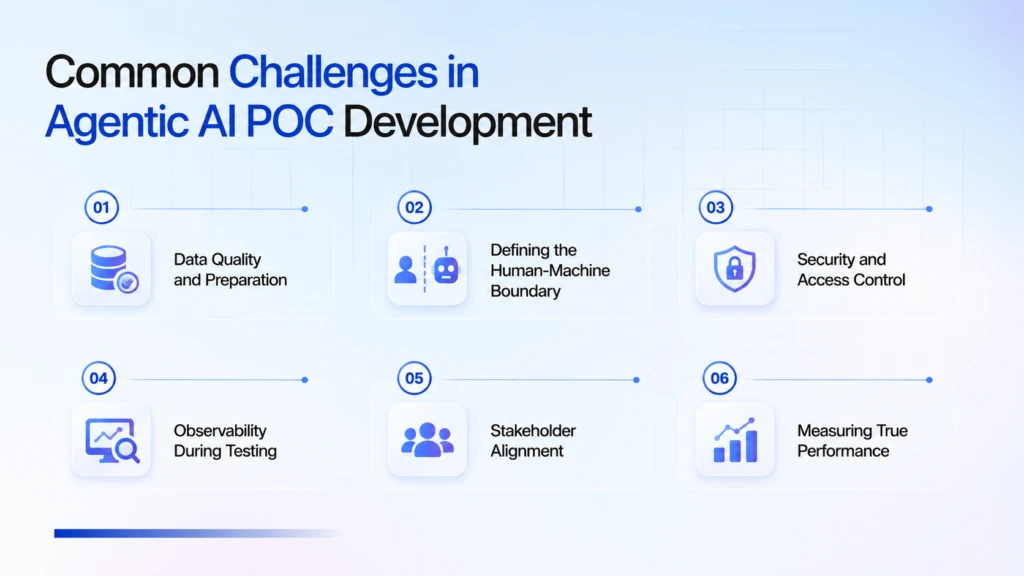
1. Data Quality and Preparation
If your data is inconsistent, unstructured, or siloed across systems, plan to spend the majority of your POC effort here, not on the agent itself.
2. Defining the Human-Machine Boundary
The hardest design question in any agentic POC isn’t what the agent does. It’s where it stops. Get this wrong, and you’ll either have an agent that’s micromanaged into uselessness or one making decisions it shouldn’t.
3. Security and Access Control
Autonomous agents interacting with live systems create new attack surfaces. Define exactly what data the agent can read, what it can write or modify, and what always requires human approval.
4. Observability During Testing
Without tracing, you can’t reliably evaluate why the agent failed on specific inputs. Observability isn’t optional even at the POC stage.
5. Stakeholder Alignment
Getting alignment on scope, success metrics, and governance before building, not after, saves significant rework. The most common reason POCs get scrapped before production isn’t technical failure. It’s misaligned expectations.
6. Measuring True Performance
A single successful demo is not a successful POC. Performance must be measured across varied, representative inputs, including edge cases and ambiguous scenarios. If your POC only ran on handpicked examples, the results don’t tell you anything reliable about production behavior.
Agentic AI POC: The Do’s and Don’ts
Do These
- Start narrower than feels necessary, scope creep is the number one POC killer
- Use real data in a sandboxed environment; synthetic data hides the challenges that will surface in production
- Set observability tools from day one, tracing agent behavior is how you learn what to fix
- Involve end users early, the people working alongside the agent know things your architecture diagram doesn’t
- Define escalation rules before you build, not after the agent makes a decision it shouldn’t have
- Document failures as rigorously as successes; they’re equally valuable for the decision that follows
Avoid These
- Trying to validate multiple use cases in one POC, you’ll prove nothing clearly
- Skipping integration planning, most POC breakdowns happen at the data and API layer
- Measuring only ideal-case performance, stress testing edge cases is the point
- Running a POC without observability, you can’t debug or improve what you can’t trace
- Presenting results without a recommendation, leadership expects the POC team to have a view on what comes next
Conclusion
Agentic AI isn’t a concept to keep on the roadmap for ‘someday.’ Organizations that moved thoughtfully, starting with well-scoped POCs, are already generating measurable returns. The ones that waited are now catching up against teams with 18 months of real-world agent data in hand.
A POC doesn’t ask you to bet big. It asks you to test smart. Pick one workflow that costs real time or money today. Define what success looks like before you build. Test honestly, including the edge cases. Let the evidence guide what comes next.
The most important lesson from every successful agentic AI deployment is consistency: they validated carefully, iterated based on what the data said, not what the demo looked like, and scaled what actually worked.
Frequently Asked Questions
A simple single-agent POC can be completed in 1–2 weeks. A standard POC with real data and 2–3 integrations typically takes 2–4 weeks. Multi-agent or regulated-environment POCs run 4–12 weeks. Timeline depends almost entirely on integration complexity and data readiness, not the AI model.
A POC validates technical feasibility internally. Can this agent do the task reliably? An MVP is a functional product built for real users to validate market demand. In agentic AI, most teams go from POC to a production pilot, skipping a traditional MVP phase, because agents are backend systems rather than user-facing products.
Financial services, healthcare, retail, manufacturing, and IT currently lead in deployments, but the use cases apply across almost every sector. Any industry with high-volume, rule-based, multi-step workflows, insurance, legal, logistics, education, and government is a strong candidate.
No. A team of 3–4 people with clear roles, an AI engineer, a product owner or business analyst, a domain expert, and a data person, can run a focused POC effectively. Larger teams often introduce coordination overhead without improving outcomes.
For most teams starting: LangGraph for complex conditional workflows, CrewAI for multi-agent collaboration with less coding overhead. If you’re already on Azure, the Microsoft Agent Framework is a strong production-ready option. Don’t pick a framework based on popularity alone; pick it based on your workflow complexity and team’s technical background.
A POC that reveals a use case isn’t ready yet is a success, not a failure. It means you avoided a much larger investment in something that wouldn’t have worked. Take the findings, adjust the use case scope or data approach, and re-run or redirect. Most failed POCs fail because of data or integration issues, both of which are solvable.
Yes, with the right architecture. Human-in-the-loop designs, clear escalation rules, audit logging, and explainability guardrails make agentic AI deployable even in healthcare, finance, and legal environments. The POC is specifically where you validate these controls before exposing them to real regulatory risk.