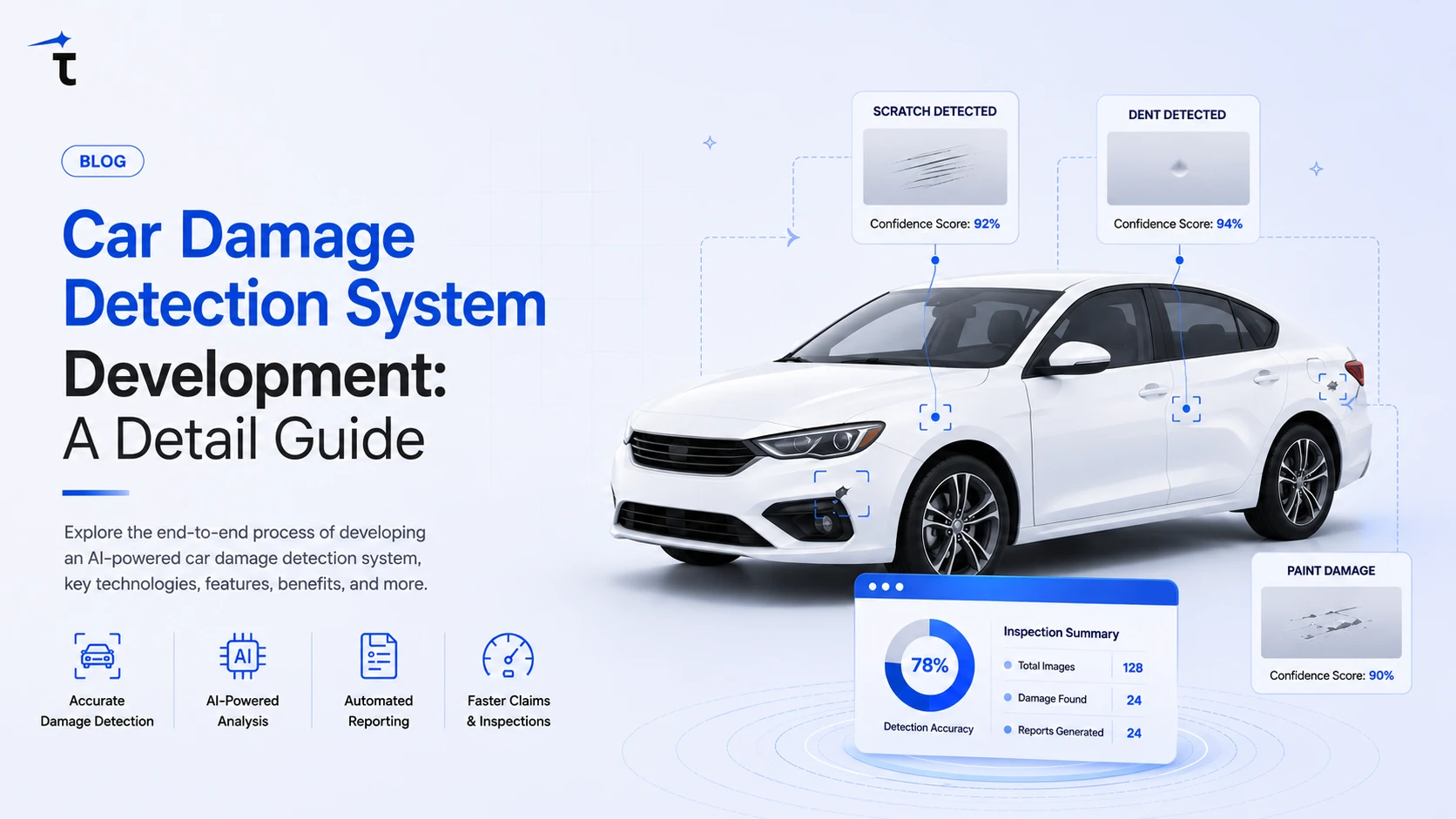
The way vehicle damage is assessed is rapidly changing, driven by the growing adoption of artificial intelligence in the automotive and insurance industries. Traditionally, inspections relied heavily on manual evaluation often leading to delays, inconsistent results, and higher operational costs. Today, car damage detection system development is transforming this process by introducing faster, more accurate, and automated solutions powered by AI.
From insurance claims to fleet management and car rental services, businesses are increasingly turning to vehicle damage detection using AI to streamline inspections and reduce fraud. These systems use advanced computer vision models to analyze images, identify damages like dents or scratches, and even estimate repair costs in real time.
In this guide to vehicle damage detection, we’ll break down how these systems work, the technologies behind them, and what it takes to build one. Whether you’re exploring innovation opportunities or evaluating the cost to vehicle damage detection system development, this guide covers everything you need to know.
So, let’s have a look!
Key Takeaways
- AI is transforming vehicle inspections by replacing slow, manual processes with fast, automated analysis, making car damage detection system development a high-demand solution across industries.
- Vehicle damage detection using AI leverages computer vision and deep learning to accurately identify dents, scratches, and structural issues from images or videos.
- Businesses in insurance, fleet management, and car rentals are adopting these systems to reduce costs, prevent fraud, and improve claim processing speed.
- A well-built damage detection system development process involves data collection, model training, testing, and seamless integration with existing platforms.
- The cost to vehicle damage detection systems depends on complexity, features, and AI model sophistication, typically ranging from basic MVPs to enterprise-grade solutions.
- Investing in this technology not only enhances operational efficiency but also delivers a better customer experience through faster and more transparent assessments.
What is an AI-Based Car Damage Detection System?
An AI-based car damage detection system is a smart solution that uses computer vision and machine learning to identify vehicle damage from images or videos. Instead of manual inspection, it automatically detects issues like dents, scratches, or broken parts with high accuracy. Widely used in insurance and automotive sectors, vehicle damage detection using AI helps speed up claims, reduce human error, and improve consistency. It’s a core part of modern car damage detection system development, enabling faster and more reliable damage assessment.
How Car Damage Detection Systems Work
Understanding how these systems function step by step helps you see the real value behind car damage detection system development, especially how AI turns simple images into accurate, actionable insights within seconds
Capturing Vehicle Images or Videos
The process begins with capturing high-quality images or videos of the vehicle using smartphones, cameras, or IoT-enabled devices. In vehicle damage detection using AI, clear visuals from multiple angles are crucial to ensure accurate analysis and reliable damage identification.
Data Preprocessing and Cleaning
Once images are captured, they are cleaned and standardized by removing noise, adjusting lighting, and resizing formats. This step in car damage detection system development ensures the data is consistent, improving model performance and reducing errors during analysis.
Feature Extraction Techniques
AI models analyze images to extract important visual patterns such as edges, textures, and shapes. Using deep learning, the system identifies features that distinguish normal surfaces from damaged areas, forming the backbone of accurate damage detection system development.
Damage Detection and Classification
The trained model scans the processed images to detect and classify damage types like dents, scratches, or cracks. Vehicle damage detection using AI enables precise localization and categorization, making the inspection process faster and more consistent than manual methods.
Severity Analysis and Report Generation
After detecting damage, the system evaluates its severity and estimates repair requirements. It generates detailed reports with visual highlights and insights, helping insurers and businesses make quick decisions, an essential part of scalable car damage detection system development.
Data Storage and Integration
Finally, all data, reports, and insights are securely stored and integrated with existing systems like insurance platforms or fleet management tools. This ensures seamless workflows, real-time access, and better decision-making across the entire damage detection system development lifecycle.
Industry Use Cases of Car Damage Detection Systems
Insurance Claims Automation
Insurance companies are using AI to make claims processing faster and more accurate. Instead of waiting days for an adjuster, customers simply upload photos. The system instantly detects the damage and provides an automated repair estimate, which saves time, reduces paperwork, and helps settle claims quickly without the usual human delay.
Car Rental and Fleet Management
Rental agencies use these systems to keep track of their vehicles’ condition automatically. By scanning a car when it is returned, the system spots any new scratches or dents that weren’t there before. This creates a fair, objective record that protects the business and helps staff manage their fleet more efficiently.
Automotive Repair and Maintenance
Repair shops use AI-driven tools to get a clearer, more consistent look at vehicle damage. By scanning a car, the software helps technicians create detailed repair reports and parts lists in seconds. This prevents mistakes, speeds up the quoting process, and builds better trust with customers who want honest, data-backed assessments.
Core Technologies Behind Car Damage Detection Systems
Computer Vision and Image Processing
Computer vision is the core technology behind Car Damage Detection solution, which allows the software to “see” and interpret vehicle images. By utilizing advanced algorithms, the system processes pixel data to identify edges, contours, and surface textures, effectively distinguishing between a harmless reflection and an actual structural dent or deep scratch.
Deep Learning and Neural Networks
Deep learning powers the brain of these systems, specifically through Convolutional Neural Networks (CNNs). These models are trained on thousands of labeled images of car damage, allowing them to learn and recognize complex patterns, shapes, and severities, which ensures the detection is consistently accurate even when environmental lighting or camera angles change.
Edge Computing for Real-Time Analysis
Edge computing is critical for systems that need to process data immediately on-site, such as at a rental return lot. By performing the heavy computational work locally on a device rather than in the cloud, the system delivers real-time results, providing instant feedback without the latency issues associated with remote server communication.
Specialized Hardware and Sensor Fusion
Beyond just cameras, modern development often integrates hardware like LiDAR, ultrasonic sensors, or high-resolution 360-degree scanners. This sensor fusion creates a more complete 3D model of the vehicle, allowing the system to measure the depth and volume of damage, providing a much higher level of precision than traditional image-only inspections could achieve.
Deep Learning Models (CNNs)
Convolutional Neural Networks (CNNs) are specifically designed for image analysis and play a major role in damage detection system development. They process visual data layer by layer to detect complex damage patterns like scratches, dents, and cracks, even under varying lighting conditions or angles.
Object Detection Models (YOLO, SSD, Faster R-CNN)
Object detection models focus on identifying where the damage is located within an image. In vehicle damage detection using AI, models like YOLO and Faster R-CNN quickly scan images, draw bounding boxes around damaged areas, and classify them, making the inspection process both fast and highly efficient.
Segmentation Models (U-Net, Mask R-CNN)
While detection models locate damage, segmentation models go deeper by outlining the exact shape and size of the affected area. This level of detail is crucial in advanced car damage detection system development, especially when estimating repair costs or analyzing the severity of the damage.
Frameworks & Libraries (TensorFlow, PyTorch, OpenCV)
Behind every intelligent system are powerful development tools. Frameworks like TensorFlow and PyTorch help train and deploy AI models, while OpenCV handles image processing tasks. Together, they simplify and accelerate the entire damage detection system development lifecycle.
Key Features of a Car Damage Detection Solution
Automated Damage Classification
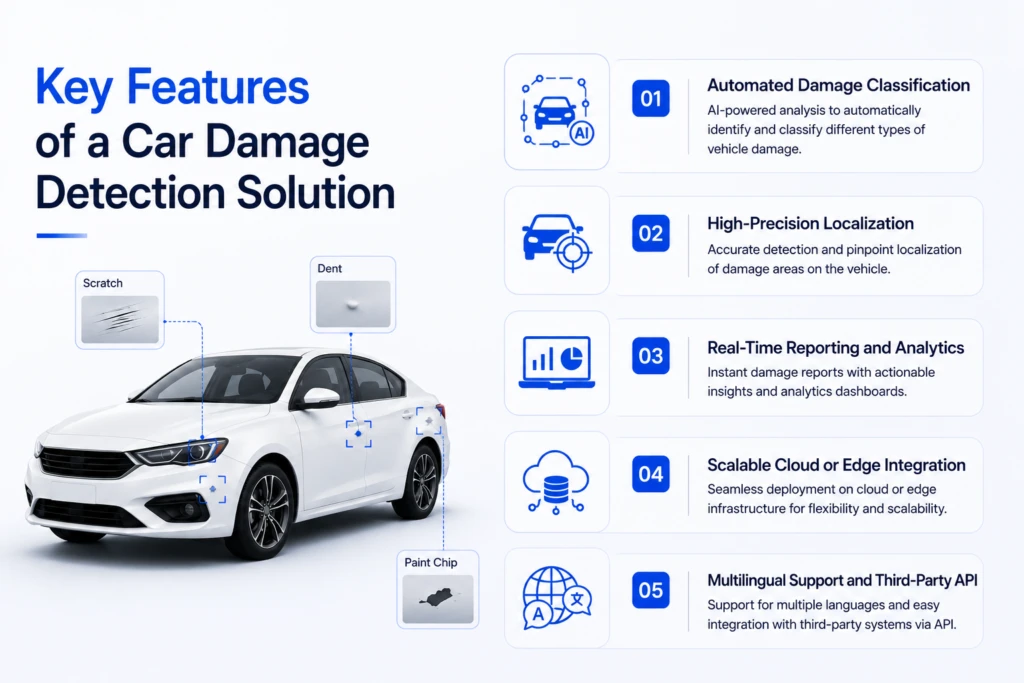
A top-tier system must automatically categorize damage types, such as scratches, dents, cracks, or paint chips. By instantly labeling the issue and its location, the software enables repair shops and insurance providers to speed up their assessment workflows while maintaining consistent, data-backed standards that minimize subjective errors.
High-Precision Localization
The solution should pinpoint exactly where the damage is on the vehicle body using precise coordinates or heat maps. This visual feedback is crucial for users, as it clearly identifies the affected area, making it easier for technicians to plan repairs and for insurance adjusters to verify the exact scope of the incident.
Real-Time Reporting and Analytics
Your development should prioritize a dashboard that generates instant, shareable reports. Once the system identifies damage, it should compile a summary including the severity, estimated repair requirements, and visual evidence. This feature empowers businesses to make faster decisions and keeps communication transparent between the company, their partners, and the end customer.
Scalable Cloud or Edge Integration
A car damage detection system development strategy requires flexibility. Whether you are operating from a single laptop or a network of automated inspection kiosks, the software must handle large amounts of image data efficiently. Choosing between cloud or edge processing ensures your system remains responsive and reliable under any operational volume.
Multilingual Support and Third-Party API
To truly serve the automotive industry, your solution should integrate easily with existing CRM or insurance platforms via APIs. Additionally, providing support for various languages ensures the system is user-friendly for diverse global teams, making the adoption of AI-powered vehicle inspection technology smooth for repair shops, dealerships, and fleet managers worldwide.
The Benefits of Developing a Car Damage Detection System
Integrating AI-driven damage detection into your automotive operations is about much more than just saving time; it’s about creating a smarter, more transparent business model. Here are the key advantages of investing in this technology:
Massive Efficiency Gains
Manual inspections are notoriously slow and labor-intensive. By automating the process, your system can scan a vehicle and generate a full damage report in minutes, not hours. This speed allows your team to handle significantly higher volumes of vehicles whether for insurance claims or daily rental turnovers without needing a massive increase in staff.
Improved Accuracy and Consistency
Human inspectors, no matter how skilled, are prone to fatigue and personal bias. AI provides an objective, impartial assessment every single time. By relying on consistent computer vision algorithms, you ensure that every vehicle is evaluated against the same standard, which drastically reduces errors and ensures high-quality data for every repair estimate.
Significant Cost Reduction
Automated systems help you cut operational costs by streamlining workflows. By catching damage early, you avoid the high costs of “emergency” repairs. Additionally, the system provides accurate repair estimates immediately, which prevents expensive over-quoting and helps businesses maintain tighter control over their budget and resource allocation.
Fraud Prevention and Transparency
One of the biggest issues in the insurance industry is fraudulent claims. AI-powered tools can analyze images to identify signs of tampering or inconsistent damage patterns that a human eye might miss. This added layer of validation builds trust, keeps your company protected, and ensures that settlements are fair, data-backed, and transparent.
Enhanced Customer Experience
Transparency builds trust. When you provide customers with an instant, easy-to-understand damage report that includes photos and professional assessments, their confidence in your service grows. Faster settlements and clear communication mean happier clients, which is a massive competitive advantage in the modern automotive and insurance landscape.
Process of Car Damage Detection System Development
Creating a professional-grade vehicle inspection tool is a rigorous engineering challenge. To build a system capable of real-world deployment, you must move beyond basic concepts and implement a robust pipeline that handles data engineering, model optimization, and scalable software architecture with precision.
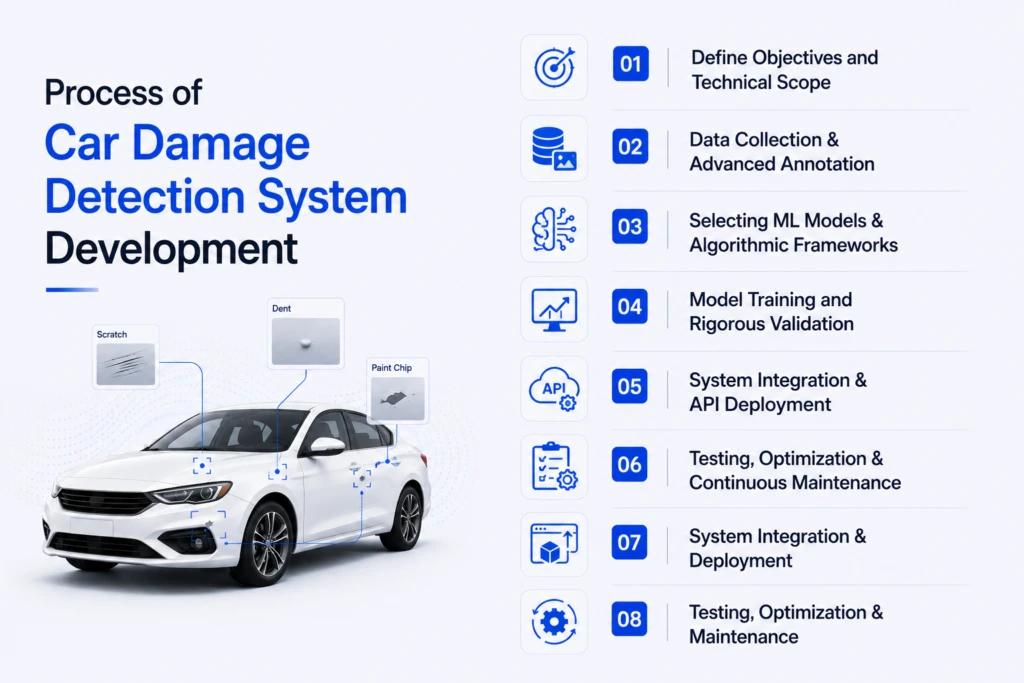
Define Objectives and Technical Scope
Before writing code, define the specific “damage vocabulary” your system will support. Are you targeting simple surface-level dents and scratches, or complex structural damage like chassis misalignment? Define your performance benchmarks, such as the required accuracy (mAPmean Average Precision) and acceptable latency (inference time). Establishing these constraints early dictates your hardware requirements whether you need high-end GPUs for training or edge-optimized hardware like NVIDIA Jetson for real-time inference at the point of inspection.
Data Collection & Advanced Annotation
Your AI’s performance is limited entirely by the quality of your dataset. Aim for high-resolution, multi-angle imagery covering various vehicle classes, paint finishes, and lighting conditions. For annotation, use professional tools to create precise polygonal masks rather than simple bounding boxes. This captures the exact contour of a dent or crack, providing the deep learning model with the granular spatial data required to distinguish between genuine structural compromise and benign surface artifacts like dirt, mud, or reflections.
Selecting ML Models & Algorithmic Frameworks
The core of your system relies on selecting the right architecture for your specific data. For real-time requirements, state-of-the-art object detection models like YOLO (specifically v8 or later) are the industry standard for their speed. If your use case requires high-precision damage segmentation, look toward Mask R-CNN or segment-anything models. The goal is to choose a backbone such as ResNet or EfficientNetthat provides the optimal balance between feature extraction depth and computational throughput, ensuring your system doesn’t lag during peak usage.
Model Training and Rigorous Validation
Training is an iterative process of fine-tuning hyperparameters. Use techniques like “transfer learning” by starting with pre-trained weights from large datasets, then specializing your model on your custom car damage data. During validation, implement a strict “train-test-validation” split, ensuring your model is evaluated on images it has never processed. Monitor for “overfitting”where the model performs perfectly on training data but fails on new, unseen vehicles by utilizing techniques like image augmentation, rotation, and color jittering to expose the model to diverse scenarios.
System Integration & API Deployment
To make your model functional, encapsulate it within a scalable containerized environment, such as Docker, and expose it via a RESTful API. This allows your backend to ingest images from mobile devices or static cameras seamlessly. Build a robust pipeline that can pre-process input images standardizing resolution and color space before passing them to the AI engine. Ensure your architecture can handle asynchronous processing so that while the AI analyzes an image, the user interface remains responsive, providing a smooth, professional experience for the end-user.
Testing, Optimization & Continuous Maintenance
The final stage is the “Human-in-the-Loop” (HITL) feedback cycle. Implement a mechanism where professional human adjusters can verify the AI’s output and correct any false positives or negatives. This corrected data must be fed back into your training set, allowing the model to improve continuously. Regularly profile your system for bottlenecks, optimize your inference code for hardware acceleration, and perform periodic retraining to ensure the system stays current with new vehicle body designs and paint technologies.
System Integration & Deployment
Once the model is accurate, it is integrated into your business software via APIs. This allows staff to upload images from mobile devices or cameras directly into a dashboard. The system then automatically analyzes the photos and delivers a clear, digital report that staff can use to make quick decisions.
Testing, Optimization & Maintenance
The development process doesn’t end at launch. Engineers continuously test the system in real-world scenarios to catch errors and improve performance. By regularly updating the model with new images of modern vehicle designs, you keep the system reliable, ensuring it remains accurate and competitive as your business needs evolve.
Challenges in Developing Car Damage Detection Systems
Challenges You May Face When Developing Car Damage Detection Systems
Developing your own AI-powered vehicle inspection tool is an exciting technical journey, but it comes with real-world hurdles that can frustrate even experienced developers. Understanding these common obstacles upfront will help you plan your project more effectively and avoid common pitfalls.
Data Quality and Diversity Issues
The biggest challenge you will face is building a dataset that covers every “what-if” scenario. AI models can easily get confused by environmental variables like harsh shadows, reflections on glossy paint, or changing weather conditions. If your training data lacks enough variety, your system will struggle to tell the difference between a minor scuff and a serious structural dent in the real world.
High Computational Demands
Training sophisticated deep learning models requires serious processing power. Even if you manage the initial training, running the system for real-time detection needs efficient hardware to avoid lag. If your software isn’t optimized properly, it may run too slowly on standard devices, making the “instant” inspection experience feel clunky or unresponsive for the end-user.
Difficulty in Distinguishing Damage Types
Teaching an AI to categorize damage accurately is deceptively difficult. It can be quite a struggle to help the model learn the nuance between a superficial paint scratch, which requires a simple buff, and a deep body-panel dent that needs a professional repair. Achieving this level of precision requires constant fine-tuning and massive amounts of labeled data.
Integration with Existing Workflows
Building the AI model is only half the battle; integrating it into a real business environment is the other. Many developers find it tricky to connect their system to existing insurance platforms or repair shop databases. If your API isn’t stable or your interface isn’t intuitive, even the best-performing AI model will struggle to gain adoption among staff who need a smooth, simple tool.
Keeping the Model Updated
The automotive industry evolves rapidly, with new car designs, paint finishes, and materials appearing every year. Your model isn’t “set it and forget it”it requires a feedback loop. You will need to continuously collect new data and re-train your model to ensure it doesn’t lose accuracy as vehicle designs change over time
Cost of Developing a Car Damage Detection System
Building a car damage detection system involves multiple cost components, and the total investment depends on the system’s complexity, accuracy requirements, and deployment scale. Businesses often underestimate how factors like AI model training, data collection, and real-time processing impact the overall budget.
Data Collection & Annotation
A high-performing system requires thousands of labeled images of damaged vehicles (scratches, dents, cracks, etc.). Collecting and annotating this data can cost anywhere between $5,000 to $25,000+, depending on dataset size and quality.
AI Model Development
Developing computer vision models using technologies like deep learning and object detection (e.g., YOLO, CNNs) is one of the biggest cost drivers. This phase typically ranges from $15,000 to $50,000+, based on accuracy and customization needs.
App & Backend Development
If you’re building a mobile or web app for users to upload images and receive damage analysis, development costs can range from $10,000 to $40,000+, depending on features like real-time detection, dashboards, and integrations.
Cloud Infrastructure & Storage
Hosting models, processing images, and storing data requires cloud services (AWS, Google Cloud, etc.). Monthly costs can range from $500 to $5,000+, depending on usage and scaling.
Testing, Optimization & Maintenance
Continuous improvement, model retraining, and bug fixes are ongoing costs. Expect to invest 15–25% of the initial development cost annually.
Future Trends in AI-Based Vehicle Damage Detection
The field of AI-driven vehicle inspection is evolving rapidly, moving beyond simple surface-level detection toward holistic, data-integrated ecosystems that promise to transform the entire automotive lifecycle.
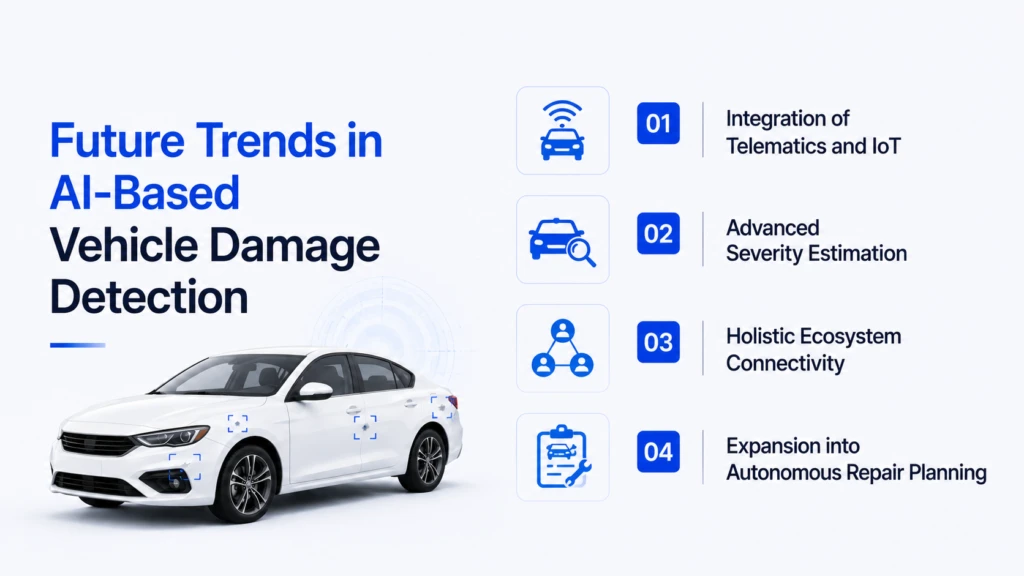
Integration of Telematics and IoT
Future systems will not rely on visual data alone. By merging AI-powered image analysis with real-time telematics and IoT sensor data from connected vehicles, the software will provide a “holistic” view of a car’s condition. This allows for immediate impact alerts and precise insights into internal damage that cameras might miss.
Advanced Severity Estimation
While early AI could only flag “damage vs. no damage,” next-generation models are being built to perform precise, automated severity assessments. This evolution will allow insurance companies to generate instant, audit-ready repair cost estimates, effectively automating the entire claims adjudication process from the moment an accident is reported.
Holistic Ecosystem Connectivity
Expect deeper integration between tech providers, insurance firms, and automotive repair shops. Emerging trends involve building secure, blockchain-based networks for shared damage documentation. This ensures that every vehicle has a standardized, unalterable “digital health record,” which simplifies lease returns, streamlines secondary market sales, and boosts overall industry transparency.
Expansion into Autonomous Repair Planning
The ultimate goal of this technology is moving toward end-to-end automated workflows. Future innovations aim to use AI to automatically generate precise parts lists and repair instructions based on the detected damage. Some pioneers are even exploring how AI-driven robots could eventually assist in minor repairs, reducing human intervention and operational downtime.
Still Feeling Stuck? Let TechnoYuga Build It For You
If the technical complexity of building an AI damage detection system feels like an uphill battle, you aren’t alone. Between selecting the right neural network architecture, sourcing high-quality training datasets, and managing the infrastructure for real-time inference, there is a lot to get right. Trying to do it all yourself can lead to costly delays and performance issues that compromise your business goals.
TechnoYuga is here to bridge that gap. We specialize in turning complex AI concepts into reliable, production-ready software. Our team provides end-to-end support, including:
- Custom Model Architecture: Designing AI systems tailored specifically to your business needs, whether you’re focusing on simple surface scratches or complex structural integrity assessments.
- Scalable Integration: We build seamless APIs that connect your new damage detection engine directly to your existing CRM, insurance platform, or fleet management dashboard.
- Performance Optimization: We handle the heavy lifting of training and deploying your models, ensuring your system is fast, responsive, and capable of handling high volumes of inspections.
Don’t let technical hurdles slow your progress. Let TechnoYuga handle the development process so you can stay focused on improving your customer experience and streamlining your operations.
Conclusion
The development of an AI-driven car damage detection system is a transformative investment that redefines how businesses manage vehicle health, insurance claims, and fleet transparency. While the path from initial data collection to a production-ready model is technically demanding, the long-term benefits ranging from massive operational efficiency to higher accuracy and improved customer trust are clear.
As AI technology continues to evolve, the ability to automate vehicle assessments will shift from a competitive advantage to an industry standard. Whether you are building an internal tool or an enterprise-grade platform, success lies in your ability to maintain data quality, prioritize model scalability, and build seamless integrations into your existing workflows. If you are ready to modernize your operations and leverage the power of computer vision, the time to start your development journey is now.
FAQs
A car damage detection system is an AI-powered software solution that uses computer vision and deep learning to automatically scan, identify, and categorize vehicle damage, such as dents, scratches, or cracks, from digital images or video feeds.
The AI processes input images through deep learning models like Convolutional Neural Networks (CNNs). By training on thousands of annotated vehicle images, the system learns to recognize patterns associated with specific types of damage, allowing it to localize and classify issues in real-time.
Development costs vary based on project scope and features. A basic MVP can range from $25,000 to $60,000, while a fully scalable enterprise platform with advanced fraud detection and custom API integrations can exceed $120,000 to $200,000.
Leading systems typically utilize advanced object detection frameworks like YOLO (You Only Look Once) or Mask R-CNN. These algorithms are preferred for their speed and precision, allowing the system to perform high-accuracy analysis even in complex, real-world environments.
To maintain high accuracy, implement a continuous feedback loop where human adjusters review uncertain “edge cases” flagged by the AI. Feeding these verified corrections back into your training data allows the model to learn, adapt, and improve as vehicle designs change.