Every user lands on your platform with a goal. Find something useful. Find it fast. If they don’t, they leave. No second chances.
This is the gap most digital products still struggle with. Too many choices. Too little relevance. Users scroll, compare, hesitate, and drop off. That is where intelligent recommendations change the game. They guide users, simplify decisions, and quietly influence what happens next.
For businesses, this is not about adding another feature. It is about shaping user journeys, increasing conversions, and making every interaction count. Understanding the use cases of an AI-based recommendation engine helps you move from guesswork to precision.
Key Takeaways
- AI-powered recommendation engines improve user engagement by delivering highly personalized experiences across different AI recommendation system use cases.
- Businesses across industries like eCommerce, media, healthcare, and fintech are leveraging use cases of AI-based recommendation engine to increase conversions and retention.
- Real-time data processing and continuous learning make modern systems more accurate and adaptive compared to traditional models.
- Choosing the right data, approach, and technology stack is critical to successfully develop AI-based recommendation system solutions.
- Implementing recommendation engines helps businesses drive revenue, optimize user journeys, and stay competitive in a data-driven market.
What Is an AI-Based Recommendation Engine?
An AI-based recommendation engine is a system that predicts what your users want before they explicitly ask for it. It studies behavior, preferences, and interactions to deliver suggestions that feel relevant and timely.
Unlike traditional systems, it does not rely on fixed rules. It learns continuously. Every click, search, or purchase becomes input for better recommendations.
You see this in action every day:
- Products suggested while shopping
- Movies recommended on streaming platforms
- Posts ranked on social feeds
Behind all of this is a system designed to understand users at scale. This is why businesses are actively investing to develop AI-based recommendation system capabilities that adapt in real time
Why Recommendation Engines Matter in the Digital Age
Digital platforms today compete on experience, not just features. Users expect relevance. They expect speed. They expect platforms to understand them without effort.
If your platform fails to do this, users move to one that does.
Here is why recommendation engines have become critical:
- They reduce decision fatigue
Users face too many options. Recommendations narrow down choices and make decisions easier. - They increase conversions
Relevant suggestions push users toward action. This directly impacts sales and engagement. - They improve retention
When users consistently see value, they return more often and stay longer. - They unlock hidden revenue opportunities
Cross-selling and upselling become natural when recommendations are aligned with user intent.
These outcomes explain why AI recommendation system use cases are expanding across industries.
How AI Supercharges Traditional Recommendation Systems
Traditional recommendation systems were rule-based. They worked on simple logic like “show related items” or “display popular products.” This approach worked at a basic level but failed with scale and complexity.
AI changes the entire approach.
Instead of static rules, AI uses patterns. Instead of assumptions, it uses real-time data. This shift makes recommendations more accurate and more useful.
Here is what improves with AI:
- Real-time adaptability
Recommendations change instantly based on user behavior. - Deeper personalization
AI considers multiple data points, not just past actions. - Better accuracy over time
The system improves as more data flows in. - Context awareness
Time, location, and device influence what gets recommended.
This is why modern use cases of AI-based recommendation systems deliver stronger business outcomes compared to traditional methods.
Key Features of an AI-Based Recommendation Engine
Before diving into how these systems work, it is important to understand the core features that make them effective. A well-designed engine ensures better accuracy, scalability, and performance across different AI recommendation system use cases.
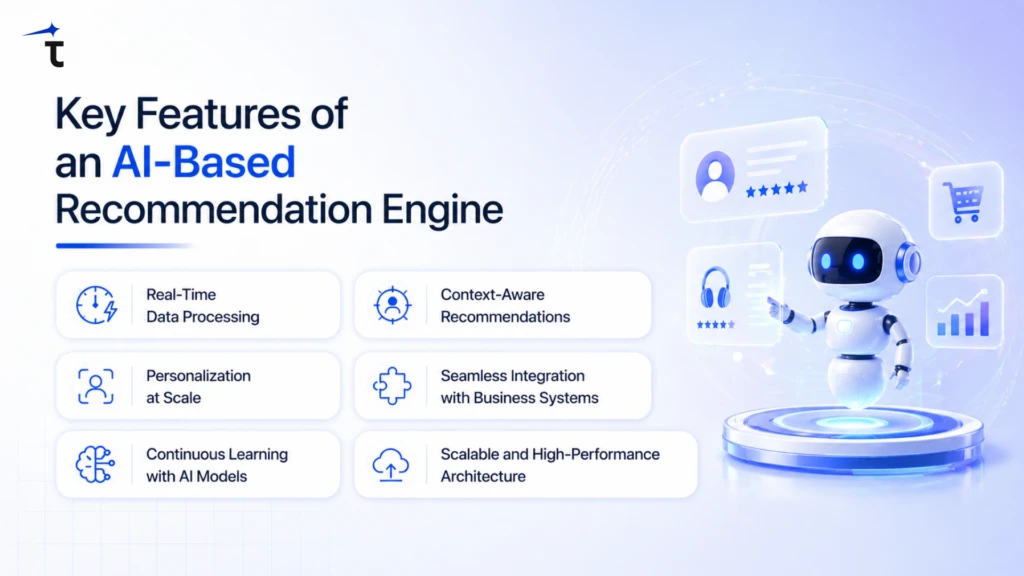
- Real-Time Data Processing
The system analyzes user behavior instantly to deliver timely and relevant suggestions, improving engagement across various use cases of the AI-based recommendation engine. - Personalization at Scale
It tailors recommendations for each user based on preferences and interactions, making large-scale AI recommendation system use cases more effective. - Continuous Learning with AI Models
Machine learning algorithms improve recommendations over time by learning from user behavior, which strengthens long-term performance. - Context-Aware Recommendations
The engine considers factors like location, time, and device to deliver more accurate suggestions in real-time scenarios. - Seamless Integration with Business Systems
It integrates with CRM, analytics tools, and product databases, making it easier to develop AI-based recommendation system solutions. - Scalable and High-Performance Architecture
The system is built to handle large volumes of data and users, ensuring smooth performance as your business grows.
How AI Recommendation Engines Work
AI recommendation engines follow a continuous learning cycle that turns user data into relevant suggestions. They collect inputs like clicks, searches, and purchases, process this data to identify patterns, and use machine learning models to predict what a user is likely to engage with next. These predictions are then delivered as personalized recommendations across the platform. As users interact further, the system keeps updating itself in real time, improving accuracy with every step. This ongoing feedback loop is what makes modern AI recommendation system use cases effective and scalable across different industries.
Core Technologies: Machine Learning, Deep Learning & NLP
AI recommendation engines rely on a combination of technologies that work together to understand users better.
- Machine Learning (ML)
This is the foundation. ML models analyze user behavior and identify patterns. For example, if a user frequently browses a certain category, the system learns to prioritize similar items. Over time, these models improve without manual intervention.
- Deep Learning (DL)
Deep learning handles more complex data like images, videos, and large interaction datasets. It helps platforms recommend visually similar products or content. This becomes important in advanced use cases of AI-based recommendation engine, especially in media and retail.
- Natural Language Processing (NLP)
NLP helps the system understand text-based inputs like search queries, reviews, and user feedback. It ensures that recommendations match user intent, not just behavior.
Together, these technologies make recommendations more accurate, contextual, and personalized.
Types of Recommendation Approaches
Not all recommendation engines work the same way. Different approaches are used depending on the business model, data availability, and user behavior.
Choosing the right approach is critical when planning use cases of AI-based recommendation system for your platform.
Content-Based Filtering
This approach focuses on the individual user.
- It recommends items similar to what the user has interacted with before
- It relies on item attributes like category, features, or tags
- It works well when user-specific data is strong
For example, if a user watches action movies, the system continues to suggest similar content. This approach is simple and effective but may limit discovery if not combined with other methods.
Collaborative Filtering
This approach focuses on user similarity.
- It recommends items based on what similar users prefer
- It does not depend heavily on item details
- It improves as more users interact with the platform
For example, if users with similar behavior purchase certain products, those products get recommended to others in that group. This is one of the most widely used AI recommendation system use cases.
Hybrid Recommendation Systems
Hybrid systems combine multiple approaches.
- They use both content-based and collaborative filtering
- They reduce the limitations of individual methods
- They deliver more balanced and accurate recommendations
Most modern platforms use hybrid systems because they provide better results across diverse user scenarios.
Knowledge-Based Systems
This approach relies on explicit user input and domain knowledge.
- It recommends items based on user requirements or constraints
- It works well in complex industries like finance or healthcare
- It does not depend heavily on past user behavior
For example, recommending financial products based on income, risk appetite, and goals. These systems are important in specialized use cases of AI-based recommendation engine where accuracy matters more than volume.
Key Data Inputs: Behavioral, Transactional & Contextual Data
AI recommendation engines rely on a combination of data types to deliver accurate and relevant suggestions. Behavioral data captures how users interact with a platform, such as clicks, searches, and time spent, helping the system understand interest patterns. Transactional data reflects actual decisions like purchases or subscriptions, which adds stronger intent signals. Contextual data brings in real-time factors such as location, device, and timing, making recommendations more relevant in the moment. When combined, these inputs create a complete view of the user, enabling more precise and high-performing use cases of AI-based recommendation system across platforms.
Top Use Cases of AI-Based Recommendation Engines
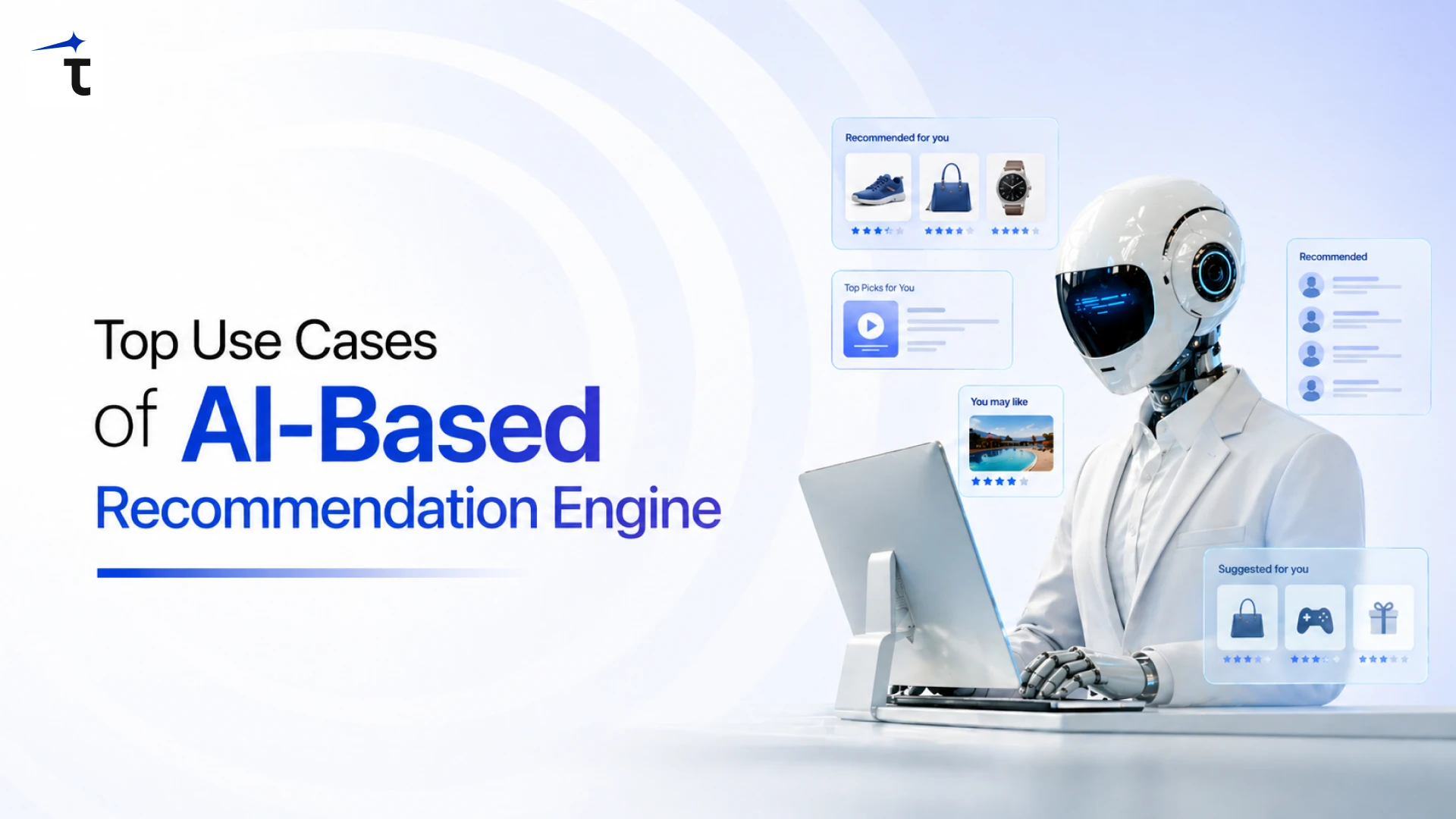
AI recommendation engines are shaping how businesses interact with users across industries. Instead of overwhelming users with choices, these systems guide decisions with relevant, timely suggestions. Below are some of the most impactful use cases of AI-based recommendation engine, explained in a clear and practical way.
E-Commerce & Retail
In eCommerce, recommendation engines directly influence buying decisions. They suggest products based on browsing behavior, highlight complementary items for cross-selling, and promote higher-value alternatives for upselling. This not only improves user experience but also increases average order value, making it one of the most revenue-driven AI recommendation system use cases.
Media & Entertainment
Streaming platforms rely on AI to keep users engaged. Recommendation engines analyze viewing history and preferences to suggest movies, shows, or music that match user interests. They also personalize home screens, ensuring users always find something relevant quickly. This continuous engagement reduces churn and increases platform retention.
Social Media
Social media platforms use recommendation engines to decide what users see. From curating feeds based on engagement patterns to suggesting new connections, these systems shape the entire user experience. They also power targeted content and ads, ensuring relevance, which makes this one of the most visible use cases of AI-based recommendation system in daily life.
Healthcare
In healthcare, recommendation engines focus on improving outcomes. They analyze patient data to suggest personalized treatment plans, recommend preventive care actions, and assist doctors with data-backed insights. These AI recommendation system use cases require high accuracy, as they directly impact patient care and decision-making.
Financial Services
Financial platforms use AI recommendations to simplify complex choices. Based on user profiles and financial behavior, systems suggest suitable products like loans, investments, or insurance plans. This helps users make informed decisions while increasing product adoption, making it a strong use case of AI-based recommendation engine in fintech.
Travel & Hospitality
Travel platforms use recommendation engines to personalize every step of the journey. From suggesting hotels and flights based on past behavior to recommending activities and experiences, these systems enhance planning and booking. They also support dynamic pricing and tailored packages, improving both conversions and customer satisfaction.
EdTech & E-Learning
EdTech platforms use AI to guide users through personalized learning journeys. Recommendation engines suggest courses based on skill level, create structured learning paths, and adapt content based on progress. These AI recommendation system use cases focus on improving learning outcomes and long-term user engagement.
Supply Chain & B2B
In B2B and supply chain environments, recommendation engines improve efficiency and decision-making. They suggest reliable vendors based on past performance, optimize inventory levels using demand predictions, and support procurement decisions. These advanced use cases of AI-based recommendation systems help businesses reduce costs and operate more efficiently.
Real-World Examples & Success Stories
Leading digital platforms have already proven the impact of recommendation engines at scale. These systems are not experimental anymore. They are driving engagement, retention, and revenue across industries. Looking at real-world implementations helps you understand how powerful these use cases of AI-based recommendation engine can be when executed correctly.
Netflix: Reducing Churn Through Personalization
Netflix uses advanced recommendation engines to keep users engaged from the moment they log in. By analyzing viewing history, watch time, and user preferences, it suggests content that aligns closely with individual interests. This level of personalization reduces decision fatigue and keeps users watching longer, which plays a key role in lowering churn. It stands as one of the most impactful AI recommendation system use cases in the media industry.
Amazon: Driving 35% of Sales via Recommendations
Amazon’s recommendation engine is a major driver of its revenue. By suggesting related products, frequently bought items, and personalized deals, it influences a large portion of purchase decisions. These recommendations are based on browsing behavior, purchase history, and user patterns, making them highly relevant. This is one of the strongest use cases of AI-based recommendation engine, where personalization directly translates into measurable business growth.
Spotify: Discover Weekly & Mood-Based Playlists
Spotify uses AI to create highly personalized music experiences. Features like Discover Weekly and mood-based playlists are built on user listening habits, preferences, and patterns. These recommendations help users discover new music without effort, increasing engagement and time spent on the platform. This is a clear example of how AI recommendation system use cases can enhance user satisfaction and retention
Other Industry Leaders
Many global platforms across industries are investing heavily in recommendation systems to stay competitive. From eCommerce and fintech to travel and EdTech, businesses are using AI to deliver personalized experiences at scale. These companies focus on continuously improving their systems, showing how diverse use cases of AI-based recommendation system are driving innovation and long-term growth.
Business Benefits of Implementing AI Recommendation Engines
AI recommendation engines do more than improve user experience. They directly impact key business metrics like conversions, retention, and revenue. By delivering relevant suggestions at the right time, they help businesses create more meaningful and result-driven user interactions.
- Higher Conversion Rates
Personalized suggestions guide users toward faster decisions, increasing the chances of conversions. - Increased Average Order Value
Cross-selling and upselling through recommendations encourage users to spend more per transaction. - Improved Customer Retention
Relevant and consistent experiences keep users engaged and bring them back to the platform. - Enhanced User Experience
Users find what they need quickly, reducing friction and improving overall satisfaction. - Data-Driven Decision Making
Insights from user behavior help businesses refine strategies and improve product offerings. - Scalable Personalization
AI enables businesses to deliver personalized experiences to a large user base without manual effort, making it a key advantage in modern AI recommendation system use cases.
Key Challenges You Must Address Before Implementing AI Recommendation Engines
While the benefits are clear, building and scaling recommendation systems come with their own set of challenges. Ignoring these can impact performance, user trust, and long-term ROI. Understanding these early helps you plan better and execute the right AI recommendation system use cases effectively.
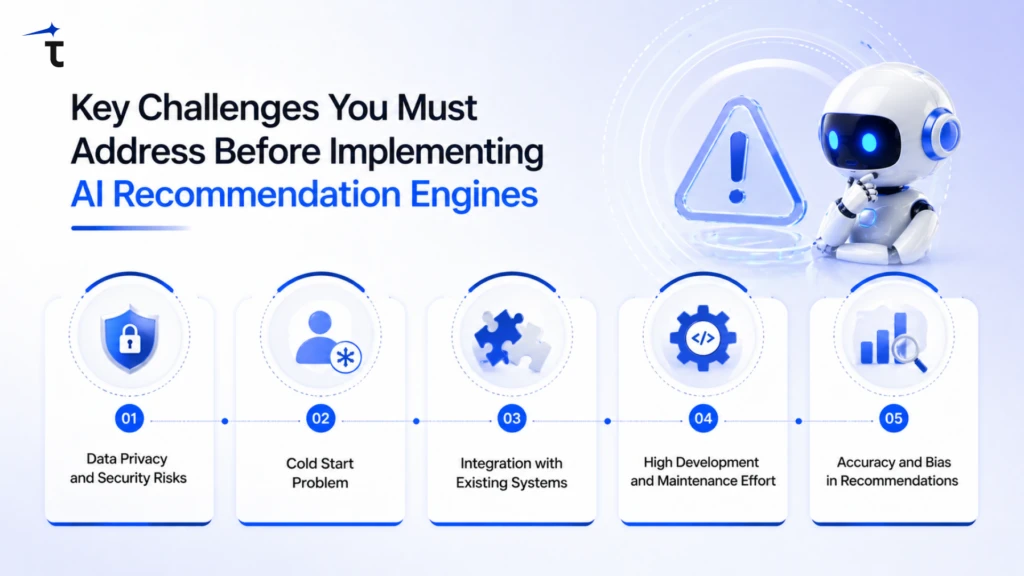
- Data Privacy and Security Risks
Recommendation engines rely heavily on user data, which makes data protection critical. Any misuse or breach can damage trust and lead to compliance issues. - Cold Start Problem
New users or products lack sufficient data, making it difficult to generate accurate recommendations in the early stages. - Integration with Existing Systems
Connecting recommendation engines with current platforms and workflows can be complex and time-consuming. - High Development and Maintenance Effort
The cost of building AI recommendation system depends on data scale, model complexity, and infrastructure, which can be a challenge for many businesses. - Accuracy and Bias in Recommendations
Poor data quality or biased models can lead to irrelevant suggestions, affecting user experience and decision-making.
How to Build or Integrate an AI Recommendation Engine
Building a recommendation engine is not only a technical task. It is a business decision. You need clarity on goals, data readiness, and how personalization fits into your product experience. Whether you build from scratch or integrate an existing solution, the focus should stay on delivering measurable outcomes from your AI recommendation system use cases.
Build vs. Buy: Key Considerations
Choosing between building or buying depends on your business goals, timelines, and how deeply you want to customize your AI recommendation system use cases. Here is a simple comparison to help you decide:
| Factor | Build (Custom Solution) | Buy (Ready-Made Solution) |
| Customization | Full control over features and algorithms | Limited flexibility based on platform capabilities |
| Time to Market | Longer development time | Faster implementation |
| Cost | Higher upfront investment, flexible long-term | Lower initial cost, ongoing subscription fees |
| Scalability | Designed as per your business needs | Depends on vendor capabilities |
| Maintenance | Requires in-house expertise and continuous updates | Managed by the service provider |
For businesses planning to develop AI-based recommendation system with unique requirements, building makes more sense. For faster deployment with standard features, buying is often the practical choice.
Tech Stack & Tools Overview
A strong tech foundation is essential for building scalable recommendation systems.
- Programming languages
Python is widely used for building and training models due to its strong ecosystem. - Frameworks and libraries
Tools like TensorFlow and PyTorch help in developing machine learning models efficiently. - Data processing tools
Systems like Apache Spark handle large-scale data processing in real time. - Cloud platforms
Cloud infrastructure ensures scalability, flexibility, and faster deployment.
Choosing the right stack directly impacts performance and the overall cost of building AI recommendation system.
Steps to Implement a Recommendation System
A structured approach ensures better results and fewer roadblocks.
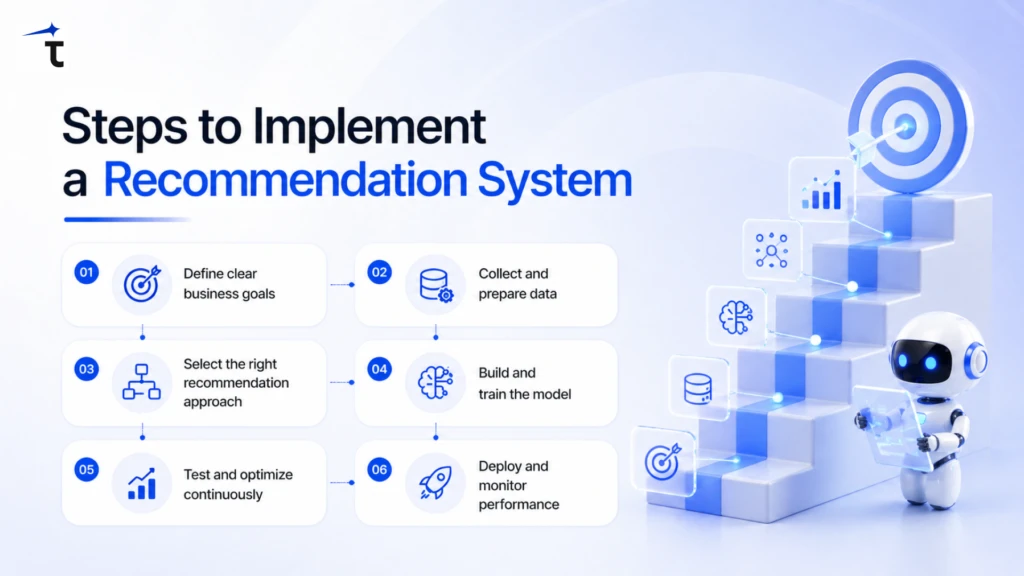
- Define clear business goals
Identify where recommendations will create the most impact, such as conversions, engagement, or retention. - Collect and prepare data
Gather behavioral, transactional, and contextual data to train your models effectively. - Select the right recommendation approach
Choose between content-based, collaborative, or hybrid models based on your use case. - Build and train the model
Develop algorithms that can analyze patterns and predict user preferences. - Test and optimize continuously
Measure performance, refine models, and improve accuracy over time. - Deploy and monitor performance
Launch the system and track how it impacts key business metrics.
Following these steps helps you successfully implement high-performing use cases of AI-based recommendation system while keeping scalability and efficiency in focus.
Future Trends in AI Recommendation Engines
Recommendation engines are evolving fast. What started as simple product suggestions is now moving toward deeper personalization, real-time interaction, and context-aware intelligence. Businesses investing early in these advancements will lead the next wave of innovation in AI recommendation system use cases.
Generative AI & LLMs in Recommendations
Generative AI and large language models are changing how recommendations are created. Instead of only predicting what users might like, systems can now generate personalized suggestions in a more human-like way. This improves content discovery, product descriptions, and even recommendation explanations, making interactions more engaging and meaningful.
Conversational & Voice-Based Recommendations
Users are shifting toward conversational interfaces like chat and voice assistants. Recommendation engines are now integrating with these channels to deliver suggestions through natural conversations. This makes the experience more interactive and reduces the effort required to search or browse, especially on mobile and smart devices.
Hyper-Personalization at Scale
Personalization is moving beyond basic preferences. AI systems are now capable of delivering highly tailored experiences for each user in real time. By combining multiple data points, businesses can offer precise recommendations at every touchpoint, making this one of the most advanced use cases of AI-based recommendation engine.
Multimodal Recommendation Systems
Future recommendation engines will process multiple types of data together, including text, images, audio, and video. This allows systems to understand user intent more accurately and deliver richer recommendations. For example, users can search using images or voice and still receive highly relevant results, improving overall experience and engagement.
Conclusion
AI recommendation engines have moved from being a supporting feature to a core business driver. The wide range of use cases of AI-based recommendation engines across industries shows how strongly they influence user decisions, engagement, and revenue. The real impact comes when you choose the right use case based on your business goals, user behavior, and data readiness, rather than trying to implement everything at once.
Getting started requires a clear approach and the right execution partner. If you plan to develop AI-based recommendation system, focusing on scalability, accuracy, and real business outcomes is critical. With the right strategy and support from a team like TechnoYuga, you can build recommendation systems that not only personalize experiences but also deliver measurable growth for your business.