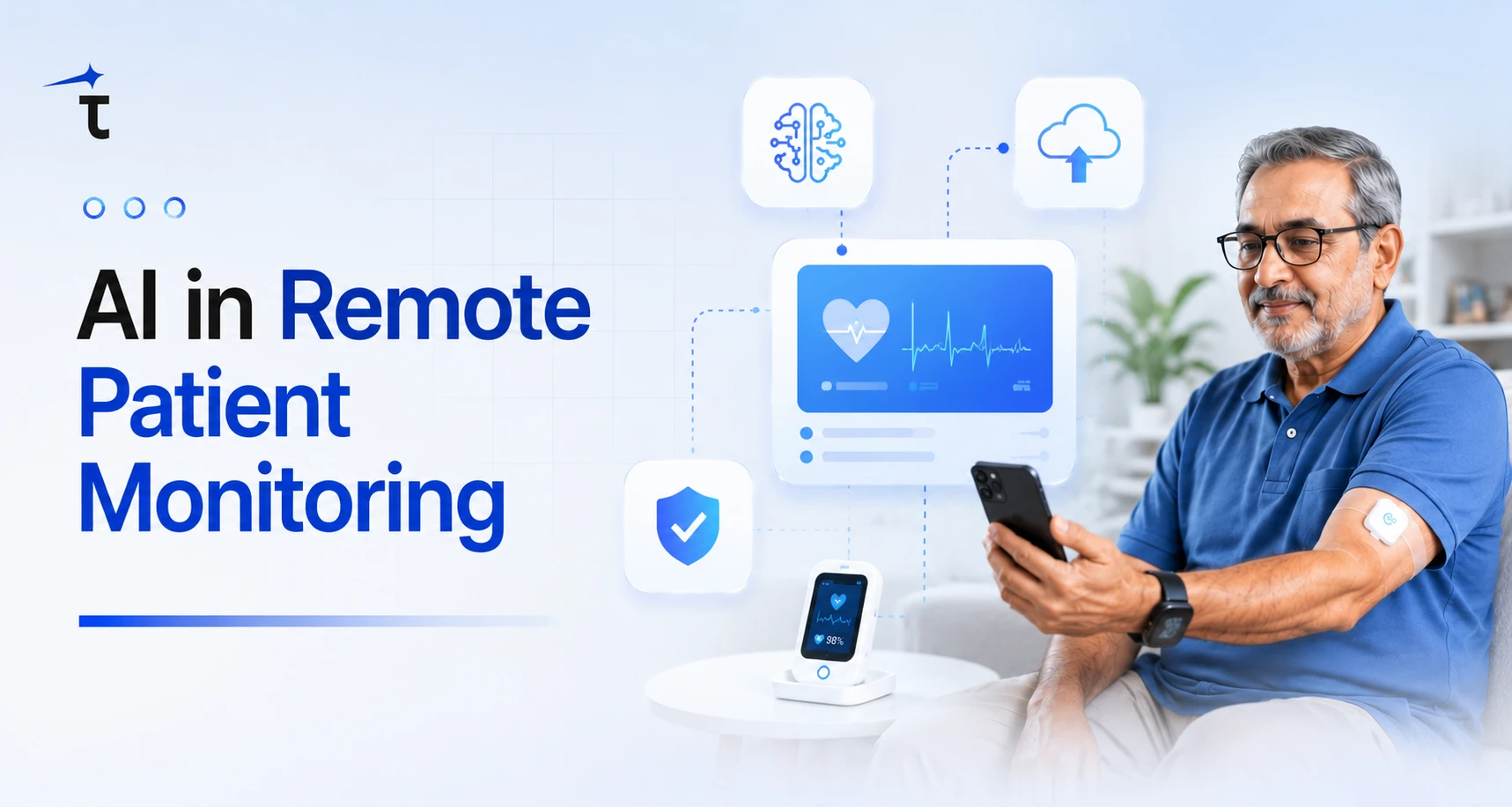
Think about the last time someone you love had a health scare. Chances are, the fear wasn’t just about the diagnosis, it was about the waiting. Waiting for an appointment. Waiting for test results. Wondering whether what you noticed at home was serious enough to call the doctor.
Now imagine a different scenario. A small device on your wrist or a patch on your chest quietly watches over you every hour of every day. Not in a surveillance way, in a looking-out-for-you way. And if something shifts in your body that matters, your care team knows about it before you’ve even noticed anything wrong.
That’s not a vision of some distant future. That’s what AI-powered remote patient monitoring is doing for real patients right now, from managing heart failure in urban hospitals to keeping tabs on diabetic patients in rural communities hours away from the nearest specialist.
This blog breaks down what remote patient monitoring actually is, how AI has transformed it, who it helps the most, and what the honest challenges are that still need solving. No hype. Just what’s real, what’s working, and what you need to know.
What remote patient monitoring actually means
Remote patient monitoring, RPM for short, is the practice of collecting health data from patients outside a clinical setting and transmitting it to their care team for ongoing review. Blood pressure, heart rhythm, oxygen levels, and glucose readings, all flowing securely from your home to your doctor’s dashboard.
- There have been ways to monitor BP for decades, such as home blood pressure monitors, phone calls, and devices that recorded blood pressure for later use, but most were sporadic and reactive.
- However, in more traditional setups, the nurses or care team may only check readings once a week or even less often, creating a dangerous lag time between data collection and intervention, particularly with chronic patients.
- AI and machine learning changed this, as they are constantly monitoring real-time patient data streams and adjusting to the patient’s needs based on his or her unique circumstances.
- The models can detect subtle early warning indicators, such as slight variations in heart rhythm, oxygen saturation, or weight shifts, that a human might not notice with occasional checks.
- AI-powered RPM systems can generate alerts, triage risk levels, and direct the appropriate information to clinicians to prevent a minor deviation from becoming an emergency situation.
Also read: AI Fall Detection Technology for Injury Prevention in Hospitals
How AI actually works inside these systems
Most general articles about this topic stop at AI analyzes the data. That’s true, but not very useful. Here’s what’s actually happening under the hood.
Personalized Baselines
A resting heart rate of 82 beats per minute might be completely normal for one person and a meaningful warning sign for another. Generic thresholds miss this. AI models trained on continuous data from individual patients build a personalized baseline, and flag deviations from that baseline, not from population averages. This is one of the most important differences from traditional monitoring.
Multi-Signal Pattern Detection
Chronic conditions rarely announce themselves through a single reading. A patient with heart failure who’s trending toward a hospitalization will often show subtle changes in weight, blood pressure, oxygen saturation, and sleep quality, sometimes over days, sometimes over weeks.
No human reviewing individual daily readings would reliably connect these dots. An AI system watching all of them simultaneously can detect the pattern and alert the care team while there’s still time for a non-emergency intervention.
Risk-Based Prioritization
A physician or nurse managing a panel of 200 remotely monitored patients cannot give every patient equal attention every day. AI risk-scoring changes this. It looks across the entire patient population and surfaces who needs attention today, who is stable, and who might need a proactive call before next week’s scheduled check-in. That’s not replacing clinical judgment.
Generative AI Summaries
This is newer and worth noting. Instead of a clinician opening a dashboard before a telehealth visit and manually sifting through 30 days of data, AI tools now generate a readable briefing: what changed, what the trend looks like, and what questions might be worth exploring.
Validic launched exactly this kind of tool in early 2025, integrated directly into electronic health records. It saves clinician time and reduces the chance of something important getting buried in raw numbers.
Where it’s making the biggest difference
RPM isn’t one-size-fits-all. Some clinical areas have seen stronger evidence than others. Here’s where AI-powered monitoring is genuinely moving the needle.
1. Heart Failure and Cardiac Rhythm Monitoring
AI-enabled ECG patches worn on the skin capture heart rhythms continuously, something a 30-second in-office EKG simply can’t do. Machine learning flags arrhythmias in near real-time, and hospitals using these programs have seen meaningful reductions in 30-day readmission rates, benefiting both patients and the healthcare systems penalized when those numbers rise.
2. Diabetes Management
Modern AI-powered CGMs don’t just report your glucose, they predict where it’s going, forecasting a low before it happens. The FDA cleared over-the-counter CGMs in 2024, broadening access beyond insulin-dependent patients. Abbott’s Libre platform became the first CGM linked to reduced heart-related hospitalizations in diabetic patients, per a 2025 study.
3. COPD and Respiratory Monitoring
For COPD patients, catching an exacerbation two days early can mean home treatment instead of an ICU admission. AI now analyzes breathing patterns, oxygen saturation, and even the sound of how someone breathes to detect early flare-up signals. GE Healthcare built this capability directly into its RPM platform, helping care teams intervene before symptoms turn acute.
4. Post-Discharge Recovery
The 30 days after discharge are among the highest-risk in a patient’s care journey. People go home, feel better, and stop paying attention, and that’s when things quietly go wrong. AI-powered RPM monitors patients through this window and catches warning signs early. Studies show these patients have fewer ER visits and shorter subsequent hospital stays than those in standard follow-up care.
5. Mental Health Monitoring
AI can now detect early signs of depression relapse or bipolar episodes through passive behavioral signals, shifts in sleep, reduced activity, and changes in app response timing. This matters because mental health providers are severely scarce. AI-powered RPM lets a single psychiatrist effectively monitor a patient panel that would otherwise go unwatched between appointments.
Who Benefits Most from AI-Powered Remote Monitoring
The equity argument behind AI-powered remote patient monitoring doesn’t get discussed nearly enough. Here’s who stands to gain the most:
Rural Patients Facing Distance Barriers to Care
- Living an hour from the nearest cardiologist changes everything
- Remote monitoring means your care team can track your heart and reach out before something goes wrong
- It’s simply the standard of care that urban patients already take for granted
Low-Income and Underserved Communities
- People in low-income areas have historically had the least access to consistent, quality care
- AI-powered RPM brings continuous monitoring to patients who can’t afford frequent in-person visits
- The technology meets people where they are
Patients Who Cannot Easily Access Hospital Care
- The Centers for Medicare & Medicaid Services recognized this gap directly
- Serve patients who either can’t reach a hospital easily or recover better at home with monitoring support
Elderly Patients Managing Multiple Chronic Conditions
- Juggling four or five chronic diseases at once is an enormous cognitive and logistical burden
- AI-powered RPM removes the hardest part, patients don’t have to interpret their own data or decide when something is serious
- The system flags it, and a human responds, simple, but genuinely life-changing for older adults
The Real Challenges
AI-powered remote monitoring is promising, but a fair account has to address the problems. These aren’t small footnotes, they determine whether the benefits actually reach patients.
Data Privacy and Security
Your ongoing health information is very delicate. It goes wireless, resides in cloud systems, and dips between platforms, all vulnerable areas. One of the most frequent areas of attack is healthcare. Compliance is the minimum requirement, HIPAA and GDPR. Patients should feel entitled to know how their information is being kept, who has access to it, and what might go wrong.
Algorithmic Bias
AI is based on past data, and when the data is a certain demographic, the algorithm does not work as well for the rest. This isn’t theoretical. Overestimation of oxygen levels is documented for patients with darker skin tones, and AI systems trained on this data will also inherit the error. Rigorous demographic testing and diverse training data are crucial but not yet common practices.
Connectivity Gaps
Reliable broadband is needed for most RPM systems. Internet connectivity is limited or non-existent in rural regions where it’s most needed. 5G is filling in the suburbs, but it hasn’t made an impact on the rural shortfall. Often, the populations who can’t connect have most to lose.
Alert Fatigue
When there are too many alerts, particularly false alerts, clinicians begin to ignore them. Hospitals already have problems with alert fatigue. Real events must be captured by well-tuned algorithms without spurious false alarms. It can’t be done with just good lab numbers, it needs to be validated in the real world of a clinic.
Integration with Existing Systems
RPM data that’s not integrated with a hospital’s EHR is little more than a paper logbook. When it comes to real clinical value, it should flow easily between devices, platforms, and the EHR systems the clinicians use. It is technically possible, but requires an investment that smaller health systems may not be able to make.
What’s Coming Next in AI-Powered Remote Monitoring
The pace of change is fast, but a few directions are clear enough to talk about honestly.
1. No more wearables
Sensors built into mattresses, mirrors, and everyday home devices will collect health data passively. Patients, especially older adults, won’t need to wear, charge, or manage anything.
2. Reading more than just vitals
Instead of tracking only heart rate or blood pressure, future systems will layer in how you sleep, how you move, and even how your voice sounds, finding patterns no single reading could reveal.
3. Better AI without sharing your data
A technique called federated learning lets AI improve by learning from many patients’ data without any raw information ever leaving their device. Smarter technology, without the privacy trade-off.
4. Care plans built around you
Future AI will factor in your genetics, daily habits, living situation, and health history to suggest care that fits your actual life, not a textbook average for someone with your condition.
5. Rules are finally catching up
The FDA, EU, and US insurance programs are all tightening what AI health tools must prove before they can be used. For patients, that’s good news, it means the products that reach you have been properly tested, not just marketed.
Conclusion
AI-powered remote patient monitoring isn’t a futuristic concept or a niche tool for well-funded health systems. It’s a shift in how care is delivered — from reactive to continuous, from episodic to personal, from available to some to accessible to many more.
The technology is ready. The clinical evidence is accumulating. The biggest remaining gaps are implementation, equity, and infrastructure, problems that are solvable with the right investment and the right priorities.
For patients, it means the possibility of care that actually keeps up with daily life. For clinicians, it means the ability to act earlier and more effectively with the same number of hours in the day. For the healthcare system broadly, it means a more sustainable model — one where hospitalisation is the exception rather than the inevitable destination.
The goal has always been simple: keep people healthier, for longer, wherever they live. AI-powered RPM is finally making that genuinely achievable.
FAQs
It’s the use of artificial intelligence to continuously collect, analyse, and interpret patient health data, heart rate, blood pressure, glucose, oxygen levels, from outside a clinical setting, and transmit it to a care team for real-time monitoring and intervention.
Consumer health apps track general wellness. AI-powered RPM involves clinical-grade devices, medical-level data, secure transmission to a licensed care team, and algorithms trained to detect clinically meaningful changes, not just count steps or estimate sleep.
In the United States, Medicare covers RPM for chronic condition management under specific CPT billing codes. Many major commercial insurers also cover it. Coverage depends on the condition, the program structure, and your insurer. It’s worth asking your provider directly.
Patients managing chronic conditions, heart failure, COPD, diabetes, hypertension, or those recently discharged from hospital, tend to benefit most. Elderly patients managing multiple conditions simultaneously are also strong candidates.
Reputable RPM programs are required to comply with HIPAA in the US and GDPR in Europe. You have the right to ask how your data is stored, who can access it, whether it is sold to third parties, and what happens in the event of a breach. Don’t hesitate to ask before enrolling.
No, and it isn’t designed to. AI surfaces information and flags patterns. Clinical judgement, diagnosis, and treatment decisions remain with your care team. Think of it as giving your doctor a much clearer, more continuous view of what’s happening with your health between appointments.
Depending on the program, an alert is sent to a nurse, care coordinator, or physician. They review it and decide whether to call you, adjust your treatment, schedule a telehealth visit, or recommend you come in. Response time and protocols vary by program, ask about this before enrolling.