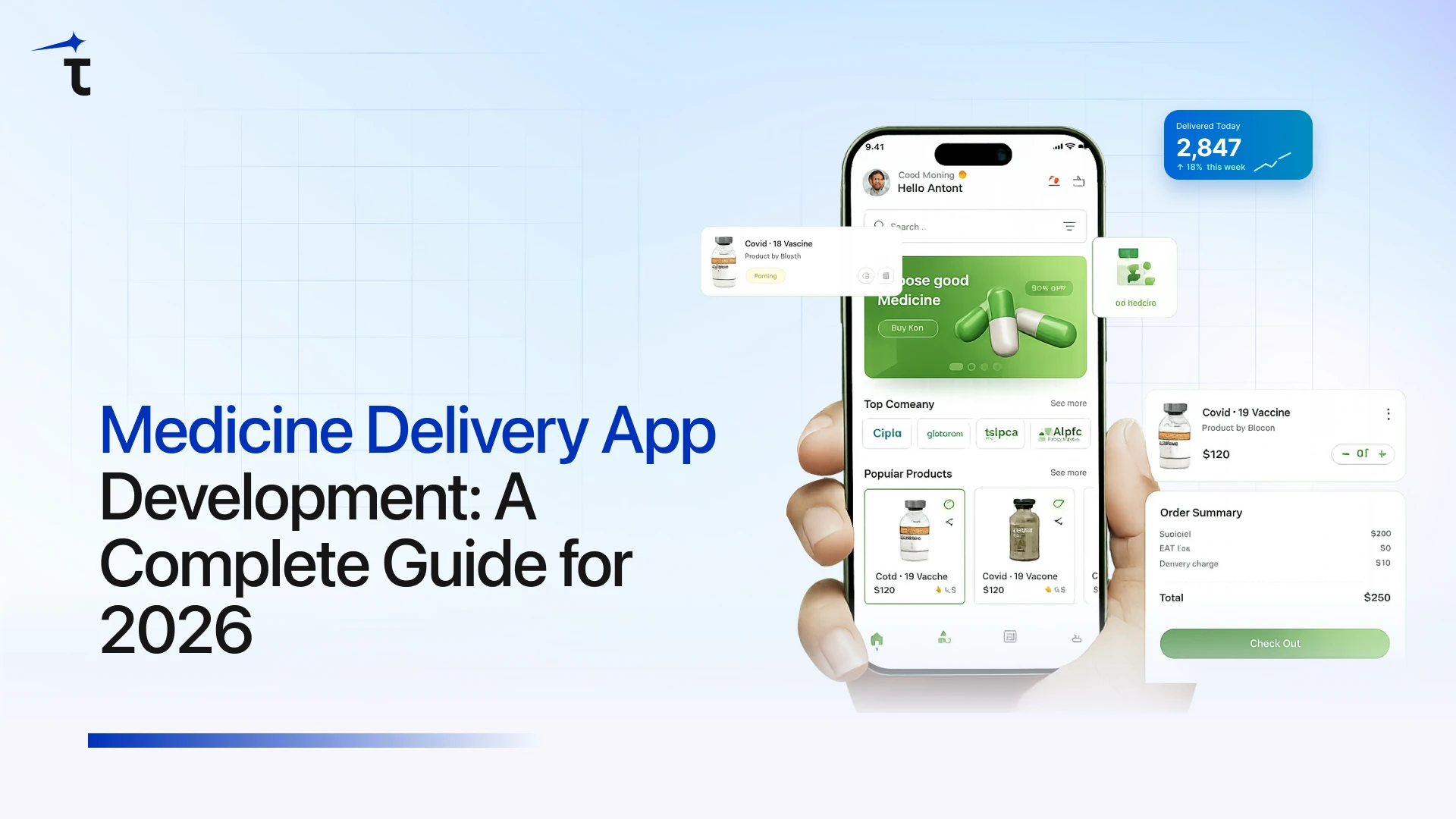
Digital innovation has created a paradigm shift in the healthcare field in a manner that has never been seen before. One of the most influential solutions has turned out to be the medicine delivery apps that transformed the manner in which patients obtain their medications. The pre-digital era meant that to get medicines, one had to go to actual pharmacies and wait in queues, had to deal with little stock and do a lot of paperwork. Nowadays, a couple of taps on a smartphone are sufficient to allow patients to order medicines, make an appointment with a licensed pharmacist, monitor deliveries in real-time, and get medications at the doorstep within a few hours.
The importance of the transformations cannot be overestimated. Medicine delivery applications tackle the key areas of concern of accessibility, affordability, and convenience of healthcare. Circumventing the problem of mobility, helping the elderly, residents of remote locations, busy individual,s and those dealing with chronic illnesses, these applications can offer crucial services that can enhance quality of life and health results.
This detailed blog will help you to know about developing medicine delivery apps. Keep on reading till the end to know everything in detail!
Key Takeaways:
- Medicine delivery applications are transforming healthcare convenience and access.
- The market in online pharmacies is booming and has multiple business opportunities.
- The ability to use it conveniently, affordably, and accessibly are major user adoption motivators.
- Good regulatory compliance is a major driver of long-term success and trust.
- Developed functionality is an important element in user engagement and retention.
- The selection of an appropriate development partner directly affects app scalability and performance.
- The future-ready apps combine AI, telemedicine, and new technologies.
Market Overview and Opportunity
Rising Demand for Online Medicine Delivery
Medicine delivery apps are also a very big opportunity in the field of digital healthcare. This demand boom can be attributed to several converging trends:
Convenience and Time Saving:
Life is becoming busy. Customers appreciate services that make their lives without friction. Going to the pharmacy involves traveling, waiting, and in many cases, a lack of supply. These inefficiencies are removed through online ordering. In cases of chronic disease, patients who have to refill medicine regularly, automatic delivery systems do away with the necessity of making frequent visits.
Accessibility Expansion:
Limiting factors to pharmacy are geographic and socioeconomic barriers. Rural patients can take a 50 (or more) km ride to pharmacies. Drug availability is not even in developing countries. The online pharmacies are able to overcome these restrictions and attend to patients all over. The rural Indian farmer is now able to obtain the same drugs as a person in the metropolis.
Cost Competitiveness:
Internet drug stores run with much lower overhead charges than the brick-and-mortar outlets. They do not keep up the costly retail outlets, staff numbers are not high, and they do not have huge inventories in various places. These savings correspond to competitive pricing that is usually 15-30 percent less expensive than brick-and-mortar pharmacies. Annual savings with chronic patients who are on many medications can be significant.
Chronic Disease Management:
Chronic diseases are on the increase all over the world. The WHO reports that more than three-quarters of the deaths around the globe are caused by chronic diseases. Patients with diabetes, hypertension, asthma etc. must have unlimited access to medication. Delivery apps can provide easy and continuous access to medicine, improve medication adherence, which is a critical health outcome element.
Privacy Considerations:
The social stigma or privacy of some medications is there. Customers who desire to buy treatments to fight erectile dysfunction, psychiatric drugs, birth controls, or sexually transmitted diseases, would wish to do it privately and discreetly. The online pharmacies provide this privacy in a nonjudgmental way.
Data and Personalization:
Modern medicine delivery applications capture data on medication usage that can be utilized to offer individual health guidance, drug interactions, and medication adherence. This type of data-driven solution improves health outcomes and provides the possibility to access additional revenue bases.
Key Market Trends and Statistics
Market size and growth:
In 2023, the market of online pharmacies all over the world was estimated at about 100 billion dollars. The industry analysts are projecting future growth to 200+ billion with 15-17% in annual growth rates. This is a substantial increase in comparison to the traditional retail pharmacy growth rates of 2-3, which means that there will be substantial market transfer to the digital channels.
Geographic Variations:
North America and Europe are developed markets with a level of digital adoption and regulations in place. The growth rates are average (8-10% per year) due to the market saturation. The most promising growth opportunity is in Asia-Pacific, particularly in India, Southeast Asia and China. India alone with the market of online pharmacy is projected to grow by 20-25% annually, backed by 400+ million web users, favorable regulatory changes and minimal friction in digital payments.
Market Composition:
Major players are different by region. Amazon Pharmacy, the application of CVS Health, and Walgreens prevail in the United States. National players and Zur Rose Group are in the lead in Europe. In Asia, Netmeds and PharmEasy (India), Halodoc (Indonesia), and Myna Stores (Southeast Asia) have a presence. There are no limits to the number of successful competitors in most markets, especially niche-specific apps.
Regulatory Evolution:
Trends in regulation are in favor of market expansion. Governments acknowledge the importance of online pharmacies in enhancing access to healthcare and lowering expenses. In India, Brazil, and the Southeast, the new regulations provide entry points into the market. Nevertheless, there are jurisdictions that retain a prohibition on the sale and distribution of controlled substances and demand licensed pharmacist supervision, which offers business challenges and opportunities to players that comply.
Integration Trends:
Individual medicine-delivering apps are becoming an inclusive healthcare platform. Effective apps are starting to combine telemedicine consultation, lab tests, health insurance, and health tracking. This integration generates switching costs, enhances customer lifetime value, and offers numerous monetization points.
Technology Adoption:
Machine learning and AI are redefining the healthcare delivery process. The algorithms of prescription analysis are used to identify possible drug interactions. Recommendation engines propose pertinent drugs. Inventory optimization is through demand forecasting. Fraud detection systems detect suspicious transactions. Such technologies make a difference between winners and commoditised competitors.
About Medicine Delivery App Development
What is a Medicine Delivery App?
A medicine delivery app can essentially be defined as a digital platform that allows customers to buy pharmaceutical products and ship them to convenient locations, which in most cases is their homes. Nevertheless, the current medicine delivery apps serve as a full-fledged healthcare platform going much beyond merely transactions.
Fundamentally, medicine delivery apps are a solution to one important issue: to make pharmaceutical products accessible, affordable, and convenient. They bridge three critical stakeholders: patients in need of medications, pharmacies and healthcare providers offering this medication, and the partners in logistics that facilitate it.
The value proposition of the different stakeholders is different. To patients, the app is convenient, saves costs, is accessible, and informs about their health. In the case of pharmacies, the app has the ability to increase the number of customers reached, as well as transaction volumes, and generate data insights. In the case of healthcare systems, the apps enhance medication compliance and lowers health care expenditures.
Current medicine delivery apps are full-stack healthcare platforms, featuring prescription management, clinical decision support, integration of telemedicine, insurance connection, and health monitoring. They act as a connector between the patients and the whole healthcare system.
Types of Medicine Delivery Apps
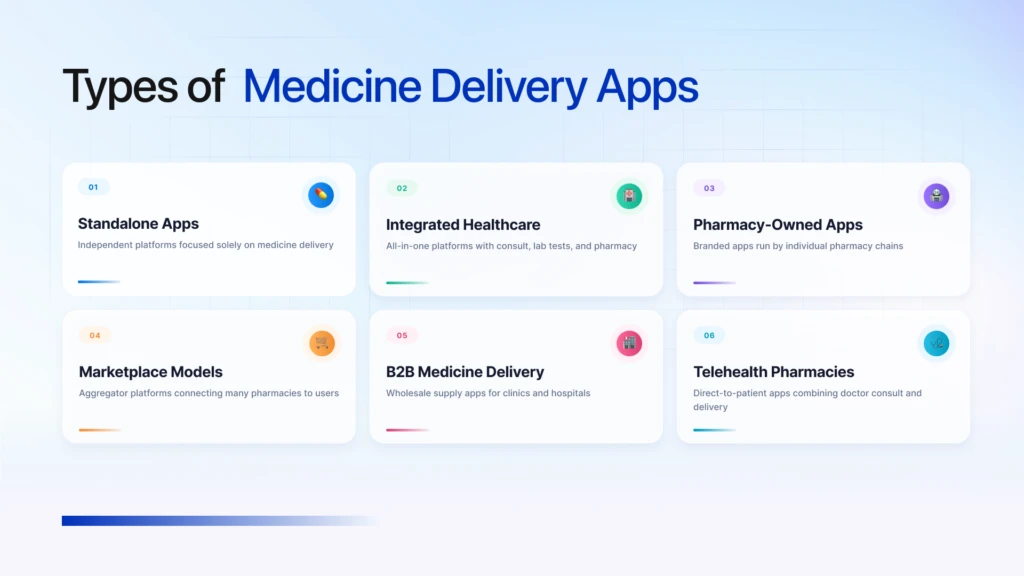
Standalone Medicine Delivery Apps:
These are only concerned with sales and delivery of medication. In India, examples are Netmeds and PharmEasy. These apps are small in scale but can have great scale with focus and operational excellence.
Integrated Healthcare Platforms:
Applications that provide several healthcare services all in one, such as telemedicine, medicine delivery, lab testing, and health monitoring. Such examples are Apollo 24/7 and Practo. Such platforms have the advantages of cross-selling and customer retention, but they involve more development.
Pharmacy-Owned Apps:
created by developed pharmacy chains, with their services going online. Examples are the CVS app and the Walgreens app. They build on the established customer connections and fulfilment systems, but cannot be as flexed as stand-alone apps.
Marketplace Models:
Aggregators that provide the connection between several pharmacies and allow price comparison and a wide choice. The models do not risk inventory; they demand having numerous pharmacy partners and logistics.
B2B Medicine Delivery Apps:
Targeted at institutional clientele, such as hospitals, clinics, and healthcare systems, which handle the procurement of medications. The feature requirement in these apps varies from those in B2C applications, with a focus on bulk buying, inventory, and interconnections with hospitals.
Direct-to-Patient Telehealth Pharmacies:
Applications with a combination of doctor-patient consultation, prescriptions, and medicine delivery. Such combined experiences eradicate intermediaries but entail licensing of telemedicine and cooperation of pharmacists.
How Medicine Delivery Apps Work
Knowing how the system works makes the system architecture and feature requirements clear:
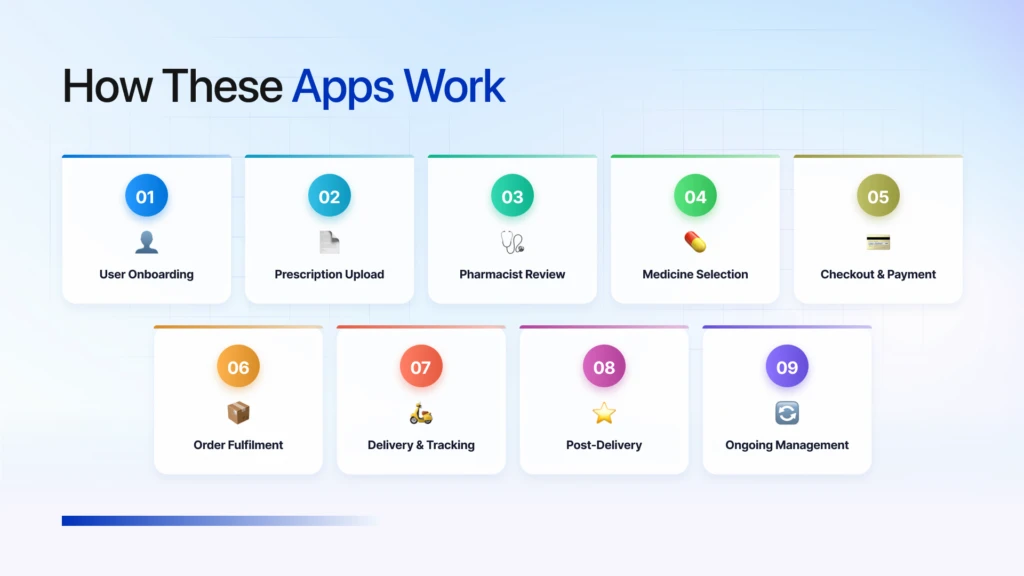
User Onboarding:
The new users download the app and register their accounts, supplying their email, phone number, and general information. Registration causes email/SMS authentication. Users create in-depth health profiles, such as medical history, allergies, chronic illnesses, medications they take, and insurance details. A full profile allows enhanced clinical decision support and expedited checkout.
Prescription Submission:
Healthcare providers provide users with prescriptions using various means: physical prescriptions when physically meeting, electronic prescriptions when having a telemedicine session, or direct feeds when using the EHR system of a provider. Users enter physical prescriptions through the smartphone camera-OCR technology, which automatically captures medication information, or enter digital prescriptions.
Pharmacist Review:
Licensed pharmacists check signed prescriptions and verify their validity, accuracy of information about the patient, and provide a clinical check (drug interactions, contraindications, proper dose). Pharmacists make calls back to the prescribers to verify in instances when prescriptions are not known by the prescribers or controlled substances. This review protects the patients and imposes regulations.
Medicine Selection and Shopping:
The app allows users to navigate through the drug database by either drug name, active ingredient or condition. They read detailed information like side effects, contraindications, precautions and cost. The customers can make a decision in terms of generic options, shopping price with other outlets and insurance coverage. There exist many apps, which provide medication education videos, which improve medication adherence.
Checkout and Payment:
Users choose the delivery methods (express, standard, economy), as well as the payment methods (credit card, digital wallet, insurance, cash-on-delivery). The system estimates the cost in terms of delivery expenses and taxes. Secure gateways with fraud detection are utilised to process payments.
Order Fulfilment:
Orders that are accepted go to pharmacies to be fulfilled. Pharmacists check medicine availability, fill prescriptions, securely package orders, and deliver to delivery partners. Quality checks ensure proper medication and amounts. Verification of complex prescriptions can lead to further processes.
Delivery and Tracking:
Delivery partners are given assigned orders and make the best plans. Customers get the GPS location tracking, approximate time of delivery, and the details of the delivery agent in real-time. Customers are updated with milestones through push notifications. Prescription delivery involves documentation of compliance by the delivery agents, who take photos of the prescriptions and gather signatures during delivery.
Post-Delivery Experience:
Customers can rate an experience with delivery and check reviews of medications and report problems. The feedback to the system enhances service quality. Orders placed are recorded in the order history, where they can be easily reordered once more in the future.
Ongoing Management:
In the case of chronic medications, customers are reminded of the expiration of prescriptions or when they run out of medication. Features such as subscription allow automatic, frequent delivery. The medication compliance is monitored, and health reminders are provided through the system. Customers are able to make refills several weeks ahead, which guarantees them a constant supply.
Essential Features and Functionalities
These are some essential features that cannot be ignored during medicine app delivery development:
User Registration and Profiles
The point of entry to your platform is user registration. Registering should be an exercise in completeness, and the experience should be frictionless. Users will register using either email, phone number, or even social media (Google, Facebook), as well as biometric authentication. Protect against fake accounts by using email verification and SMS OTP.
Prescription Upload
The ability to post prescriptions has a direct effect on user experience and compliance with regulations. The functionality should include a variety of submissions like smartphone camera capture through OCR technology, uploading PDF documents, forwarding emails to special addresses, and direct connection to healthcare provider systems. Photo-based uploads are essential in OCR technology.
Medicine Search and Filters
The key aspect of user experience is medication search. The users have to locate medications fast, intuitively. The search engine will need to allow many types of queries: drug name (brand and generic), active ingredient, therapeutic class, symptom/condition, or specific indication. Autocomplete recommendations are given as one types to avoid the frustration that results from missing.
Real-Time Order Tracking
Customers are satisfied by being able to see the status of their orders in real-time. Show confirmation of delivery status updates, such as prescription verification phases. Display real-time GPS location of delivery agents on interactive maps. Offer living ETAs that are adjusted to traffic and delivery queues. Add details of the delivery agent; include a photo and contact information. Push, SMS, and in-app messages keep the customers informed about each milestone, reduce anxiety, and help with questions.
Secure Payment Integration
Accept a variety of payment options according to the preferences of customers. Make credit/debit card integration with PCI-DSS compliant tokenisation. Facilitate electronic wallets such as Apple Pay and Google Pay. Add mobile wallets like Paytm and PhonePe, Bank transfers, cash-on-delivery, insurance billing, and buy now pay later. Adopt machine learning detection of fraud.
E-Prescriptions and Doctor Integration
Prescription upload friction is removed with integration. Allow direct reception of electronic prescriptions via NCPDP standards. Provide telemedicine appointments within apps that produce prescriptions. Incorporate APIs that ensure prescription verification and verify that it is legitimate. Link to EHRs such as Epic and Cerner to medical histories.
Notifications and Alerts
Smart notices promote interaction and enhanced health results. Send transactional messages of orders, payment,s and deliveries. Scheduling of medication and refill methods. Warn on drug interactions and contraindications. Give notice prior to the expiry of the prescription. Provide tailored suggestions according to medication history.
Order History and Reordering
Automated reordering boosts repeat business. Allow rearranging with pre-filled information. Allow users to develop individual drug lists. Provide subscription management of chronic drugs with automatic repeat orders. Keep libraries of prescriptions to use. Show detailed order details. Install machine learning forecasting the need to buy by the frequency of purchases, so proactive notifications will be provided to motivate and order purchases.
Customer Support Integration
Extensive support is essential to retention. OSL Live chats with pharmacists and agents. Have phone helplines that have trained personnel. Use email ticketing for non-urgent inquiries. Create comprehensive FAQs. Provide video conferences with pharmacists. Create community forums through user-generated Q&A.
Admin Dashboard
Backend allows making decisions and efficient operations. Use real-time inventory control and auto-notices. Show full visibility of orders, including fulfillment status. Create analytics reports of sales patterns and customer behaviour. Role-based permission to control staff. Prepare prescriptions to be examined by the pharmacist. Optimality of delivery agent assignments. Add complex marketing tools to create the campaigns and A/B testing to keep optimizing them.
Process for Medicine Delivery App Development
There is a simple process that has been followed by the development partner, like TechnoYuga, for the smooth delivery of the product:
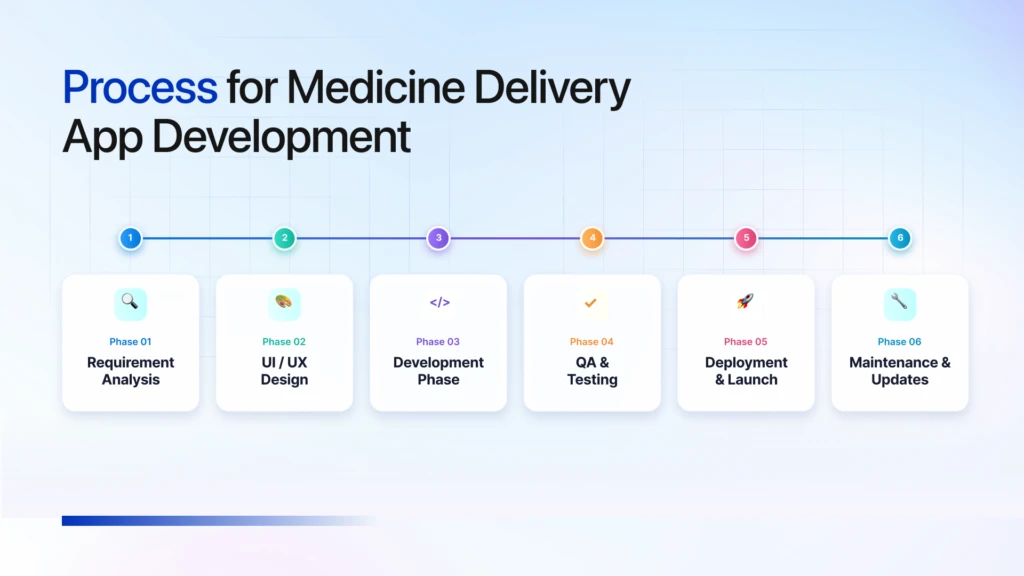
Requirement Analysis
Effective development of an app starts with clear requirements. Document: feature specifications, user journeys, integration requirements, performance requirements, and security requirements. Perform market research and competitor analysis, and user interviews. Establish success measures and KPI. Regulatory documents of target jurisdictions. Technical requirements are specifications of the technology stack, infrastructure, and scalability requirements. An effective requirement analysis helps avoid any unnecessary mistakes in the future.
UI/UX Design
Converting specifications into friendly, appealing user interfaces. Design wireframes with page layout and user flows. Carry out user testing that substantiates design choices. Create mockups at high fidelity using real visual design. Design accommodation with regard to elderly users, persons with visual/motor disabilities, and non-technical users. Design on multiple screens and devices. Set up design systems that are consistent throughout the app.
Development Phase
Create a strong backend infrastructure to meet the anticipated size. Create iOS and Android (native or cross-platform) mobile apps. Develop operational management admin dashboards. Combine third-party services (payment gateways, logistics services, pharmacy systems). Apply agile practices in 2-week sprints, frequent reviews, and constant improvement. Introduce code inspection programs and test frameworks.
Quality Assurance and Testing
Extensive testing guarantees trustworthiness and safety. Unit testing verifies a single component of the code. Integration testing ensures that components are operating. System testing ensures the full functionality. The usability problems are found by user acceptance testing with real users. Security testing involves code security analysis, vulnerability scanning, and penetration testing. Performance testing is used to guarantee acceptable load response times. Usability is checked by accessibility testing, which tests usability against individuals with disabilities. Achieve >80% code coverag,e indicative of thorough testing.
Deployment and Launch
Deploy to staging environments that mimic production to do end-to-end testing. Carry out production preparedness checks. Roll out in phases, beginning with a few users (beta) and full release. Enact wholesome observation that identifies problems at an early stage. Make arrangements to launch communication and marketing. Brief support teams. Once launched, be aware of problems and prepare rollback efforts.
Maintenance and Updates
After the launch, offer continuous support in fixing bugs, adding features, and ensuring security. It is Release is released frequently and contains new features and improvements. Monitor performance continuously. Develop and implement security patches. Observe user response and include in roadmap. Be backwards compatible with updates. Record all the modifications to be compliant.
How to Choose the Development Partner to Develop a Medicine Delivery App
The choice of an appropriate development partner is a great determinant of success. Evaluate the development partner on:
Industry Experience
Healthcare app development partners have experience and understand the regulatory requirements, security needs, and industry best practices. Inquire about past medicine delivery or healthcare apps that they have developed. Solicit case studies and references. Ensure they are aware of your target regulations (HIPAA, GDPR, etc.).
Technical Expertise
Confirm technical capacity to suit your needs: mobile application development (iOS/Android), technical architecture, cloud, integrations (pharmacy systems, payment gateways, logistics). Evaluate staffing, credentials, and technology knowledge. Ensure they comply with best practices of security and code quality.
Portfolio and Case Studies
Survey past efforts in measuring quality, complexity, and relevance. Ask case studies to explain projects, the challenges encountered, and the outcomes of the projects. Go to deployed applications to test the quality and functionality.
Reviews and Testimonials of the Clients
Get client recommendations and call them personally. Questions should be regarding communication, delivery schedules, quality, after-sales services and experience. Bad reviews or inaccessible sources of information might be problematic.
Post-Launch Support
The development of the app is not fully over with its launch. Make sure the partner has continued support: bug fixes, performance monitoring, updates, and new features. Know support SLA, response times, and costs. Lack of clarity in after-sales support results in a high amount of abandoned applications and annoyed users.
Future Trends to know (AI, Telemedicine Integration)
Along with the medicine app delivery development, be sure the same is compatible with future trends/updates too:
Artificial Intelligence:
Analysis of prescriptions identifying drug interactions, predicting side effects, forecasting demand to optimize inventory, recommendation engines proposing the most suitable medication, and chatbots answering common questions. AI facilitates customization on a large scale.
Telemedicine Integration:
External friction is removed through consultations with healthcare providers in the app. Doctors give out prescriptions that are automatically set into the medicine order form.
Health Monitoring:
Health monitoring apps and wearables give background to medication. A client who has a high blood pressure is advised on hypertension medication.
Blockchain:
Counterfeit drugs are avoided by supply chain checks. Prescriptions on blockchain will be tamper-proof.
IoT Devices:
The approval of medications is monitored by medication adherence devices, which give information on whether patients adhere to medications or not, to analyze health outcomes.
Planning for future integrations prevents architectural lock-in, requiring later overhauls.
Conclusion
In conclusion, the development of medicine delivery apps is a considerable chance of enhancing healthcare access and creating valuable businesses. The market is expanding at a high rate, regulatory frameworks are getting clear, and technology is a way to provide sophisticated solutions.
To be successful excellence in various dimensions is necessary. Technical architecture should be secure, scalable, and robust. Characteristics should deal with real user needs intuitively. The compliance with the regulations cannot be neglected. Operations should be effective and customer oriented. Business models should be profitable and sustainable.
The apps and companies that will spearhead this change will be the ones that walk the fine line between innovation and responsibility, growth aspirations and regulatory considerations, and technological complexity and end-user easiness. This is a real opportunity and it is high time to build.
FAQ
It usually requires 6-12 months to develop a medicine delivery app. The development of MVP may require 3-4 months. Costs may vary based on complexity and features, with prices varying between $50,000 and 300,000. The monthly hosting, payment processing, APIs, and support costs of the project are an additional $10,000-50,000.
HIPAA compliance is a requirement in the US. GDPR is enforced in the EU and on all user data with stringent provisions. India needs licensed pharmacist supervision and adherence to the Drugs and Cosmetics Act. A majority of jurisdictions have a licensed pharmacy that operates the app or performs fulfilment. Hire healthcare attorneys in your area of interest.
Introduction of a licensed review of all prescriptions by pharmacists before dispensing. Automate prescriber checking through computerised systems. Confirm the authenticity of prescription documents. In the case of controlled substances, contact prescribers directly. Use identity validation of users. Apply the methods of fraud detection to suspicious transactions.
Accept a wide range of payments: credit/debit cards, digital wallets (Apple Pay, Google Pay), mobile wallets (Paytm, PhonePe), bank, cash-on-delivery, and insurance billing. Geographic preferences are highly differentiated- research on your target market. Multiple support options boost conversion and customer satisfaction.
Laws differ tremendously across jurisdictions. There are other countries where the sale of controlled substances via online means is outright banned. Others permit it with strict verification conditions, such as prescriber verification, identity authentication, and license-specific. Verify with your local laws.