Theft is not an issue that has emerged recently, but today, businesses are dealing with it more often than ever, and it’s getting harder to ignore. From retail stores to warehouses and manufacturing units, frequent cases of theft happen.
That’s the real gap. Traditional surveillance assists you to observe what has already occurred, but not in its current state. By the time someone reviews the footage, the damage is already done. That is why now businesses consider AI Theft Detection System Development as a way not only to monitor but also actively prevent before they occur.
These systems can identify suspicious behavior, predict risks early, and provide alerts in real-time with the assistance of AI and computer vision. Whether it’s shoplifting, unauthorized access, or suspicious movement, the goal is simple: catch it before it becomes a problem.
In this guide, we’ll break down how these systems actually work, where they are used, what it takes to build one, and what you should consider before getting started.
Key Takeaways
- Legacy surveillance is reactive and only records events, while AI helps prevent theft in real time.
- AI can identify specific human actions such as concealment and repeat suspicious access that is not easily spotted by humans during surveillance.
- A single AI system can handle hundreds of cameras in multiple locations, which can truly be scaled without adding extra strain on the operation.
- The development process is organized in stages, and every stage, such as data to deployment, has a direct influence on the accuracy and performance of the final system.
- To enhance trust and response quality, AI systems minimize false alarms by interpreting context, not only motion, and this is much better than motion-based.
- Real-time notifications enable security teams to respond in real-time rather than examining the incidents after they have caused damage.
What Is an AI Theft Detection System?
An AI theft detection system is an intelligent surveillance system that employs artificial intelligence, computer vision and machine learning to observe an environment in real time and automatically indicate a potential theft.It is not simply a recorder like the traditional CCTV, but an interpreter. It’s trained to recognize what normal behavior looks like, and to raise an alert the moment something deviates from that pattern. Concealment gestures, loitering near high-value zones, unauthorized access attempts, unusual vehicle movement — these are the behavioral signals this system catches consistently, at scale, across every camera it’s connected to.
Key Problems with Legacy Surveillance Systems
Before knowing about how AI-powered systems work, it’s important to know why the old approach isn’t working because understanding the gaps makes it much easier to see what you actually need to solve.
Dependence on Manual Monitoring
Most traditional AI Theft Detection System setups depend on someone sitting in front of a wall of screens. It sounds simple, yet, in reality, it falls apart quickly. Human attention is limited. Research indicates that the level of concentration begins to decrease greatly after approximately 20 minutes of continuous monitoring. In the case of a big retail store/warehouse with hundreds of cameras and multiple shifts, 24-hour human surveillance is costly and untrustworthy.
The problem isn’t that security personnel aren’t doing their jobs — it’s that the job, as designed, asks too much of human cognition.
Post-incident Detection
Legacy systems are not designed to prevent theft. They are intended to write it down. Footage gets reviewed after a loss is reported. Timestamps get pulled. Sometimes the culprit is identified, sometimes not. In any case, the damage is already done. For enterprises dealing with high-value inventory or frequent shrinkage, a reactive approach is functionally the same as having no detection at all — you’re just getting better at counting what went missing.
High False Alarm Rates
Basic video analytics and motion detectors are activated at all times, a customer picking up a product, a shadow of an oncoming headlights, a cleaning crew going through after closing. As time progresses, security teams begin to ignore alerts as noise. And when there is actually a real danger at hand, the reaction is slower due to alert fatigue. This is a failure mode that is least recognized in enterprise security. The system raises the alarm so frequently that no one runs at the right time.
Challenges in Scaling Across Locations
Conventional systems do not scale well. By adding the locations, it translates to adding the cameras, adding the storage, and adding the personnel to oversee all that. No central layer of intelligence that ties it all together. Companies that have many warehouses or other retail outlets in different areas find themselves operating a mosaic of systems that are not linked on to each other – and the cracks between the systems are the very places where thieves are likely to find easy access.
Lack of Behavioral Or Contextual Intelligence
The greatest weakness, perhaps legacy systems can capture what is occurring, but not what it means. They are not able to tell the difference between a customer who is browsing and one who hides. The systems can not be able to notice when a person has already visited a limited place 3 times within an hour. Couldn’t pull over a car that has been idling at a loading dock unusually long. That interpretive layer – the capability to read intent out of behavior – can only be available at scale by AI.
How AI-Powered Theft Detection Systems Work
Camera feeds are fed into an AI engine – either processed on-board using edge computing, or sent to a cloud server. Computer vision and machine learning models then analyze the footage frame by frame, looking for behavioral anomalies: concealment gestures, loitering near high-value zones, unauthorized access, unusual movement patterns.
With detection of something suspicious, the system sends an alert, to a dashboard, a mobile app, or straight to a security team in real-time. All incidents are stored and produce actionable reports in the long run. Most importantly, the model continues to learn with each new incident, and this implies that the detection accuracy increases as the model operates.
Traditional vs AI-Powered Theft Detection
Here’s how the two approaches stack up on what actually matters for enterprises:
| Aspect | Traditional Systems | AI-Powered Systems |
| Detection approach | Motion triggers, manual review | Behavioral analysis, real-time inference |
| Response time | After the incident | During the incident |
| Accuracy | High false alarm rate | Reduced false positives via context |
| Human dependency | Constant manual monitoring | Automated, alerts only when needed |
| Scalability | Costly to expand | Scales across sites without adding headcount |
| Behavioral intelligence | None | Concealment, loitering, repeat access detection |
| Insights & analytics | Playback only | Trends, heatmaps, incident reports |
| Long-term cost | Lower upfront, higher losses | Higher upfront, measurable loss reduction |

Industry Use cases of Theft Detection System
This is where the AI theft detection system earns its keep — and the range of applications is broader than most enterprises expect.
Retail
Retail Stores deal with constant foot traffic, multiple touchpoints, and limited visibility across aisles and stockrooms. By developing an AI-based theft detection system, the store owners are able to detect shoplifting, self-checkout fraud, and even subtle employee theft patterns in real time. Instead of reviewing hours of footage later, teams get alerts the moment something feels off—when concealment happens, when behavior deviates, or when patterns repeat.
Warehousing and logistics
Warehouses are risky places not due to customer activity but due to size. When building theft detection systems for logistics, the focus shifts to movement patterns; who accessed what, when, and how often. AI systems monitor employee behavior, vehicle movement, and inventory flow to detect anomalies.
Manufacturing
Manufacturing environments operate on precision, but security often lags behind operations. Through detection system development using AI, the factory owners can monitor production floors, storage areas, and access points in real time.
Banking and financial institutions
Banks are working in an environment where a minor security breach can lead to serious consequences. The development of the AI-driven theft detection system will allow the institutions to monitor the work at the ATM, banks in real-time. The system recognizes unusual behavior, such as long loitering duration, repeated access attempts, or abnormal movement patterns and sends alerts instantly.
Healthcare & pharmaceuticals
Hospitals and pharmaceutical facilities deal with highly sensitive and high-value assets—controlled drugs, medical equipment, and restricted inventory. By building theft detection systems customized for the healthcare sector can monitor access to sensitive areas and ensure that only authorized personnel handle critical resources.
Airports & public transport
Airports and railway stations are some of the most complex areas to monitor. With AI detection systems development, authorities will be able to monitor behavioral trends at scale, such as suspicious activity, unattended baggage, or unauthorized access without solely having to resort to human observation. This system helps to prevent theft as well as maintain overall situations in crowded spaces.
Hotels and hospitality
In hospitality, security directly impacts customer trust. Guests prioritise safety, in space they stay. Hotels can be smarter on how they track these areas with the development of AI theft detection systems. The system detects unusual movement, restricted access requests or suspicious activity in real-time without being intrusive. It helps to create a safer experience for guests.
Educational institutions
Campuses are open environments, which makes them difficult to secure using traditional methods. Labs, classrooms, and common areas often remain vulnerable, especially after hours. By developing an AI-driven theft detection system, the Educational institutes will be able to check the activity on campus and identify the patterns that will suggest a possible threat of unauthorized access, unusual movement, or constant visits to restricted zones. This improves security without turning campuses into controlled environments.
Key Benefits of AI Theft Detection System Development
See how your enterprise can get benefit of AI powered Theft Detection System Development
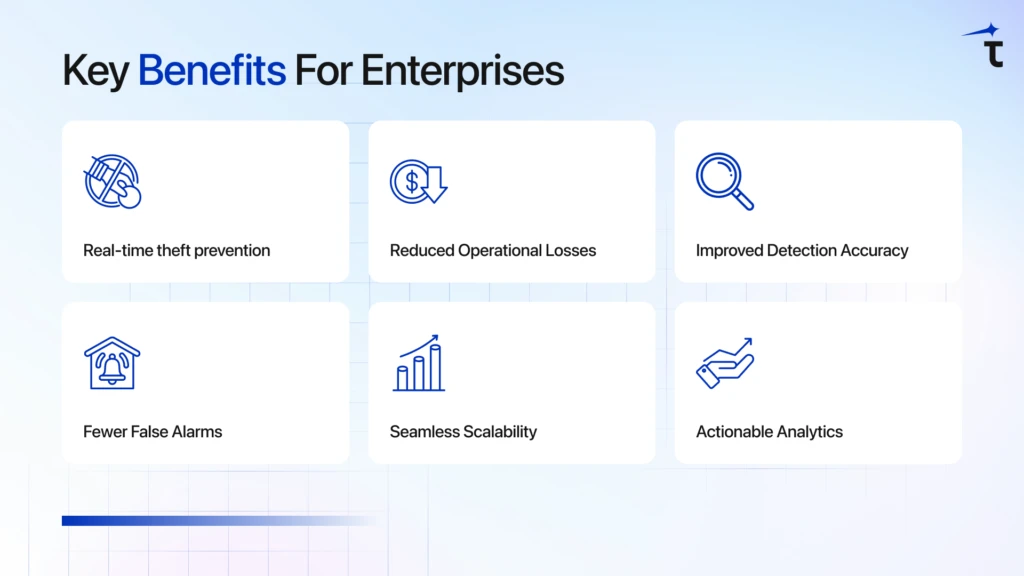
Real-Time Theft Prevention
The biggest shift with AI theft detection system development is timing. Instead of reviewing footage later, your team gets alerts as incidents unfold—giving you a real chance to act, not just react.
Reduced Operational Losses
When theft is detected early and consistently, losses don’t pile up quietly. Over time, you start noticing a clear drop in shrinkage, asset loss, and operational inefficiencies.
Improved Detection Accuracy
It monitors every camera, every second, with the same level of focus spotting patterns and behaviors that are easy to miss manually.
Seamless Scalability
Scaling security shouldn’t mean scaling your team endlessly. A well-designed system grows with your business, whether you’re managing a handful of sites or hundreds of locations.
Actionable Analytics
Each incident is registered and examined. Over time, you get trend data, risk heatmaps, and behavioral patterns that help optimize security operations proactively.
Technical Components and Technology Stack
Video data layer
IP cameras, CCTV systems, and IoT devices streaming live images into the system. The planning of resolution and placement is as important as artificial intelligence.
AI detection engine
The core of the system is computer vision and machine learning models that recognize suspicious activity, anomalies, and patterns of threats on video streams.
Alerting & dashboard layer
Real-time notification service that sends notifications to security dashboards, mobile applications, or control rooms as soon as a threat is detected.
Data storage & processing infrastructure
Manages video archives, metadata, and processing pipelines. Constructed to be fast – particularly important in edge deployments where latency is important.
Integration layer
Integrates the AI system with your current security infrastructure, enterprise tools, and third-party platforms over REST APIs, WebSockets, or custom SDKs.
Technology stack
- Programming languages: Python (AI/ML), C++ (real-time processing), JavaScript (frontend dashboards)
- AI and ML Frameworks: TensorFlow, PyTorch, OpenCV, Keras – to train and fine-tune and process videos.
- Edge & cloud platforms: NVIDIA Jetson for on-device edge processing; AWS, Azure, or GCP for cloud-based scalability and storage
- Databases: SQL/NoSQL metadata and event logs; cloud object storage video archives.
- Integration tools: REST APIs, WebSockets, and custom SDKs for connecting with enterprise security systems and dashboard
Must-Have Features For Enterprise Deployment
Not every AI Theft Detection System must have following features:
Real-time detection and instant alerts
The system must be able to identify suspicious activity and send alerts to dashboards, mobile devices or control rooms, quick enough that security personnel can actually take action. The lateness of alerts is almost as effective as post-incident video surveillance.
Behavioral Analysis Engine
This is what AI theft detection systems must have. The system is expected to identify and highlight certain patterns of behavior: concealment, abnormal loitering around high-value areas, multiple attempts of unauthorized access, and abnormal movements. Context-sensitive detection – not movement detection.
Multi-Camera and Multi-Location Support
The enterprise system must be able to consume feeds of hundreds of cameras in hundreds of facilities at the same time and present all of it in one, centralized dashboard. Should the system be able to clean up one location only, then it is not enterprise-ready.
Anomaly Detection And Pattern Recognition
Beyond flagging individual incidents, the system should recognize patterns over time — a person who visits the same restricted area three times in one shift, a vehicle that idles near a loading dock longer than usual, inventory movement that doesn’t match logged activity. Such is the start of predictive capability.
Scalable and Modular Architecture
The system must be made to expand without the need to rebuild. New cameras, new locations, new detection use cases – everything should be addable without structural refinements. Modular architecture also means you can start with core detection and expand to analytics, predictive scoring, and IoT integration as the system matures.
Integration With Existing Security Infrastructure
A theft detection system that exists in isolation creates more work, not less. It must be compatible with your existing CCTV system, access control, alarm infrastructure, and enterprise security processes – via REST APIs, WebSockets or custom SDKs based on your stack.
Centralized Dashboard And Reporting
Security managers need a single interface that shows live feeds, active alerts, incident logs, and trend analytics across all monitored locations. The dashboard must be designed to work with the business, not the data scientists. Actionable, clean and fast.
Data Analytics And Incident Reporting
All flagged incidents need to be automatically logged, including timestamps, camera identities, clip identities, and behavioral identifications. In the long run this information can become actually useful – showing areas of theft, dangerous periods of time, the behavior of a repeat offender, and coverage gaps that must be filled.
AI powered Theft Detection System Development Process
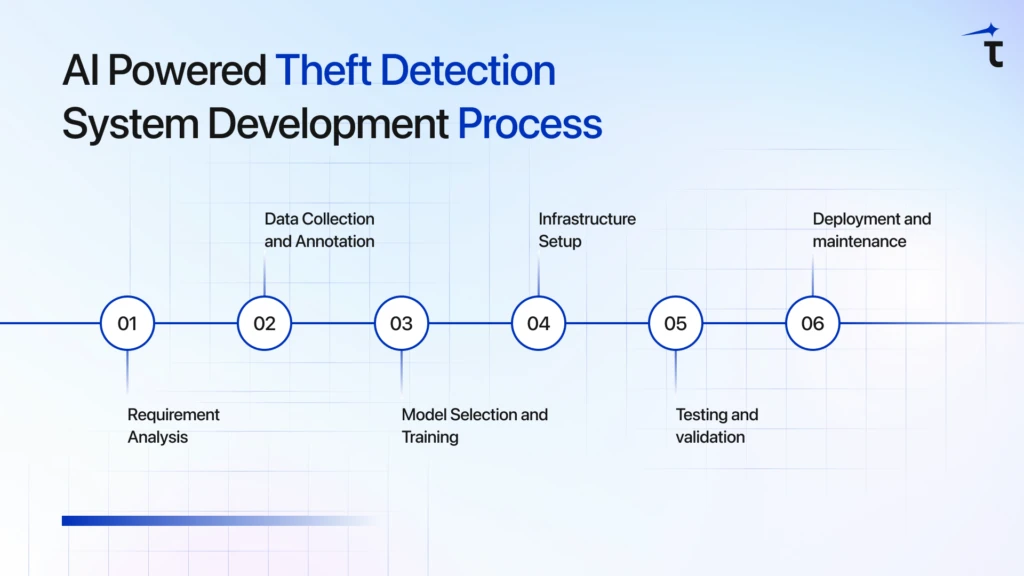
The process of building Theft Detection Systems using AI has a very definite order of steps – jump steps and you will regret later in terms of accuracy and reliability.
Requirement Analysis
While starting the Detection System Development Using AI, firstly you need to determine what you are detecting (shoplifting, insider theft, unauthorized access) and what areas you need to monitor and what infrastructure you are dealing with.
Data Collection and Annotation
After a requirement analysis. You need to take video footage from real places where the system will be used, like retail stores, warehouses, or offices. Then you carefully label the footage by marking normal behavior and anything that looks unusual, such as hiding items, suspicious movement, or repeated access to restricted areas. The performance of models directly depends on the quality of this dataset.
Model Selection and Training
In this stage of AI powered theft detection system development, you choose the right AI models based on what you want to detect such as objects, unusual behavior, or specific actions. These models are then trained and Fine tune using your prepared and labeled video data.
Infrastructure Setup
In this stage, you decide how the system will actually run in real life. You may use edge AI to learn faster on your device, cloud to scale, or both, depending on your application. Along with this, you set up secure data pipelines and storage systems so video data and alerts move safely and efficiently across the network.
Integration and alerts
Once the core system is ready, it needs to connect with your existing security setup. This includes building dashboards, setting up mobile notifications, and creating real-time alert workflows. The principle is that when something suspicious is identified, your security staff should be informed instantly and take quick action.
Testing and validation
Before going deployment, test the system in real conditions. This involves testing performance under various lighting conditions, camera angles and real-world conditions. You also consider the accuracy of the detection, the frequency of false alarms and the speed of alert generation. Based on these results, the system is refined and improved.
Deployment and maintenance
After testing, the system is ready for deployment however you must update regularly to maintain accuracy. Monitoring of performance is a continuous process. The system continues to get better with time as it gets learned with real-world activity.
Challenges in Development and How to Overcome Them
Accuracy in crowded environments
High traffic congestion in shopping malls or warehouses makes analysis of behavior more difficult. To ensure detection reliability, training data should be representative of the real-world conditions of the crowd.
Lighting and camera angle variability
The unfavorable camera positioning, blind spots and poor lighting deteriorate model performance. Both the hardware planning and software compensation require consideration during the design phase.
Data collection and annotation at scale
Creating a high-quality labeled dataset is time consuming. Not only volume but domain expertise is necessary to annotate thousands of hours of video footage with the minor behaviors such as concealment.
Multi-location scalability
Controlling the model performance across facilities with varying layouts, camera configurations, and threat profiles provides a large technical challenge.
Data privacy and regulatory compliance
Surveillance systems are also liable to GDPR, local privacy regulations and data retention regulations. Compliance should be designed in, not added on afterwards.
Integration with legacy infrastructure
Most enterprises already have CCTV systems, access control platforms, and security workflows in place. Combining AI layers with existing infrastructure may necessitate the creation of custom middleware or even API.
How TechnoYuga Can Help In Building Theft Detection Systems?
TechnoYuga works closely with enterprises to build practical AI solutions that actually solve real security problems. We focus on computer vision, machine learning, and video analytics systems that may be applied in everyday life. We have successfully delivered 50+ AI projects over the years in various sectors.
For AI theft detection system development, we help businesses move beyond basic surveillance by building systems that can understand activity in real time. They are able to identify abnormal behavior, generate real-time notifications and assist security personnel to react quicker, which allows monitoring to be more dependable and efficient in various destinations.
Conclusion
Theft and security issues continue to be a challenge for industries like retail, logistics, manufacturing, and warehousing. Traditional CCTV systems are still useful, but they mainly work after something has already happened. They don’t really help in stopping incidents in real time. This is where the AI powered theft detection systems development comes in. With computer vision, machine learning, and smart analytics, these systems are able to perceive what is occurring in real-time. They assist companies to detect suspicious activity early, minimize losses, and enhance response time. Simply put, security is more proactive than reactive.

FAQs
A typical CCTV system captures video – that is it. The footage is actively analyzed by an AI theft detection system in real time based on computer vision and machine learning. It detects suspicious activity, highlights anomalies and notifies your security team when an incident is occurring and not after. The camera remains the same, the intelligence behind it is entirely different.
Prices will depend on scope, the size of the facility and model of deployment. A simple one-location system costs about $30,000-60,000. Multi-site monitoring and model training of mid-scale enterprise solutions are usually priced between $80,000 and 200,000.
Mass implementations that include edge AI, predictive analytics and deep integrations can be over 300,000. The ROI is typically easy to compute – in case you are losing 500K a year to shrinkage, a system that recovers 40% of that will pay off in the first year.
In most cases, yes. With AI theft detection systems, the aim is to be compatible with existing IP cameras and CCTV systems by means of an integration layer – without a complete hardware upgrade. However, camera resolution, placement, and quality of coverage directly influence the accuracy of detection and therefore a hardware audit is normally a part of the initial scoping before any development can occur.
An infrastructure deployment consisting of one location can become operational in 8-12 weeks. Builds of more complex enterprise applications – such as custom model training, multi-location deployment, and deep system integrations – are characterized by 4-6 months of required development time between requirement analysis and complete deployment. Data collection and annotation is usually the largest variable and it directly influences the time it takes to train a model.
Yes – and this is among the most useful applications that businesses tend to under-estimate. AI models are conditioned to alert about behavioral anomalies irrespective of the individuals who are performing them. Feeling of unauthorized access to restricted zones, abnormal movement, and post-office behavior in secure zones are all indicators that can be detected regardless of whether the actor is internal or external.
It can be but compliance needs to be built into the system architecture from day one, not retrofitted later. The most important factors are data retention policies, access to the recorded footage, the storage of the alerts and logs, and the processing of biometric data like face recognition by the system. Different jurisdictions have different requirements thus any reputable AI development partner will incorporate compliance scoping during the first discovery phase.
Accuracy depends heavily on training data quality, environmental conditions, and how well the model has been tuned for your specific facility. That said, well-built systems consistently outperform human monitoring for sustained attention and pattern recognition. The false positives are much lower than systems with motion sensors since AI considers both the context of the behavior and not only the motion. Detection accuracy also improves over time as the model continuously learns from new incidents in your environment.
No. Modern AI theft detection systems are built with security operations teams in mind not data scientists. The daily use is supported by intuitive dashboards and mobile alert interfaces that have limited training before becoming effective in use. Your development partner usually manages technical oversight (through an ongoing managed service or support agreement) like model retraining and infrastructure updates.
Yes – multi-location monitoring with a centralized dashboard is one of the strongest points in favor of AI compared to the old systems. A single platform can ingest live feeds from hundreds of cameras across multiple sites, apply consistent detection logic across all of them, and surface alerts through one unified interface. This is where the scalability advantage becomes most tangible for enterprise operations managing geographically distributed facilities.
The highest ROI is immediate in retail because of the magnitude of shrinkage losses in store networks. The advantages of warehousing and logistics are the capability to track high value and large inventory in extensive facilities. There are also good use cases in manufacturing, healthcare, banking, hospitality, and educational institutions.