
Selecting a software development partner is one of the most crucial decisions your business will make. This is not merely the employment of a group to write code. It is choosing a partner who shares your vision, goals, and can transform your idea into a high-performing, scalable digital product.
Many businesses hasten this decision. They compare prices, examine portfolios, and make a quick decision. However, the actual impact shows later. Missed deadlines. Poor communication. A product that fails to live up to expectations. These problems are usually caused by the wrong choice of a partner, rather than the wrong idea.
In the modern competitive digital world, the quality of your product, speed to market, and long-term growth directly depend on your development partner. This makes the process of selection strategic and not operational. This comprehensive guide will help you assess, compare, and select the appropriate software development partner with clarity and confidence. So, now let’s get started :
Why Choosing the Right Software Development Partner Matters
Your development partner is an extension of your internal team. They affect the design, construction, testing and scaling of your product. A strong partnership results in quicker implementation and enhanced product results, whereas a poor one results in delays and inefficiencies.
The appropriate partner offers technical skills, structured procedures, and business knowledge. They do not simply follow instructions, but they also bring ideas, spot risks early and steer your product in the correct direction.
- Direct influence on product quality.
An experienced partner guarantees clean code, strong architecture and smooth user experience. This saves on maintenance costs in the future and enhances performance.
- Quick and efficient delivery.
Experienced or certified teams adhere to established work processes that minimize delays. This assists you in introducing your product on time and remaining competitive.
- Greater business alignment.
The right software development partner will know what you want to achieve and develop solutions that will help you grow in the long term, not only in the short term.
- Reduced development risks
A trusted partner will spot problems at an early stage and offer solutions before they affect schedules or budgets.
Understand Your Business Needs Before You Start
You must be clear on your needs before you start evaluating any development company. Most companies do not take this step and end up selecting a partner that does not match their requirements.
Begin by determining what you are going to create, why you are building it, and who will be the users of your creation. This understanding will assist you in communicating and assessing partners in a better way.
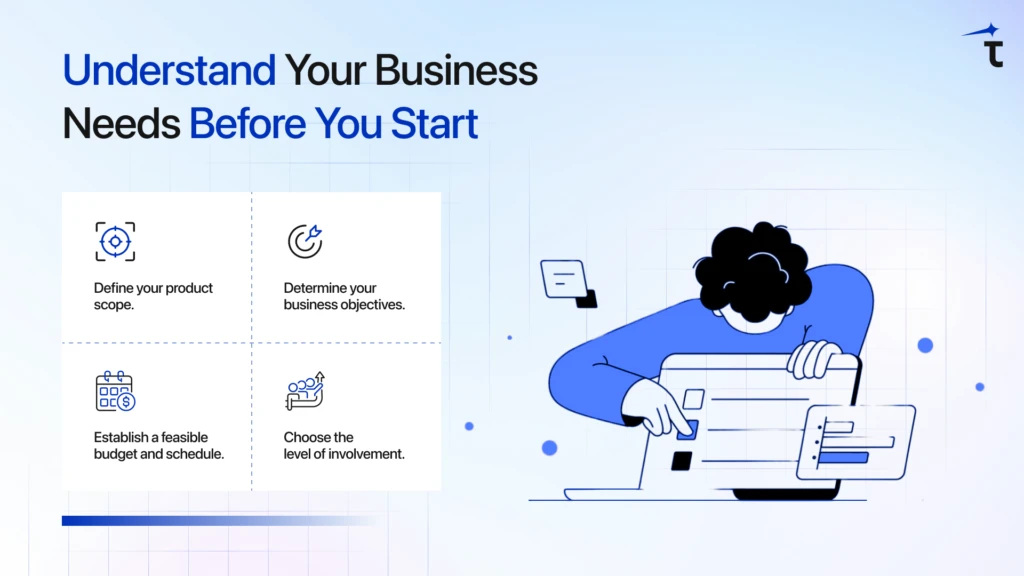
- Define your product scope.
Describe the main features and functions you desire in your product. This assists partners in knowing the complexity and gives correct estimates.
- Determine your business objectives.
Your partner should be aligned with your objectives, whether you want to acquire users, grow revenue, or improve operational efficiency.
- Establish a feasible budget and schedule.
A clear range will also help to filter out partners who are not a good fit and prevent unnecessary negotiations in the future.
- Choose the level of involvement.
Some projects need constant cooperation and those that do not need much supervision. This affects the kind of partner you ought to have.
Evaluate Technical Expertise and Experience
One of the fundamental criteria when selecting a software development partner is technical capability. But it is not only about the knowledge of programming languages. It is also concerned with the use of the appropriate technology to address your business issue.
A strong partner has worked in various industries and knows how to develop scalable and secure solutions according to your business requirements.
- Check relevant industry experience.
Partners who have collaborated on the same projects are aware of the typical challenges and can work more quickly and with fewer mistakes.
- Evaluate technology stack knowledge.
Make sure that the partner has expertise in the technologies that you need in your project, be it mobile, web, cloud, or AI-driven solutions.
- Examine previous projects and case studies.
While choosing the software development, look beyond visuals. Pay attention to the way their solutions addressed actual business issues and provided measurable long-term outcomes.
- Test scalability and architecture expertise.
Your product must be geared towards expansion. An excellent software development partner will come up with systems that can support more users and functionality as time goes by.
Analyze Communication and Collaboration Approach
Communication is often the most overlooked factor, yet it plays a major role in project success. A technically strong team can still fail if communication is weak or inconsistent.
Your development partner should maintain transparency, provide regular updates, and involve you in key decisions.
Clarity in communication channels
Ensure the partner uses structured tools and processes to keep communication smooth and organized.
Regular updates and reporting
Frequent progress updates help you stay informed and make timely decisions.
Responsiveness and availability
Delays in communication often lead to delays in development. A reliable partner responds quickly and proactively.
Collaborative mindset
The best partners work with you, not just for you. They share insights, suggest improvements, and align with your vision.
Also Read: Custom Software vs. Off-the-Shelf Software: Which is Right for Your Business?
Understand Their Development Process and Methodology
The way in which a company deals with development indicates its maturity and dependability. A systematic process provides uniformity, quality and punctuality. Therefore, you must inquire about their development methodology and their approach to planning, implementation, and testing.
- Agile or iterative development method.
Agile processes are flexible and can be improved continuously. This applies to the majority of contemporary digital products.
- Well-defined project planning and milestones.
Clear phases assist in monitoring the progress and accountability.
- Combined testing and quality assurance.
Frequent testing will make sure that bugs are detected early and the quality of the product is not compromised.
- Post-launch support services and maintenance.
The process of development does not stop at launch. Continuous maintenance will keep your product running and current.
Assess Transparency in Pricing and Engagement Models
Price is a consideration, but selecting a partner on the basis of the lowest price can cause problems in the long run. Rather, you should concentrate on value, transparency, and budgetary constraints.
An excellent partner will offer transparent pricing systems and explain how the costs are determined.
Flexible engagement models
The fixed cost, hourly, or dedicated teams can be used as options so that you can choose the one that best fits your project.
Clear breakdown of costs
Price transparency eliminates the existence of hidden costs and unexpected expenses in the long-run.
Alignment to project complexity.
The cost should be determined by the extent, functionality and technical requirements of your project.
Focus on long-term value
Quality development saves on costs in the future in terms of maintenance and upgrades.
Check Client Reviews and Reputation
Company reputation gives you a clue about the performance and reliability of their expertise and services. The real experiences of the clients are reviews and testimonials, which demonstrate the weaknesses and strengths. Therefore, one should not trust what the company puts forward. Also, seek outside reviews and opinions as well.
- Case studies and client testimonials.
These give information on the execution of the project and client satisfaction.
- Online reviews and ratings
Credibility can be proven with the help of such platforms as Clutch or Google reviews.
- Long-term client relationships
Repeat clients indicate trust and consistent performance.
- References and direct feedback
Speaking with past clients gives you a clearer picture of what to expect.
Also Check: How to Choose the Right AI Development Partner
Evaluate Cultural Fit and Work Ethics
Cultural alignment plays a major role in long-term collaboration. Differences in work style, communication, and expectations can impact project outcomes. Your development partner should align with your company’s values and working approach.
- Time zone compatibility
Overlapping working hours improve communication and collaboration.
- Work culture and professionalism
A disciplined and accountable team ensures smooth execution.
- Adaptability to your processes
The partner should integrate easily with your internal workflows.
- Commitment to quality and deadlines
Strong work ethics ensure consistent performance and timely delivery.
Consider Post-Development Support and Scalability
Your relationship with a development partner should not end at product launch. Continuous support and scalability are essential for long-term success. A good partner helps you maintain, update, and scale your product as your business grows.
- Ongoing maintenance and updates
Regular updates ensure your product remains secure and functional.
- Scalability planning
The partner should design systems that support future growth.
- Performance monitoring and optimization
Continuous improvements help maintain user satisfaction.
- Support for new features and enhancements
As your business evolves, your product should evolve with it.
Warning Signs That Can Break Your Product Before It Even Starts
The wrong development partner will usually give early indications, yet most businesses ignore them in the excitement of starting up. When communication is not clear, or there is a delay in responding to questions in the preliminary discussions, it does not get better in the future. Lack of communication leads to misunderstandings, and this directly impacts the timelines, clarity of features, and the quality of the product. On the same note, when pricing or processes are not transparent at the start, it usually results in hidden costs, misunderstanding, and lack of trust as the project advances.
The other significant issue is empty promises that lack technical substance. When one partner accepts all that without clarifying how it is going to be implemented, it normally leads to unrealistic expectations and poor performance. A small or insignificant portfolio is also a good sign of risk. In the absence of experience in similar projects, the risks of mistakes, time wastage, and ineffective solutions are high. Paying attention to these early warning signs will help you prevent future disappointments and will make sure that you find a partner who is capable of delivering.
Final Thoughts
Choosing the right software development partner is not just a hiring decision. It is a strategic move that defines your product’s future. The right partner brings more than technical skills. They bring clarity, structure, and a deep understanding of your business goals. They help you build a product that is scalable, reliable, and aligned with user expectations.
So, take the time to evaluate your options carefully. Focus on expertise, communication, process, and long-term value. When you choose the right partner, you set the foundation for a successful product and sustainable business growth.
FAQs: Choosing the Right Software Development Partner
Focus on technical expertise, communication, and process clarity. A strong partner understands your business goals, not just your technical requirements, and aligns development accordingly.
Check client reviews, case studies, and long-term partnerships. Reliable companies maintain transparency, deliver on time, and provide consistent communication throughout the project.
Both options work if communication and process are strong. Offshore partners often provide cost advantages, while local partners may offer easier collaboration. The key factor is alignment, not location.
It depends on your needs. Fixed cost works for defined projects. Dedicated teams suit long-term development. Hourly models work for flexible or evolving requirements.
Launching the product is only the beginning. Continuous updates, bug fixes, and performance improvements are crucial for maintaining your product’s relevance and functionality over time.